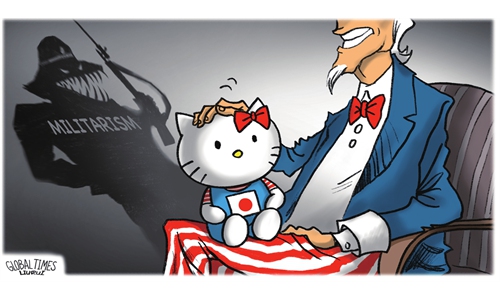
Japan's ‘neo-militarism’ constitutes same old threat in a new guise
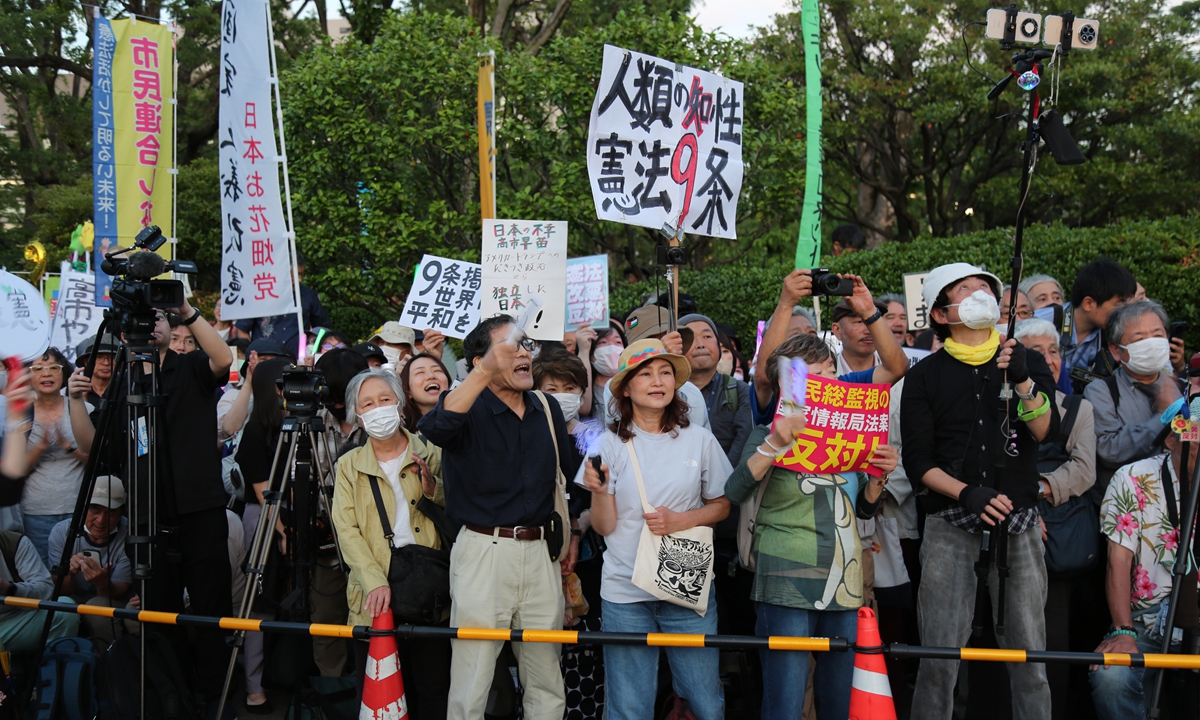
On the evening of May 19, 2026, Japanese citizens gathered in front of the National Diet Building in Tokyo to protest the Sanae Takaichi administration's attempts to revise the constitution and its series of military buildup moves. Photo: VCG
Since taking office six months ago, the Sanae Takaichi administration has not focused on the pressing livelihood issues as the public had expected. Instead, it has accelerated the institutionalization and legalization of neo-militarism, pushing Japan onto a dangerous path from "not waging war" to "being able to wage war," and even "seeking to wage war." This trend shows new features in several dimensions.
First, Japan's defense policy is increasingly driven by vested interests and becoming deeply entrenched. The Takaichi administration's record-scale military budget has effectively created a substantive closed loop of policy donations-defense contracts-political kickbacks. Defense contractors channel benefits to pro-defense politicians in order to influence policymaking; politicians then use their power to expand military procurement; and the defense conglomerates that win contracts return profits to those politicians. Senior officials from Japan's Ministry of Defense and Self-Defense Forces direct benefits to defense firms while in office and then take positions in those firms after retirement, forming a "revolving door." In this way, a Japanese version of the military-industrial complex has taken shape and become the most structural material foundation of the neo-militarism.
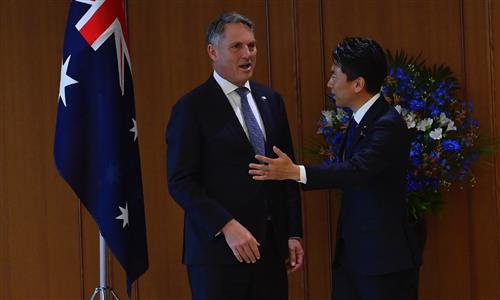
Second, Japan's security alliances are becoming increasingly outward-oriented. Japan is seeking to build a "mini-lateral" network with the US, Australia, and the Philippines, aiming to elevate itself into a "secondary center" in the regional security architecture. By binding outside powers more tightly to regional affairs and encouraging them to interfere in regional flashpoints to strengthen its own capacity for external intervention, Japan attempts to seize a leading role through alliance-building. At the same time, it has used pretexts such as a so-called "survival-threatening situation" to conduct military provocations in the name of "security self-help" and "self-defense," gradually eroding the framework of the pacifist constitution. Its ultimate objective is to break from the constraints of the postwar international order and become a country politically and militarily capable of waging war.
Third, Japan's nuclear proliferation posturing is becoming official. In the past, pro-nuclear discussions in Japan were largely confined to civilian circles. Yet since Takaichi took office, senior security officials handpicked by her have openly advocated nuclearization. Takaichi herself and Japanese Defense Minister Shinjiro Koizumi have repeatedly claimed in public that the Three Non-Nuclear Principles should be partially or fully revised, while urging the US to expand "extended nuclear deterrence" guarantees for Japan. Japan has also sought access to US nuclear submarine technology and permission to build such vessels. These remarks and actions send dangerous signals and amount to a serious provocation against the postwar international order, warranting close attention and vigilance from the international community.
It is worth noting that beneath the new exterior of neo-militarism, the core being revived is still the old militarism. This is evident in three main respects.
One is the use of "national security" rhetoric to cloak militarism with a veneer of legitimacy. The Takaichi administration has constructed a false narrative of external threats to create public support and legal justification for breaking with Japan's exclusively defense-oriented policy and accelerating rearmament. This approach is strikingly similar to the logic once used by Japan's militarist fascists to justify aggression against China and the Pacific War.
Another is the attempt to revive a control system and strengthen government centralization. Takaichi has pushed for a National Intelligence Council that would concentrate intelligence powers at the top, binding them closely to the prime minister's political authority and policy agenda while lacking meaningful legislative oversight. Such a mechanism could tighten ideological control at home and provide support for military adventurism abroad. In substance, it closely resembles the prewar Special Higher Police apparatus.
The third is the use of education and the media to internalize militarist thinking. Under policies tolerated or even encouraged by the Takaichi cabinet, Japan has intensified historical revisionism both domestically and internationally by denying militarist crimes, glorifying militarist actions, and deifying militarist figures. This has fostered a convergence of nationalism, populism, and historical revisionism in domestic public discourse, echoing the ideological control and indoctrination practices of prewar militarism.
The rapid advance of Japan's neo-militarism is already producing multiple grave consequences. Domestically, the interests of the military-industrial complex are being placed above ordinary people's livelihoods; control system is undermining democratic mechanisms; and militarist ideology is poisoning social consciousness, inflicting deep damage to Japanese society. Regionally, Japan's provocations have become an important factor undermining peace and stability in the Asia-Pacific. Internationally, Japan is ignoring the broad consensus of the international community and attempting to break free from the constraints of international law, posing a fundamental challenge to the postwar international order.
The international community must not turn a blind eye to these developments, still less indulge or enable them. It should remain highly vigilant, work together in response, and prevent Japan's neo-militarism from once again bringing calamity to the world.
Guo Yanjun is a research fellow at the Research Center on Building a Community with a Shared Future for Humanity. Wang Jiaxi is an associate professor at Dalian University of Foreign Languages.
RELATED ARTICLES