Maritime traffic enforcement east of Taiwan Island sends a pointed warning to Japan, the Philippines: Global Times editorial
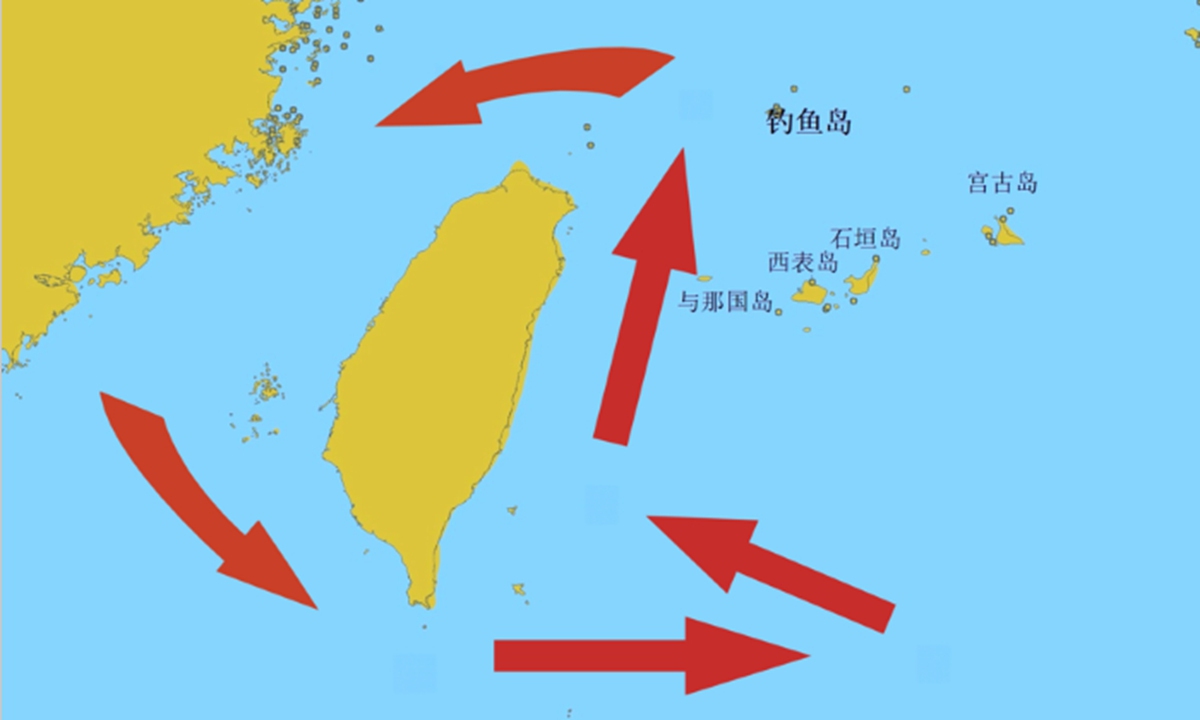
A schematic map of the special maritime traffic law enforcement and hydrographic survey operation in waters east of Taiwan island. Photo: Xinhua News Agency, courtesy of the Fujian Maritime Safety Administration
On June 10, China's Ministry of Transport concluded a maritime traffic enforcement and hydrographic survey operation in waters east of Taiwan Island. The operation demonstrates that China's exercise of jurisdiction in the waters east of Taiwan Island has moved beyond legal pronouncements and policy statements, and has now been translated into comprehensive practices, including on-site law enforcement, hydrographic survey operation, navigation management, and safety assurance. This operation is a precise countermeasure against the egregious actions of Japan and the Philippines in unilaterally announcing plans to launch so-called "negotiations on maritime delimitation" in waters east of China's Taiwan Island, a move that would seriously infringe upon China's territorial sovereignty and maritime rights and interests. As Japan and the Philippines are bypassing China to conduct so-called "negotiations on maritime delimitation" in waters east of China's Taiwan Island, China's maritime traffic enforcement and hydrographic survey operation conducted in accordance with the law is entirely legitimate, necessary, and timely. It demonstrates not only China's firm determination to resolutely safeguard its national territorial sovereignty and maritime rights and interests, but also its full capability to take concrete actions.
The operation covered an area extending north to the Diaoyu Dao and its affiliated islands, south to the waters east of Taiwan Island, and west to the waters near Kinmen, forming a triangular closed loop firmly surrounding Taiwan Island.
Meanwhile, the maritime conditions in this area are complex, posing significant challenges to vessel performance and enforcement capabilities. The successful completion of this operation proves that the CCG has already developed the capability to conduct routine law enforcement patrols and control in this sea area. It also indicates that China has established a relatively complete system for safeguarding sovereignty, maritime rights and interests, and maritime governance around Taiwan Island. Therefore, the operation is not only a legal pronouncement of sovereign rights and jurisdiction, but actually an important step in transforming rights assertions into jurisdictional practice.
The signals are very clear. First, it serves as a pointed warning to external forces attempting to manipulate the Taiwan question, significantly squeezing their room for "scheming" in the waters east of Taiwan Island. This area has long been viewed by external forces such as Japan, the Philippines, and the US as a key direction for intervening in the Taiwan Straits, linking the "first island chain," and shaping the so-called "Indo-Pacific maritime order."
The so-called "negotiations on maritime delimitation" promoted by Japan and the Philippines are in fact intended to first create legal texts through "negotiations on maritime delimitation," then establish administrative facts through "joint maritime management," and finally introduce military presence under the pretexts of "freedom of navigation," "maritime security," and "collective defense." The forward deployment of mainland law enforcement forces in the waters east of Taiwan Island is precisely aimed at preemptively blocking this chain of actions.
It marks a shift in the Chinese mainland's operations in the waters east of Taiwan Island from isolated coast guard enforcement to coordinated action involving coast guard, maritime affairs, maritime safety administration, rescue and other agencies. It also makes clear to the world that for every step external forces take to advance unlawful arrangements, the Chinese mainland's enforcement capabilities advance correspondingly to shape facts on the ground; For every "grey-zone legal construct" they attempt to create, the Chinese mainland will match it with clearer and more concrete administrative enforcement realities. There is absolutely no room for bargaining in this regard.
This also dealt a heavy blow to the Democratic Progressive Party (DPP) authorities. In the face of the blatant provocation by Japan and the Philippines, the Lai Ching-te authorities initially expressed "approval and even anticipation." Only after facing strong criticism from various sectors on the island did they change the tone, while still attempting to shift the blame onto the mainland. This a living, breathing portrait of an "unworthy descendant." The mainland's firm actions to safeguard national sovereignty and maritime rights and interests stand in stark contrast to the DPP authorities' pursuit of "Taiwan independence" through reliance on foreign forces and their acts of betraying national interests without any moral bottom line. This contrast further highlights for residents on the island where their future ultimately lies.
This law enforcement operation will be deeply integrated into the broader national goal of reunification, and will comprehensively reshape the governance and control framework of the waters surrounding Taiwan Island. The Taiwan question is fundamentally China's internal affair, and jurisdiction over the waters around Taiwan Island cannot be fragmented, manipulated , or internationalized by external forces. The CCG's enforcement operations in the waters east of Taiwan Island are significant not only because they counter the so-called "maritime delimitation" pursued by Japan and the Philippines, but also because they changed the longstanding misconceptions of external forces that the waters east of Taiwan Island are a "security backyard," "military corridor," or "strategic buffer zone."
The mainland's lawful entry, patrols, and control will gradually restore the waters east of Taiwan Island from a "vacuum" in the imagination of external forces to a real law enforcement space within China's national jurisdiction system. This serves at least three functions. First, it safeguards sovereignty and prevents Japan and the Philippines from using bilateral negotiations to erode China's maritime rights and interests. Second, it consolidates jurisdiction by accumulating administrative law enforcement experience through continuous patrols, traffic enforcement, navigation support, and emergency rescue. Third, it preserves regional order, so that the unilateral narrative framework shaped by Japan, the Philippines, and others can be fundamentally reversed through effective exercise of jurisdiction. The more external forces attempt to align the Taiwan question through alliances and militarization, the more the Chinese mainland will rely on strong law enforcement capabilities to systematize, institutionalize, and normalize management and control of the waters surrounding Taiwan Island.
This operation is a necessary move to safeguard China's sovereignty, security, and development interests. It is also a direct counteract against Japan and the Philippines' illegal delimitation efforts, external interference in the Taiwan Straits, and the DPP authorities' attempts to seek independence by relying on external forces. The message is very clear: Taiwan is part of China, and the waters east of Taiwan Island are not something that Japan and the Philippines can privately negotiate over, nor are they areas where external forces may freely deployment strategic assets. China must be present, China must conduct law enforcement, and China must defend its territorial sovereignty and maritime rights and interests through sustained, stable, and predictable national actions.
RELATED ARTICLES