S. Korea’s exports to China double in early June; China’s industrial upgrading to create more opportunities: expert
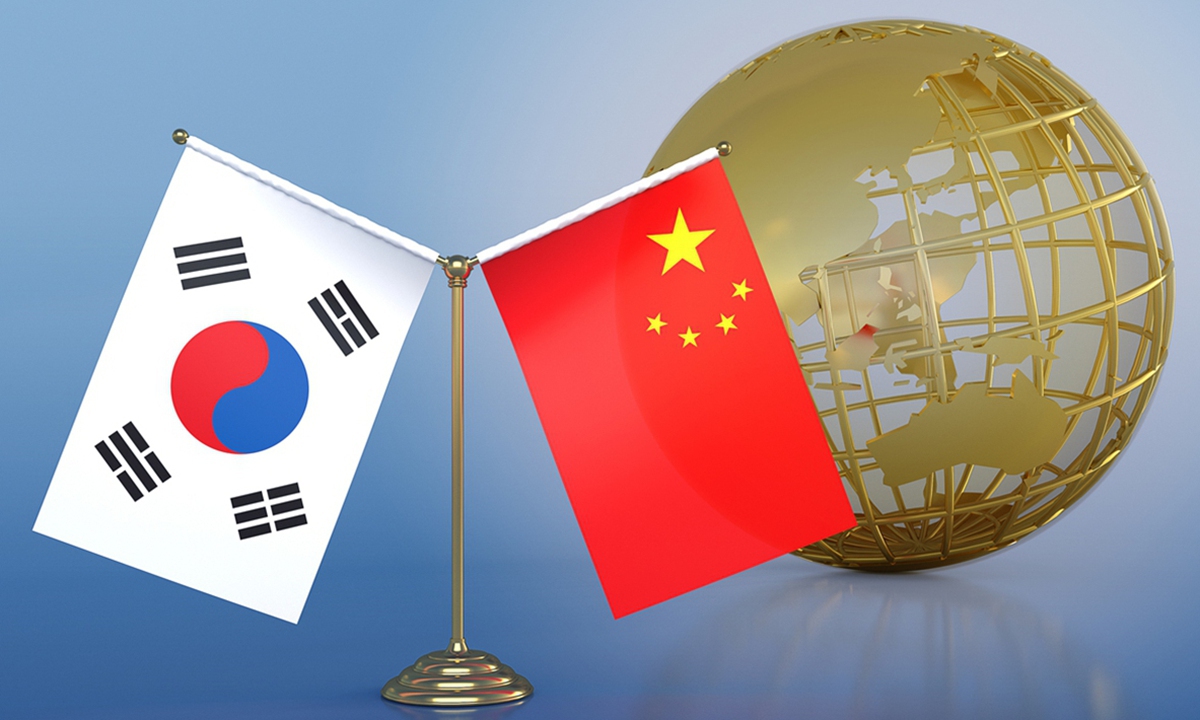
China South Korea Photo:VCG
In Wuxi, East China's Jiangsu Province, a manufacturing hub in China's Yangtze River Delta, a DRAM chip rolling off the production line at SK Hynix's China plant may soon end up in a server, a smartphone, a computer or another consumer electronics device that could be exported to markets around the world.
This small but critical component tells a larger story of booming economic and trade ties between China and South Korea.
South Korea's exports in the first 10 days of June rose to a record high for the period, with shipments to China doubling and semiconductor exports surging, in a sign that demand from the Chinese market and the complementary nature of China-South Korea industrial ties continue to support South Korea's trade growth, analysts said.
Robust growth
South Korea's exports reached $28.64 billion from June 1 to 10, up 85.9 percent year-on-year and the highest level ever recorded for the first 10 days of any month, according to data revealed by the Korea Customs Service on Thursday.
The China-related figures stood out. Exports to China rose 101.4 percent during the period to $6.18 billion, outpacing South Korea's overall export growth and making China its largest export destination, official statistics showed.
South Korean media reports said that semiconductors remained the key engine, extending the strong momentum in South Korea's chip exports in recent months. Chip exports jumped 205.8 percent year-on-year during the period, with the value also reaching a record high for the same period.
The official release did not break chip exports down by destination. Still, analysts said the parallel rise in chip exports and exports to China is notable, as South Korea's shipments to China have long centered on high-end manufacturing, semiconductors and other upstream industrial products.
The June momentum followed strong growth in May, when South Korea's exports to China rose 80.9 percent year-on-year to $18.9 billion, far outpacing the country's overall export growth of 53 percent, the Yonhap News Agency reported, with strong demand for semiconductors, agro-fisheries products and cosmetics driving the increase.
Bilateral trade has kept expanding this year, with industrial-chain integration gaining pace. China has been South Korea's largest trading partner for 21 consecutive years, while South Korea is now China's second-largest trading partner, according to China's Ministry of Commerce.
Bilateral goods trade rose 32 percent year-on-year in the first quarter of 2026, while China's imports from South Korea jumped 40.6 percent, official data showed.
Semiconductors accounted for 26 percent of bilateral trade, South Korea's Ministry of Trade, Industry and Resources said in March, noting that both nations will step up policy communication and actively support the smooth operation of Korean semiconductor plants in China.
The latest figures highlight the mutual benefits of China-South Korea industrial cooperation, as well as the market opportunities and tangible returns created by China's continued opening-up and industrial upgrading, Lü Chao, a professor at the Liaoning Academy of Social Sciences, told the Global Times.
Lü said that China's significance to South Korean companies goes beyond short-term export figures. From shipments of chips and components to long-term manufacturing projects such as SK Hynix's Wuxi plant, South Korean businesses have built a presence in China that spans both trade and production.
The Wuxi plant is more than a single investment project. Established in 2005, SK Hynix Semiconductor China is the company's largest overseas manufacturing base, producing DRAM chips used in servers, smartphones, computers and consumer electronics, according to Wuxi's official website.
Greater prospect
Over the past two decades, the facility has become a concrete example of how South Korean high-end manufacturing has integrated into China's manufacturing ecosystem. That connection is being reinforced by a new round of demand. As China expands AI infrastructure, smart manufacturing and digital industries, South Korean chipmakers are finding that China is not only a major export market, but also a key application ground for their technologies in China's industrial ecosystem.
"China's manufacturing upgrade, AI infrastructure buildout and recovering electronics demand align closely with South Korea's industrial strengths. This complementarity will remain an important external support for South Korea's export resilience and economic growth," Lü said.
A Chinese official report released on Monday showed that China's intelligent computing power had reached 1.59 million PFLOPS by 2025, ranking second globally - a scale that points to sustained demand for chips, servers and other upstream electronic products.
As China moves further into AI, smart manufacturing and industrial digitalization, that demand will give South Korean companies more room to participate in the country's next stage of industrial upgrading, Lü said.
China and South Korea should advance cooperation in areas where both sides have mutual needs and shared interests, including science and technology and semiconductors, in an open, upright and confident manner, Chinese Ambassador to South Korea Dai Bing said in an interview with the Korea Daily published on Wednesday.
Policy coordination has also picked up. At the fifth China-South Korea ministerial dialogue on industrial cooperation held in Beijing on March 18, the two sides agreed to advance practical cooperation in key areas including semiconductors, lithium batteries, industrial green development and the silver economy.
China-South Korea industrial cooperation has developed on the basis of complementary strengths and deep integration, Chinese Minister of Industry and Information Technology Li Lecheng said at the meeting, adding that China will create a favorable environment for foreign companies, including South Korean enterprises, to expand in China.
These frequent interactions show that the two neighbors are not merely competitors in high-tech sectors, but close partners in the regional production network, Lü said. "Stronger cooperation in semiconductors, AI and power batteries will help stabilize Northeast Asian supply chains and benefit companies in both countries amid certain nations' technology restrictions and 'decoupling' attempts."
In March, Chinese Commerce Minister Wang Wentao met South Korean Trade Minister Kim Jung-kwan in Beijing, with the two sides agreeing to speed up second-phase negotiations on the China-South Korea Free Trade Agreement, keep industrial and supply chains stable, and deepen trade and investment cooperation.
While some countries may seek to disrupt China-South Korea pragmatic cooperation, Lü noted that South Korea should recognize its fundamental and long-term interests, and keep expanding stable, mutually beneficial cooperation with China.
From a DRAM chip rolling off a production line in Wuxi to South Korea's latest export boom to China, the same industrial logic is clear: disruption serves neither side, while cooperation and dialogue remain the only viable path.
RELATED ARTICLES