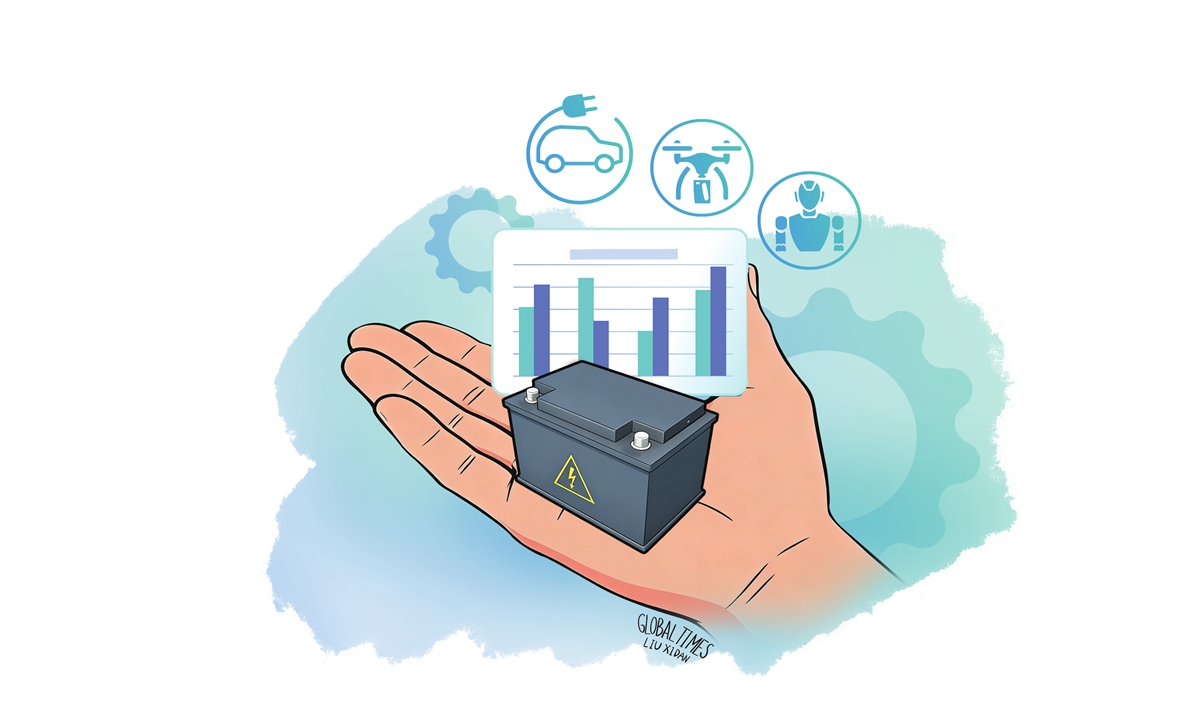
Illustration: Liu Xidan/GT
A recent assessment by South Korea's Ministry of Science and ICT has prompted heated discussion online. The Yonhap News Agency reported that a review of 11 priority sectors and 136 core scientific technologies found that the technological gap between South Korea and China had widened between 2022 and 2024.In strategic technologies, even making secondary batteries - which Yonhap reported were previously the only field in which South Korea was assessed to hold a lead - are now judged to have been surpassed by China.
Secondary batteries, also known as rechargeable or storage batteries, are generally understood to include lithium-ion batteries commonly used in mobile phones and laptops, as well as lead-acid batteries in electric vehicles. Multiple publicly available sources indicate that in recent years China has made rapid progress in this field, advancing in basic research, innovation capabilities, and the pace of industrialization.
The trend extends across a wider range of technological fields. Yonhap reported that an assessment of 50 national strategic technologies found South Korea was behind the US by 2.6 years, while China was behind by 1.4 years. Relative to 2022, South Korea narrowed its gap by 0.4 years, whereas China reduced its gap by 0.8 years. Yonhap interpreted the findings as suggesting that the technological distance between South Korea and China has kept to expand.
South Korea has invested significantly in technological development in recent years, achieving notable accomplishments and maintaining a distinctive position among developed economies. Its automobile, semiconductor, and shipbuilding industries have made important breakthroughs, supported by access to international markets.
In parallel, Chinese companies have been steadily enhancing their competitiveness across multiple sectors. Underpinned by China's economic scale and other structural advantages, South Korea's technological capabilities are gradually being surpassed in multiple areas, a trend likely to persist.
South Korea continues to possess world-class manufacturing capabilities, with leading companies such as Samsung holding high global valuations. However, its development model, focused on single-point breakthroughs and heavily export-oriented, faces vulnerabilities amid a slowdown in globalization and rapid industrial expansion in other economies. The coming years will be a critical window for South Korea to maintain its position as a semiconductor powerhouse and a high-end manufacturing hub in the Asia-Pacific supply chain.
South Korea and China follow distinct development trajectories. It is unlikely that South Korea can maintain a long-term technological advantage, or prevent Chinese firms from further surpassing South Korea in key emerging technologies. Yet, the industrial chains of both countries are highly competitive and deeply interlinked, so the outcome cannot be reduced to a simple question of one side winning and the other losing.
Complementarities in the industrial chains of South Korea and China create concrete opportunities for cooperation. For example, in the semiconductor supply chain, both sides share common interests, as the operations of some South Korean chip facilities in China are subject to certain US restrictions.
Recently, amid China's accelerating technological progress and efforts to break through US technology blockades, there has been growing discussion in South Korea about pursuing pragmatic cooperation with Chinese companies. In certain areas, the two countries could develop new forms of collaboration, though the depth of such cooperation may depend on the extent to which South Korea can maintain strategic autonomy in the face of US policy pressures.
The global industrial chain was once relatively simple, following a "center-periphery" vertical division of labor: Western economies held the technological core, while manufacturing shifted to more efficient countries, with China and South Korea among the fastest-growing economies. Today, the chain is increasingly networked and multipolar, with resilience taking priority. In this context, competing with China in high-tech sectors is unlikely to be a viable strategy for South Korea; it would be better positioned as a key node in the regional innovation ecosystem.
East and Southeast Asian industrial chains are moving toward multipolar coexistence. China's scale in research and development, market size, and talent is hard for South Korea to fully match, making it unlikely that South Korea can maintain a sustained, comprehensive technological lead over China.
South Korea can instead focus on high-end, cutting-edge segments to maintain its competitive edge and remain an irreplaceable regional supplier.
Regional supply chains are increasingly near-shored, with South Korean companies expanding into Vietnam, Indonesia, and beyond, while still importing key components from China. By securing an important role in the regional ecosystem and utilizing China's technology to access third-party markets, South Korean companies could gain profits and market share. A cooperative, rather than rivaling mindset, would strengthen its global competitiveness.
The author is a research fellow at the Society for Technology and Strategic Trends. bizopinion@globaltimes.com.cn
RELATED ARTICLES