Exports of SK ramen to China reportedly surge 47.9% in 2025; substantial potential in traditional consumption cooperation remains: expert
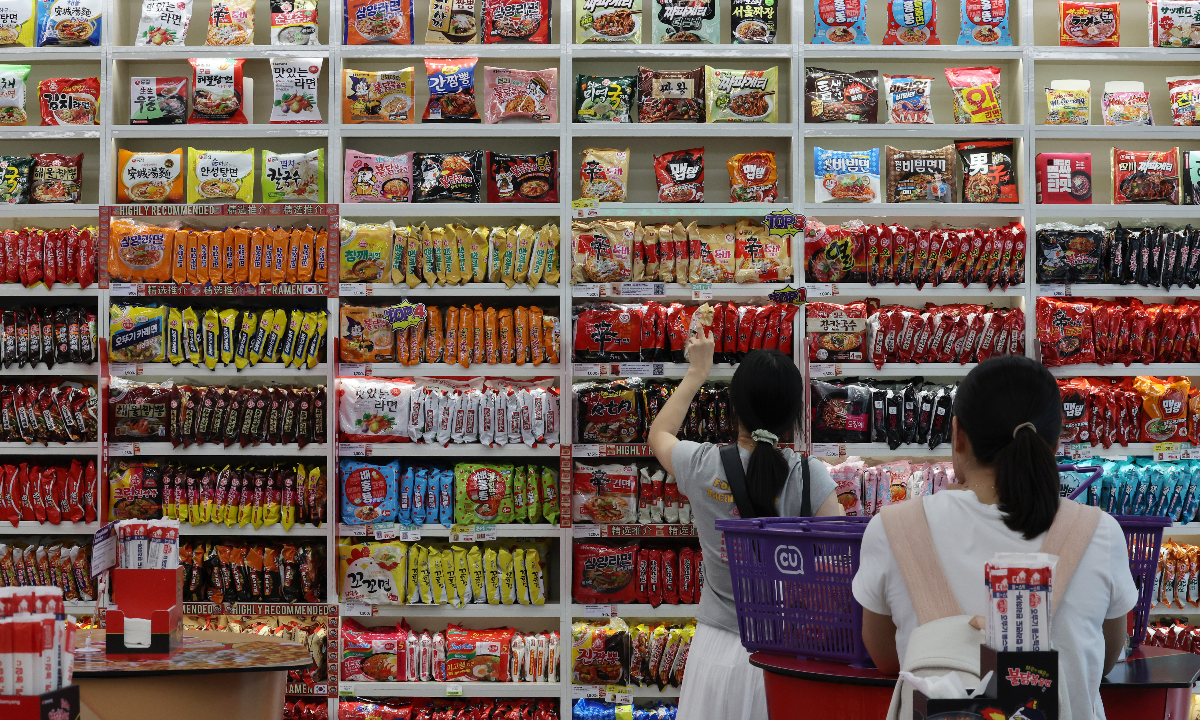
Customers select ramyeon at a store in Seoul, South Korea on August 20, 2025. Photo: VCG
Exports of South Korean instant noodles, or ramen, reached a new high of $1.52 billion in 2025, with shipments to China rising 47.9 percent year-on-year to $385 million, the Korea Herald reported on Sunday. A Chinese expert said that these figures showed the two countries still have significant potential for cooperation in the traditional consumer goods sector.
Citing the Korea Customs Service, the Korea Herald said that in 2025, China and the US together accounted for more than 40 percent of South Korea's ramen exports. Shipments to China rose 47.9 percent on-year to $385 million, or 25.3 percent of the total, whereas exports to the US totaled $255 million, or 16.7 percent.
"The overall improvement in China-South Korea economic and trade relations provides a good and stable environment for the strong growth in South Korea's instant noodle exports to China," Lü Chao, a professor at the Liaoning Academy of Social Sciences, told the Global Times on Monday, adding that the long-standing complementarity between China and South Korea in the traditional consumer goods sector has also driven this trend.
Lü noted that China's instant noodle market is vast and increasingly diverse in demand, with consumers showing a growing preference for a wide variety of flavors, particularly the unique spicy flavors of South Korean ramen. "The emerging night-snack culture in China further amplifies this demand," Lü said.
In addition, China's market opening has provided favorable conditions for South Korean food companies to export their products, the expert noted.
According to the Korea Herald, exports of South Korea's ramen to the US grew at an average annual rate of 68 percent from 2022 to 2024, but a 15 percent tariff appears to have weighed on growth last year, when shipments rose 18.1 percent below the overall export growth rate.
"Compared with the US, South Korean products can more easily enter the Chinese market through e-commerce, social media, and convenience store channels, and these food companies have also strengthened localized production in China," Lü said.
The Korea Herald reported that Nongshim, one of the country's leading noodle producers, operates factories in China, while Samyang Foods is building its first overseas plant in China.
Lü said that in the traditional consumer goods sector, the cooperation potential between China and South Korea remains broad. "China possesses a massive market that has a strong demand for South Korean beauty products and traditional foods. In particular, South Korean cosmetics products align well with Eastern aesthetics and have enjoyed long-term popularity in the Chinese market," the expert said.
With the improvement in bilateral relations, the two countries will also explore new collaboration opportunities in power batteries, clean energy, artificial intelligence (AI), and robotics, according to Lü.
On January 8, He Yadong, a spokesperson of China's Ministry of Commerce (MOFCOM), said that economic and trade relations between China and South Korea are close, with deep integration in each other's industrial and supply chains. New business forms and new models of cooperation continue to emerge, gradually becoming the "new highlights" and "new engines" driving bilateral economic and trade cooperation, he said.
China has long been South Korea's largest trading partner, while South Korea is China's second-largest trading partner. According to Chinese statistics, from January to November 2025, bilateral trade reached $298.9 billion. The role of China-South Korea economic and trade cooperation as the "ballast stone" and "propeller" in bilateral relations continues to become increasingly prominent, He Yadong noted.
The MOFCOM stands ready to work with the South Korean side to strengthen the alignment of economic and trade cooperation plans and policy coordination, maintain the stability and smooth operation of industrial and supply chains, support mutual investment by enterprises of the two countries, and further explore cooperation potential in emerging fields such as high-end manufacturing, AI, green industries, and the silver economy, the spokesperson said.
RELATED ARTICLES