Forum on Global Human Rights Governance opens in Beijing
Action Plan unveiled outlining China’s work to protect human rights in next 5 years
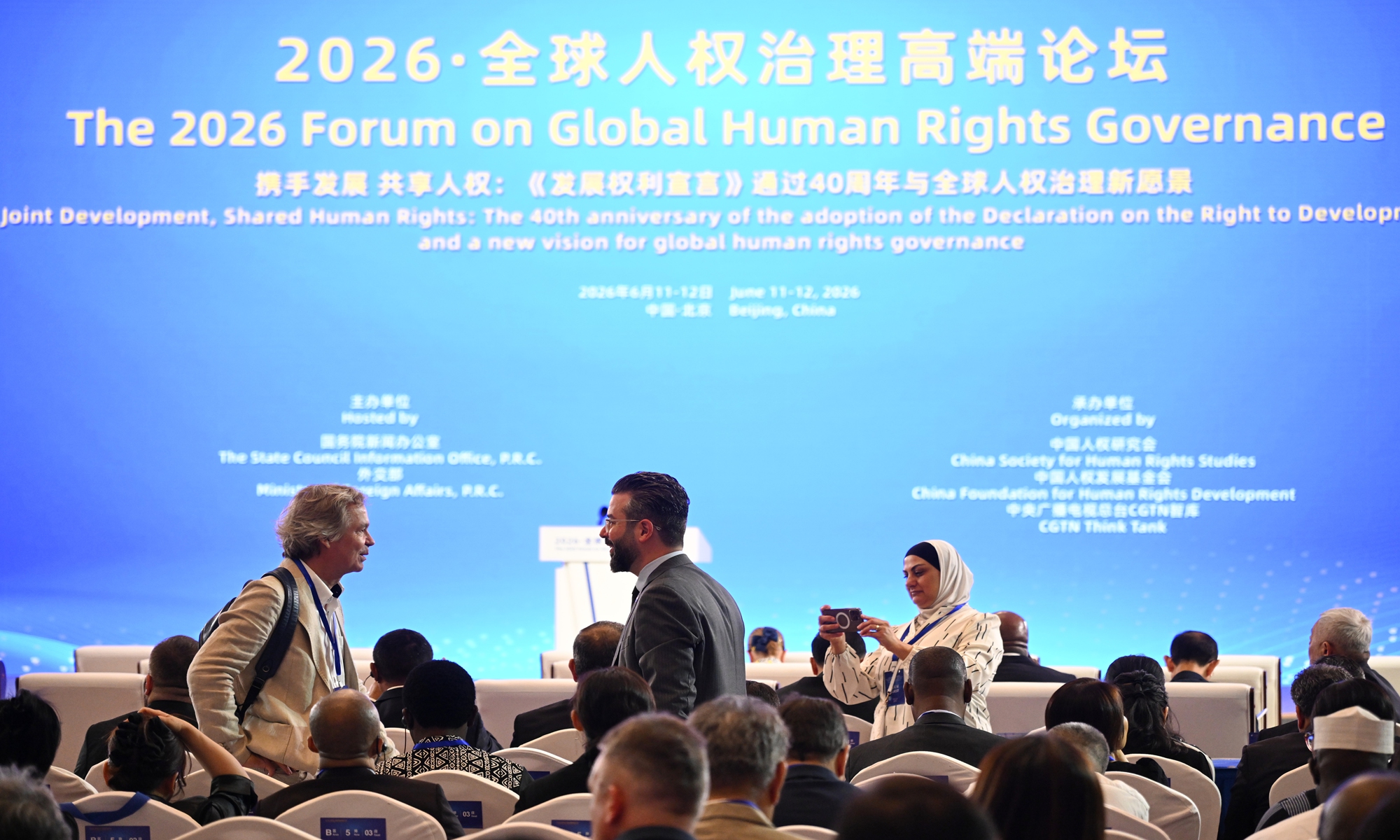
The 2026 Forum on Global Human Rights Governance is held in Beijing, capital of China, June 11, 2026.
The 2026 Forum on Global Human Rights Governance opened in Beijing on Thursday, bringing together hundreds of officials, experts and representatives from around the world to discuss the role of development in advancing human rights.
The two-day forum is themed "Joint Development, Shared Human Rights: The 40th Anniversary of the Adoption of the Declaration on the Right to Development and a New Vision for Global Human Rights Governance". Over 400 participants from over 100 countries and international organizations, including the United Nations, attended the forum, the Xinhua News Agency reported.
The forum also released the National Human Rights Action Plan of China (2026-30), which outlines China's work to protect human rights in the next five years, per Xinhua.
The forum is jointly hosted by the Information Office of the State Council and the Ministry of Foreign Affairs.
With the effective implementation of its objectives and tasks, the country achieved remarkable progress in human rights protection, providing much-needed stability and certainty for global human rights development, the latest action plan said. This viewpoint also found clear echoes in remarks made by forum attendees.
Former Iraqi president Abdul Latif Jamal Rashid said during his speech that China has made tangible contributions to energy, infrastructure and many other projects in Iraq, adding that they are "contributions that we highly appreciate."
Marcella Favretto, Acting Chief of the Development, Economic, Social and Cultural Rights Branch of Office of the United Nations High Commissioner for Human Rights, said that resolutions on economic, social and cultural rights and on advancing human rights through development, spearheaded and promoted by China, have helped countries across the world better meet the growing demand for capacity-building and technical assistance.
Standing out among academics and experts was a special speaker: Luogu Youge, Party Secretary of Sanhe Village, Liangshan Yi Autonomous Prefecture, Southwest China's Sichuan Province and director of the village committee. He shared vivid personal stories to illustrate how the country's support helped his village shake off poverty.
He said that the village's per capita net income for people lifted out of poverty reached 21,933 yuan ($3,237) in 2025, up over 15,000 yuan from 2018. "When everyone has a job, every family has a sustainable livelihood, and people thrive through their own hard work — that is the most tangible human right," he said.
Whereas Western conceptions of human rights tend to focus narrowly on civil and political rights while neglecting the rights to livelihood and development, China has politically recognized that poverty eradication is a core human right, said the forum's guest speaker Zhang Weiwei, dean of the China Institute at Fudan University.
"Giving people access to health, education, basic necessities for their existence, and giving them opportunities as well as the freedom to explore and develop their talents and entrepreneurship - I think those are very key takeaways of China's development in human rights," Robert M. Persaud, Foreign Secretary, Ministry of Foreign Affairs and International Cooperation of the Co-operative Republic of Guyana, told the Global Times on Thursday.
While listening to speeches and interviewing participants, Global Times reporters also noticed that attendees paid attention to human rights issues in war-torn regions and denounced certain Western nations for politicizing human rights.
In his address, Rashid called for Gaza's children to be granted the right to education and a safe life, Gaza's doctors to be allowed to perform their duties, and the people of Gaza to live with dignity.
Agnes Oswaha, undersecretary at the Ministry of Foreign Affairs and International Cooperation, South Sudan, said that her country has long endured targeted sanctions, adding that multiple hurdles have prevented the country's rich natural resources from being translated into driving forces, and such practices are unfair.
"Unlike those Western countries, China has reached out to help us develop," Oswaha told the Global Times. Citing the story of local women learning to grow crops, Oswaha illustrated how China has helped them become productive members of society. The skills they acquired have boosted women's personal development, she said, "This is the fundamental path to advancing human rights."
Zhang said at the forum that China's practice has provided the Global South and the world at large with valuable approaches, steering global human rights governance toward a more equitable, more rational, and more sustainable trajectory.
Zhai Dayu, assistant to the Dean of the Institute for Global South Development and Human Rights in the University of International Business and Economics, also said that if a large number of less developed countries remain stuck in prolonged underdevelopment, terrorism, armed conflicts and other crises will easily breed, which will disrupt the global order. "By advancing human rights across the Global South, China is also actively safeguarding the international order," he told the Global Times.
As the forum's first day wrapped up, Global Times reporters chatted with a senior scholar, who recalled that when the UN adopted the Declaration on the Right to Development 40 years ago, he had just started his career in human rights research. Today, he joins fellow academics of diverse backgrounds in Beijing to explore ways to advance the right to development.
Just as the scholar's research deepened over four decades, so has the cause of human rights. An original vision then, it is now rooted worldwide with tangible gains for all.
RELATED ARTICLES