S. Korea's ex-president Yoon sentenced to 30 years in drone infiltration case; verdict a strong warning to South Korean society against crimes against national security: Chinese expert
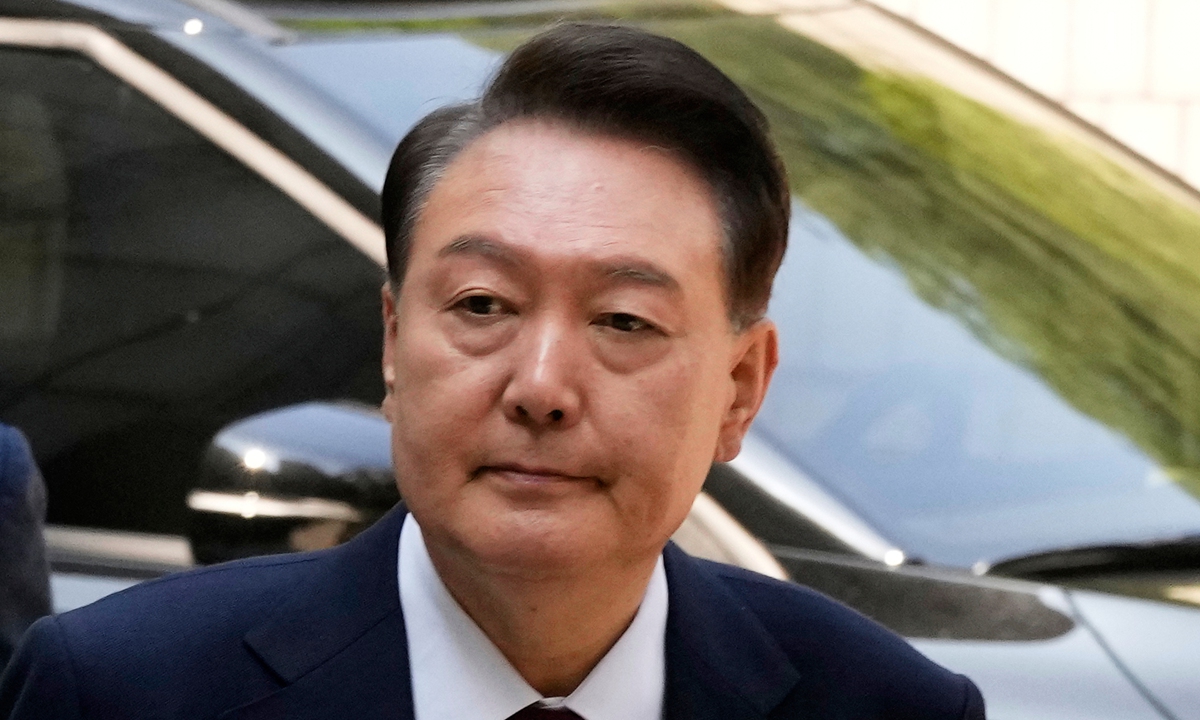
File photo: South Korea's ousted former president Yoon Suk-yeol arrives to attend his trial at the Seoul Central District Court in Seoul, South Korea, May 12, 2025. Photo: VCG
A Seoul court on Friday sentenced former president Yoon Suk-yeol to 30 years in prison after finding him guilty of ordering drone infiltrations into North Korea in an attempt to heighten cross-border tensions and create a basis for his martial law declaration in December 2024, Yonhap News Agency reported.
The Seoul Central District Court delivered the verdict, matching special counsel Cho Eun-suk's sentencing recommendation for the jailed former president on charges that included benefiting the enemy and committing abuse of power, per Yonhap News.
The court recognized that Yoon had ordered the operation in October 2024 to provoke Pyongyang and use the anticipated increase in cross-border tensions as a pretext for his December 3 declaration of martial law. "With the purpose of creating an environment for emergency martial law, the defendants used the guise of a military operation to induce North Korea's provocation," the court said.
The ruling marks the first time in South Korean constitutional history that a former president has received a court judgment on charges of general enemy-benefiting activities, a serious offense classified under crimes against the state, per the Korea Herald.
Lü Chao, a professor at the Liaoning Academy of Social Sciences, told the Global Times on Friday that Yoon's actions indeed directly triggered an escalation of tensions on the Korean Peninsula, posed security threats across the entire region, and exposed South Korea to a serious risk of military conflict.
Citing legal observers, the Korea Herald reported that the decision also represents the first conviction of a former South Korean president for an offense categorized as an external security crime.
It also sentenced former Defense Minister Kim Yong-hyun to 30 years in prison for his role in such operations, higher than the 25 years sought by the special counsel. Yeo In-hyung, former head of the Defense Counterintelligence Command, was sentenced to 15 years in prison for his involvement in the operation, while Kim Yong-dae, former chief of the Drone Operations Command, received a three-year sentence suspended for five years.
Yoon denied the allegations throughout the trial, arguing he neither ordered nor approved the operation and that it was a legitimate military response to North Korean provocations, including the launch of trash-carrying balloons across the border, the Korea Herald reported.
As a former prosecutor, Yoon boasts an intimate grasp of South Korea's legal system. His deliberate attempt to frame the case as a "legitimate military response" in a bid to overturn the first-instance verdict constitutes his legal strategy in response to the trial, Lü said.
Yoon's conduct has undeniably placed South Korea under a serious security threat, and mere allegations of "legitimate response" are not suffice to reverse the court's decision, Lü added.
The series of regionally destabilizing policies rolled out during Yoon's tenure are, in essence, a stark manifestation of the radicalization of domestic right-wing conservative ideology in South Korea, which once pushed national governance into a predicament, Lü said.
Yoon was sentenced to life in prison in February for insurrection stemming from his martial law declaration, Xinhua reported.
The judicial ruling on Yoon also delivers an unequivocal warning to South Korean society that any individual or act that sparks a national security crisis and crosses national security red lines inevitably faces legal punishment, the expert added.
RELATED ARTICLES