China backs greater role for foreign financial firms in Shanghai financial hub: regulator
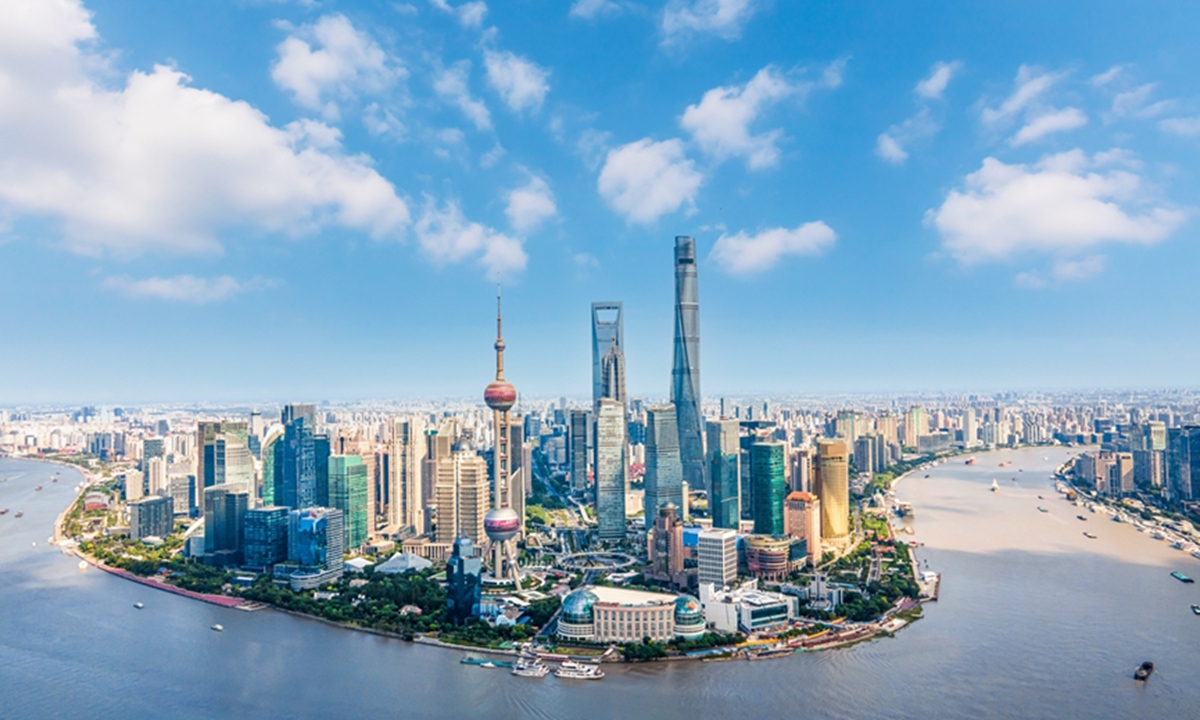
A view of the Lujiazui area in Shanghai Photo: VCG
Shanghai International Reinsurance Exchange has seen rapid growth in the first five months of 2026, recording transaction premiums of 7.5 billion yuan ($1.04 billion) and registered premiums of 62.6 billion yuan, up 256 percent and 28 percent year-on-year, respectively. The first batch of six overseas institutions has successfully established trading seats on the platform, said an official from China's top financial regulator, marking the further enhancement of Shanghai's competitiveness and influence as an international financial center, as well as its growing attractiveness to foreign financial firms.
Yan Jiao, an official with the National Financial Regulatory Administration (NFRA), made the remarks at a press conference in Shanghai on Friday ahead of the upcoming 2026 Lujiazui Forum.
The progress reflects the steady implementation of various initiatives since the NFRA and the Shanghai municipal government jointly issued a guideline on support measures to help build Shanghai into an international financial center, rolling out 27 practical measures across five key areas, said Yan.
Shanghai has become one of Asia's core international financial centers, with a concentration of diverse financial businesses, strong overall competitiveness and increasingly comprehensive financial functions, Bian Yongzu, a financial expert and executive deputy editor-in-chief of Modernization of Management magazine, told the Global Times on Friday. These advantages are also expected to further accelerate the internationalization of the yuan, Bian said.
During the press conference, Yan stressed that the NFRA supports foreign-funded financial institutions in playing a greater role in the development of Shanghai as an international financial center. Authorities have approved the opening of Shanghai operations by AIA Investment and Aegon Asset Management, and the Shanghai International Reinsurance Registration and Trading Center has attracted 26 institutions of various types, she noted.
Regarding the expansion of institutional opening-up and enhancing the internationalization of Shanghai's financial operations, the NFRA has benchmarked its efforts against high-standard international economic and trade rules. By the end of the first quarter of this year, regulators had approved 19 non-resident merger-and-acquisition loans totaling 11.3 billion yuan, supporting Chinese companies in their overseas expansion, according to Yan.
In serving the real economy, Shanghai's green finance project targeting the shipment sector had provided coverage for 11 projects by the end of the first quarter, with total risk protection exceeding 9.5 billion yuan. In addition, Shanghai has introduced inclusive financial products in areas including household services, financing for small and micro-sized enterprises, and electric bicycle travel safety in the city.
The 39th edition of the Global Financial Centres Index released on March 26 by British think tank Z/Yen Group and the China Development Institute in Shenzhen showed that Shanghai climbed two places from the previous edition to rank sixth among global financial centers such as New York and London.
Notably, Shanghai ranked among the world's top 15 financial centers across all five key indicators - business environment, human capital, infrastructure, financial sector development and reputation. Among these categories, its financial sector development ranked fifth globally, according to a report by Securities Times.
Bian said finance is the lifeblood of the real economy, and the development of Shanghai as an international financial center is an important national strategy with significant implications for China's economic development.
As a pioneer in financial policy experimentation, Shanghai has attracted a large number of international financial institutions. This enables domestic financial institutions to benchmark themselves against international peers, learn advanced practices, improve their overall strength and competitiveness in global markets, and further enhance China's financial system, experts said.
RELATED ARTICLES