ARTS / CULTURE & LEISURE
15 foreigners honored with top book award in China
234 recipients from 67 nations since 2005
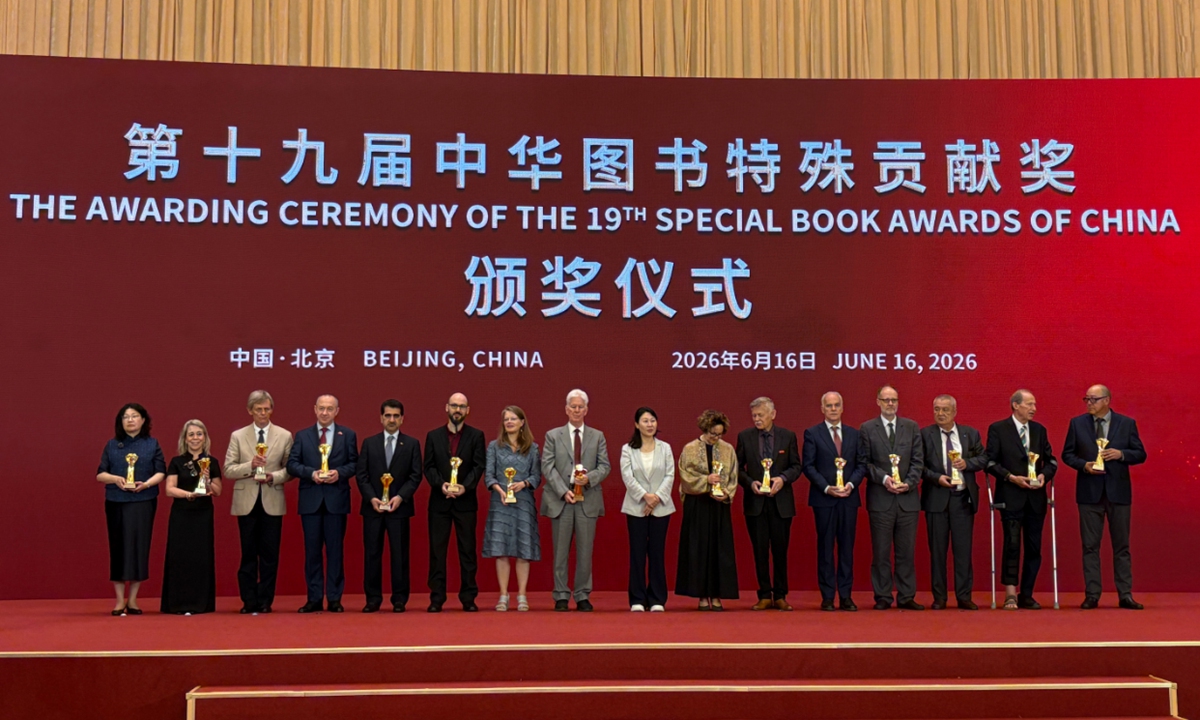
A total of 15 winners of the 19th Special Book Awards of China receive their awards in Beijing on Tuesday. Photo: Wu Jie/GT
As the highest national award granted to those who have made outstanding contributions in introducing contemporary China and promoting Chinese publications overseas, this year's honors were awarded to five authors, five translators and five publishers from countries including Russia, the US, Spain, Germany, Argentina and the United Arab Emirates (UAE).
The award ceremony served as a prelude to the 2026 Beijing International Book Fair (BIBF), which is set to run from Wednesday to Sunday. The UAE is this year's guest of honor.
Mohamed Bin Huwaidin from the UAE received the award for his focus on China's relations with the Middle East and the Gulf region.
China possesses one of the world's oldest and richest civilizations, with a long history filled with wisdom, creativity, resilience, and inspiring stories. These stories deserve to be shared not only because they belong to China, but because they also contribute to the collective human experience. Every civilization carries lessons, values, and perspectives that can enrich humanity as a whole, Huwaidin said at the ceremony.
The relationship between the UAE and China offers an important example of how cooperation in culture, education, development, and innovation can contribute positively to both societies, Huwaidin told the Global Times.
Established in 2005, the award has been granted to 234 recipients from 67 countries, the organizers told the Global Times.
Gabriel Garcia-Noblejas Sanchez-Cendal, a Spanish sinologist and tenured professor at the Faculty of Translation and Interpreting, University of Granada, received the award in translation.
Gabriel told the Global Times that his students enjoy reading classical Chinese works such as those of Confucius and Zhuangzi, as well as the Dao De Jing, or The Classic of the Way and Virtue, and poetry of the Tang Dynasty (618-907).
For Spanish readers, the most popular work of classical Chinese literature is The Art of War by ancient Chinese military strategist Sun Tzu, as its profound philosophical insights can help people achieve their goals, Gabriel said.
Among contemporary works, Spanish readers have shown great interest in the science fiction novel The Three-Body Problem by Liu Cixin, said Gabriel, who has been dedicated to translating and disseminating classical Chinese texts in the Spanish-speaking world for nearly 30 years.
Dagmar Schafer, a German sinologist and historian of science, is another laureate in the author category. She has long worked to disseminate the scientific, technological and intellectual heritage of ancient China in international academic circles.
Schafer told the Global Times it's still important to study the technological heritage of ancient China in the age of AI.
"At the moment we have a lot of data, but that doesn't mean we have a lot of knowledge. I'm interested in the impact of science and technology, and in the knowledge we develop as a society. These advances can bring tremendous benefits, but they can also have unintended consequences. Some effects are immediate and easy to see, while others only become apparent over a much longer period of time," noted Schafer, who is director at the Max Planck Institute for the History of Science in Germany.
"What we lose today may turn out to be something people need a thousand years from now. Likewise, knowledge that was lost a thousand years ago may still hold relevance for us today. I think this is what historians of science do. They examine these processes of loss and gain, tracing how knowledge disappears, survives, and reemerges across time," said Schafer.
Her monograph The Crafting of the 10,000 Things: Knowledge and Technology in Seventeenth-Century China is listed as an essential reference for the history of science, technology and culture by many universities and research institutions worldwide.
Paula Pampin, director and editor-in-chief of publishing house Ediciones Corregidor in Argentina, is one of the laureates in publishing. Pampin told the Global Time that she has published books mainly concerning the political and economic aspects of China as Latin American readers are curious about how China has grown to be a global leader in recent years.
RELATED ARTICLES