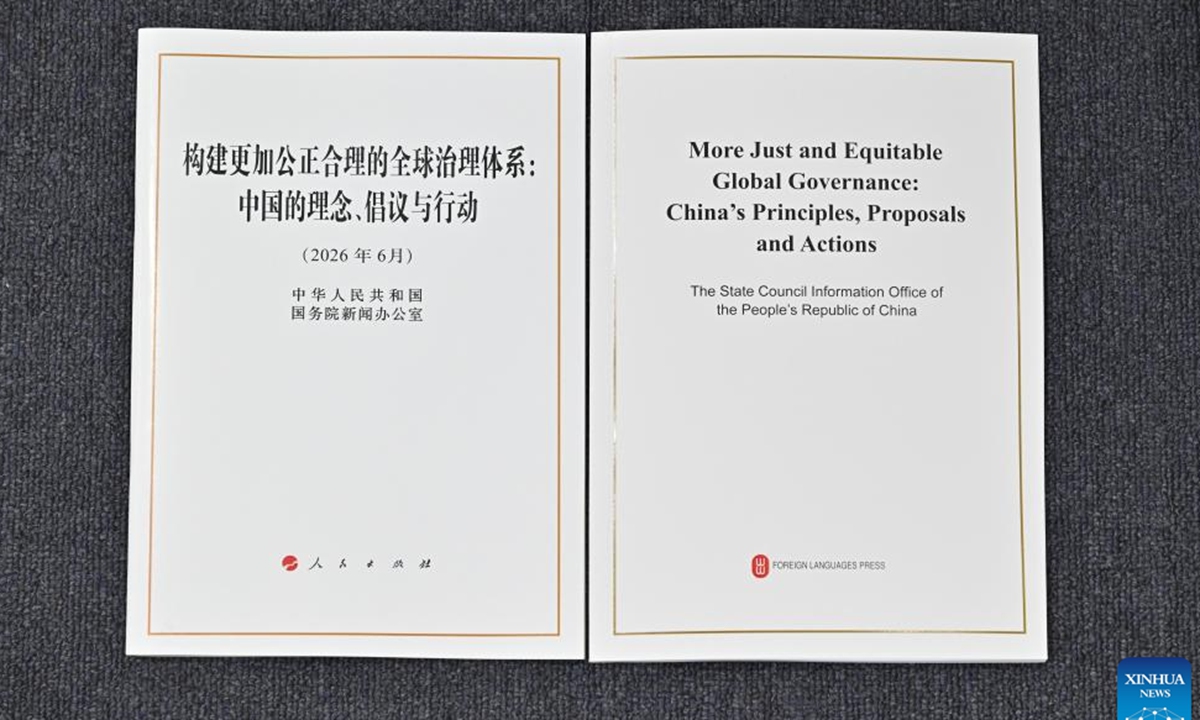
This photo shows the Chinese and English editions of a white paper titled "More Just and Equitable Global Governance: China's Principles, Proposals and Actions" released by the State Council Information Office (SCIO) on June 17, 2026. Photo: Xinhua
On Wednesday, the Chinese government released the white paper titled "More Just and Equitable Global Governance: China's Principles, Proposals and Actions." Guided by Xi Jinping Thought on Socialism with Chinese Characteristics for a New Era, the white paper systematically presents China's ideas, initiatives and practical actions regarding global governance. Its aim is to reform and improve the global governance system, effectively address global challenges, and build broader international consensus and joint efforts.
Since the concept of "global governance" was first proposed in Europe in the 1990s, the international community had never reached consensus on the core questions of who should govern, how to govern, and for whom.
The main reason lies in the Western-dominated discourse system, which has not yet addressed the peace deficit, development deficit, security deficit, and trust deficit facing today's world, nor has it corrected historical injustices. The vast majority of Global South countries remain marginalized. In some cases, under the hegemonic mindset of certain major powers, "global governance" has been distorted into "governing the globe." The authority of the UN has been greatly weakened, and the international system established after World War II has come under severe shocks from multiple crises.
In 2025, Chinese President Xi Jinping put forward the Global Governance Initiative (GGI), offering a Chinese solution to the era's question of "what kind of global governance system to build and how to reform and improve global governance."
This initiative upholds five core principles: staying committed to sovereign equality, international rule of law, multilateralism, people-centered approach and real results. It transcends the outdated "center-periphery" order of traditional international relations theory and rejects the "law of the jungle" whereby "might makes right." It has not only opened a new horizon in international political civilization but also responded strongly to the international community's calls for justice over hegemony, rule of law over disorder, cooperation over confrontation, and action over empty talk. It has received widespread welcome and positive response from the international community.
Countries around the world - more than 190 in total - have different social systems, development paths, and national conditions, yet they all share the simple aspiration to participate equally, make decisions equally, and benefit equally in the building and improvement of the global governance system. The GGI has been able to build broad consensus because consultation, joint contribution, and shared benefits represent the common aspiration of all people; equitable and orderly multipolarity and inclusive economic globalization represent the trend of the times; genuine multilateralism is the right path; and the common values of humanity are the universal principle. The proposal of this initiative means that global governance is no longer a matter of some countries governing others, but a process in which all countries participate, contribute, and benefit together. It is not about starting over or building a new system from scratch, but about making the existing international system better adapted to changed realities and more responsive to the urgent needs of people of all countries.
Whether global governance works depends on whether it can solve real problems. The international community is highly attentive to whether the Chinese proposal can be implemented and how it will be implemented. Any plan must take root to bear fruit - this is precisely why the GGI emphasizes results-oriented action.
In advancing global governance, China has accumulated a wealth of "practical experience." Whether through its proactive exploration of distinctively Chinese approaches to resolving global hotspot issues, its efforts to promote the Belt and Road Initiative, speaking up for Global South countries, or advancing the improvement of governance rules in new domains, China's efforts are evident to the international community. Innovative mechanisms such as the International Organization for Mediation are particularly refreshing and impressive.
Looking ahead, China has proposed nine major directions for reform. In less than a year, nearly 160 countries and international organizations have welcomed and supported the GGI, and more than 60 countries have actively joined the Group of Friends of Global Governance. The GGI has already transformed from a Chinese proposal into international practice, demonstrating strong vitality.
Global governance seeks the common well-being of the international community and relies on the joint efforts of all countries. After all, it is "everyone's business." It requires sustained and persistent work, supported by all parties to discuss and manage it together, and the broadest possible strength gathered around the greatest common denominator. In this process, the Global South has the will, the right, and the capability to become a key force in the reform of global governance. The reform of the UN Security Council should increase the representation and voice of developing countries, with special arrangements made to prioritize African concerns. However, this does not mean drawing a divide between the Global South and the Global North. Improving the global governance system cannot be achieved without South- North cooperation. Developed countries must earnestly fulfill their responsibilities by providing more resources and public goods, while developing countries should also unite and strengthen themselves and make contributions within their capabilities.
China is ready to advance hand in hand with all parties, holding high the torch of multilateralism, fully implementing the GGI, and promoting the building of a more just and equitable global governance system, while steadily moving toward the grand goal of building a community with a shared future for mankind. This is a long process that requires patience, wisdom, and courage. Yet the direction is clear and the path is well-defined. As the white paper calls for, all parties must persevere in the face of challenges, rise above disputes, and work together to build a more just and equitable global governance system. It is hoped the international community will unite and take action.
RELATED ARTICLES