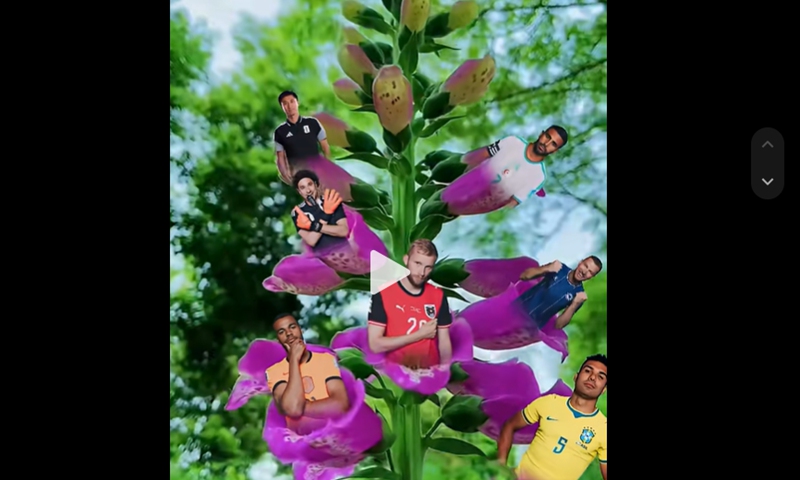
A screen shot of FIFA's promotional video featuring traditional folk music, oversized floral graphics and Chinese referee Ma Ning atop a blooming stalk
Featuring traditional folk music, oversized floral graphics and Chinese referee Ma Ning perched atop a blooming sesame stalk, a promotional video recently published by FIFA's official WeChat video account seems worlds apart from FIFA's usual sleek, globalized branding. Yet it was this contrast that revealed how the world's football governing body tried to connect with Chinese audiences of all ages.
FIFA's promotional clips are typically characterized by superstar players, dramatic stadium shots, cinematic editing, electronic soundtracks and a polished international aesthetic designed to appeal to football fans worldwide.
The recently released Chinese-themed World Cup promotional video broke almost every one of those conventions.
Instead of epic match footage, viewers are greeted by a distinctly Chinese visual landscape. Flowers bloom layer by layer, red-and-gold colors dominate the screen, folk music replaces electronic beats, and Chinese referee Ma occupies the visual center while international football stars appear as supporting elements embedded among flower buds.
Ma is one of the three Chinese match officials appointed for the 2026 World Cup, alongside assistant referee Zhou Fei and video assistant referee Fu Ming.
"Share this in your family group chat, and don't forget to invite the elders to tune in to the World Cup too," read the post with the promotional video.
The result is what many Chinese netizens affectionately describe as tuwei — a deliberately exaggerated, grassroots aesthetic often associated with festive family videos, local television productions and social media memes.
The video narrows the distance between a global sports institution and ordinary audiences, especially older Chinese audiences, by speaking through visual codes they immediately recognize, Liu Yu, a Beijing-based sports commentator, told the Global Times.
For many middle-aged and older viewers, the imagery evokes familiarity. Symbols such as "blooming prosperity" and festive red-and-gold colors have long been associated with good fortune and celebration in Chinese popular culture.
"Haha, it's so down-to-earth—my mom loves it," said a WeChat user from East China's Anhui Province.
Younger viewers, meanwhile, are attracted by the opposite dynamic. They consume the video with an ironic, meme-oriented mindset. Watching FIFA abandon its usual elite image and embrace a style often considered kitschy creates an unexpected sense of humor. The gap between FIFA's established brand identity and the video's aesthetic generates the very punchline that fuels online sharing.
In this sense, the video's popularity has less to do with football itself than with cultural adaptation.
More revealing is FIFA's decision to place Ma on top of the composition.
While the Chinese national team remains absent from the World Cup, the presence of a Chinese referee offers domestic audiences a point of identification. It is a subtle but meaningful gesture that acknowledges China's connection to the tournament despite the national team's continued absence, Liu noted.
Behind this creative choice lies a broader reality. China remains one of football's most important growth markets. Although the Chinese team has struggled to qualify for major tournaments, the country's massive audience, sponsorship potential and digital engagement remain highly valuable to international football organizations.
By embracing familiar Chinese symbols, internet humor and localized storytelling, FIFA is attempting to bypass the limitations imposed by sporting results. Rather than asking Chinese audiences to identify with the tournament through national-team participation, it encourages them to engage through cultural recognition and shared online conversation.
The strategy reflects a broader trend in global sports marketing. International organizations are no longer simply exporting a standardized product. Instead, they are learning to localize their message for different audiences, adapting to local humor, aesthetics and social media cultures.
While giving a thumbs-up to FIFA's efforts to incorporate Chinese elements into its localized marketing, fans would rather see the focus return to what truly matters: China qualifying for the World Cup on merit, rather than being represented through cultural symbolism.
The author is a reporter with the Global Times. life@globaltimes.com.cn
RELATED ARTICLES