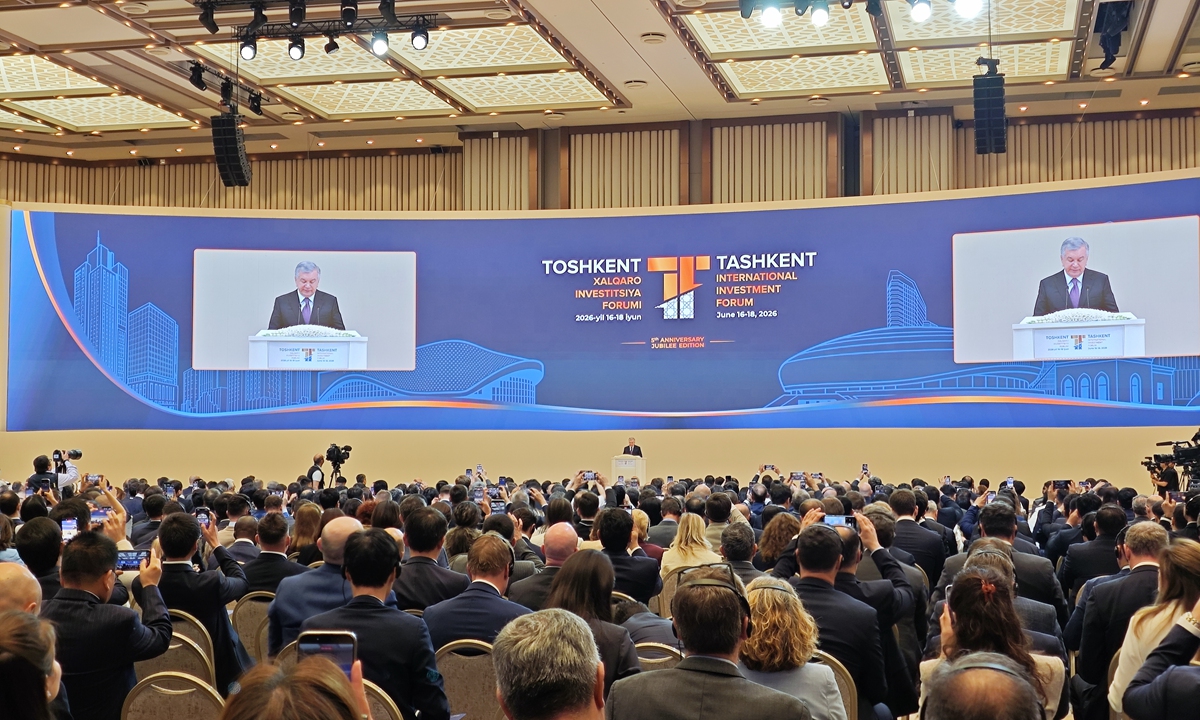
President of Uzbekistan Shavkat Mirziyoyev delivers an address at the opening ceremony of the fifth Tashkent International Investment Forum on June 17, 2026, in Tashkent, Uzbekistan. Photo: Xia Wenxin/GT
As the fifth Tashkent International Investment Forum (TIIF-2026) officially kicked off on Wednesday, Uzbek President Shavkat Mirziyoyev unveiled an aspiring roadmap to attract foreign capital, while participants across government, business, and academic circles in Uzbekistan spotlighted Chinese investment, technology, and regional infrastructure as key drivers of future growth for both Uzbekistan and the wider region.
Held under the theme “Investment Resilience: New Frontiers, New Partnerships” from Tuesday to Thursday, the TIIF-2026 marks its largest iteration to date, drawing more than 7,600 participants representing around 100 countries.
During his address at the opening ceremony on Wednesday morning, local time, President Mirziyoyev outlined six priority areas designed to provide stronger legal guarantees for investors, open high-tech industries, and firmly cement Uzbekistan as Central Asia's premier investment hub. Investment is a catalyst for advanced technologies, modern knowledge and expertise, new jobs and development that keeps pace with the demands of a rapidly changing world, said the Uzbek leader, vowing to keep the doors of New Uzbekistan open to foreign investors who come to the country with trust and ideas.
Such a high-level vision from the Uzbek government resonated strongly on the forum floor, with local business and academic leaders underscoring China as an irreplaceable partner.
During a high-profile investment dialogue between Uzbekistan, China, and Shanghai Cooperation Organisation (SCO) countries on the eve of the forum’s opening on Tuesday evening, Ilzat Kasimov, Deputy Minister of Investment, Industry and Trade, reaffirmed Uzbekistan’s unwavering commitment to deepening comprehensive ties with Beijing. “China stands as Uzbekistan’s largest trading, investment, and technological partner,” Kasimov stated, noting that over 5,600 joint ventures with Chinese capital currently operate within the country.
Many of those companies have achieved major success locally, while nine joint industrial zones established with Chinese firms have become highly efficient platforms for local production and export growth, he said.
Mukhammadkhon Soliev, the Managing Director of the Innovative Centre in Samarkand, told the Global Times that while the forum spotlighted Uzbekistan’s technological drive, China remains at the forefront of these fields. “We need more specialists who can work with many countries, including China, on this matter,” Soliev said, calling for closer collaboration to create joint laboratories and develop cooperative projects. “That would benefit our bilateral relationships, and it will be beneficial for both Uzbekistan and China.”
Gulbakhor Tojimirzaeva, the General Director of B.A Holding – a major conglomerate in Uzbekistan overseeing nearly 20 enterprises, including 10 China-Uzbekistan joint ventures – pointed out the immense complementarity between China and Uzbekistan across multiple sectors, particularly in new-energy vehicles and education. Looking ahead, she revealed that her company is targeting future strategic expansion into finance, digital development, pharmaceuticals, and international logistics. "We will actively seek out some of the most outstanding partners from China and around the world to drive these initiatives forward," Tojimirzaeva stated.
Highlighting the forum’s role as a catalyst for direct engagement, Ferhan Kara, the chief advisor to the Rector of Samarkand State Technical University, noted that convening the event in Tashkent effectively centralized government leadership and global executives onto a unified platform. Kara emphasized that the government’s tangible protection of investor rights through sweeping legal reforms remains a key advantage in attracting further foreign capital from China and beyond. "This is a monumental historical opportunity for external capital," Kara told the Global Times.
Beyond these bilateral and institutional ties on the forum floor, participants also emphasized the importance of regional cooperation in driving future growth.
During Tuesday evening’s dialogue, Kasimov had emphasized that SCO nations remain Uzbekistan’s primary economic partners, noting that the country is actively building an export-oriented, investor-friendly economic environment by expanding industrial and logistical cooperation across the bloc.
Echoing this sentiment on multilateral synergy, Piao Yangfan, Deputy Secretary-General of the SCO, stated that member states possess highly complementary economies alongside the advantage of an ultra-large-scale market. She emphasized that all parties place a premium on investment cooperation and the implementation of major projects, stressing the need to deepen the alignment of national development strategies and significantly enhance trade and investment facilitation levels across the region.
