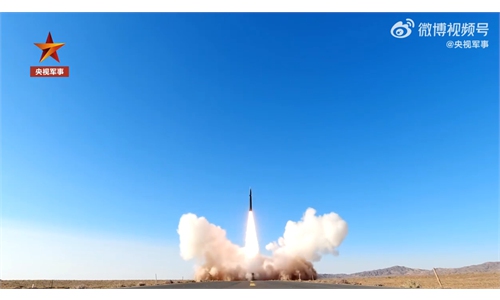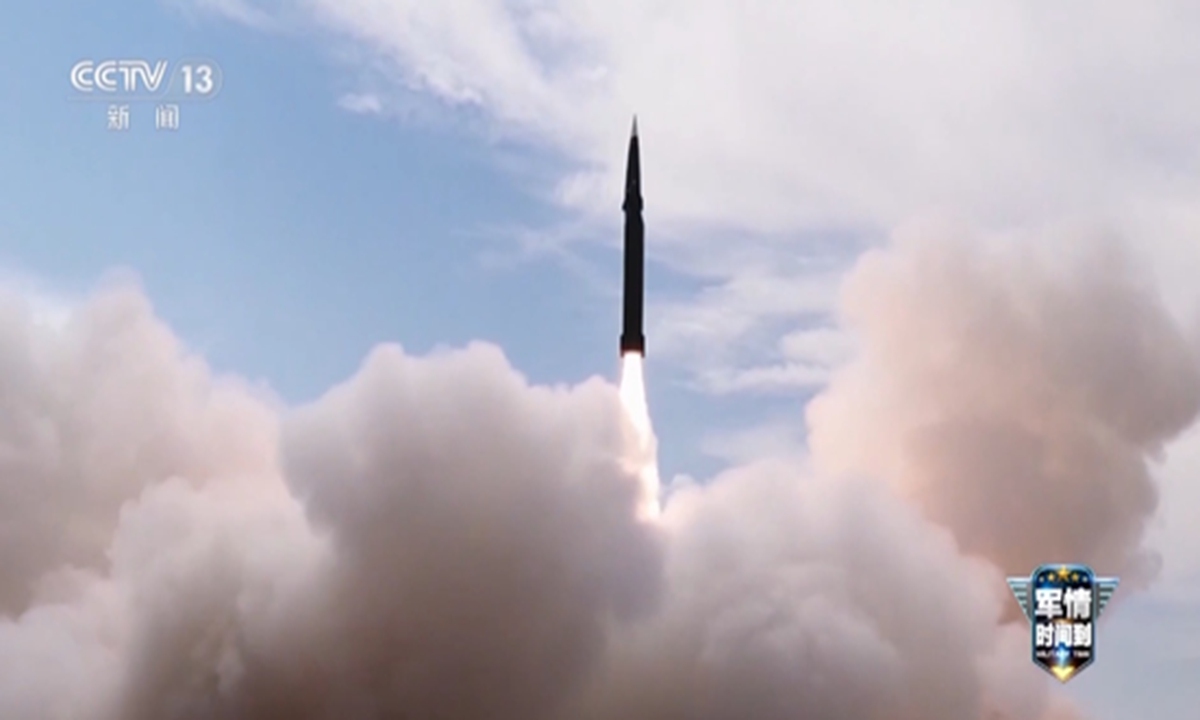
A CCTV News report on June 20, 2026 shows the launch scene of what seems to be a DF-17 hypersonic missile, characterized by its waverider aerodynamic design. Photo: Screenshot from CCTV News
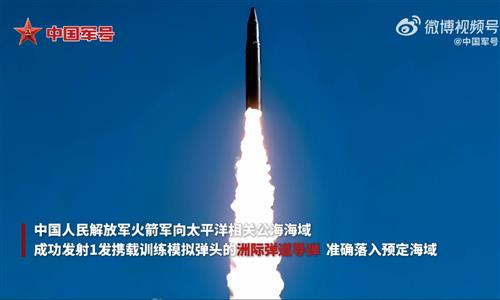
Chinese official media has publicly shown the launch of the Chinese People's Liberation Army (PLA) Rocket Force's DF-17 hypersonic missile for the first time, accompanied by the first official disclosure of what a military commentator said could be an upgraded variant of the DF-26 intermediate-range ballistic missile.
According to China Central Television (CCTV) News, the Rocket Force troops highlighted the latest missile systems' higher levels of automation, greater mobility, improved strike precision and enhanced ability to operate in all weather conditions, independent of fixed infrastructure and with stronger defense penetration capabilities.
Footage aired by CCTV showed Rocket Force units taking part in a joint training exercise in the northwestern Gobi Desert alongside Army and Air Force elements. The drill featured multiple waves of simulated strikes under complex battlefield conditions, including strong electromagnetic interference and precision-attack threats.
According to the report, missile units remained on combat patrol throughout the exercise and were able to switch rapidly between operational modes in response to changing orders. The exercise underscored the Rocket Force's growing focus on realistic, multi-domain combat scenarios and cross-service integration.
The latest generation of missile systems has also streamlined command chains and significantly shortened the time needed to generate combat power, the report said. The upgrades allow launch units to operate with fewer constraints related to geography, fixed positions and weather conditions, facilitating a shift from pre-designated launch sites to more flexible and unpredictable firing patterns.
The CCTV News footage showed the launch scene of what seems to be a DF-17 hypersonic missile, characterized by its waverider aerodynamic design, which was previously displayed at military parades in Beijing on October 1, 2019 and September 3, 2025. A separate report by the military channel of CCTV showed a transporter erector launcher similar to that of the DF-17 erecting a missile with what seems to have a bicone aerodynamic design not seen before.
Military commentator Du Wenlong told CCTV that the footage marked the first time the launch status of the DF-17 had been publicly shown and reflected the Rocket Force's high standards for combat readiness.
"First, the exercise took place under field conditions. The fact that launch vehicles maneuvered across complex terrain indicates that field operations have become the basic mode of combat, rather than conducting military operations in fixed, pre-selected areas," Du said.
"Second, the scenario was complex. The launch drill was not conducted under ideal conditions but involved various forms of interferences. The ability to carry out different combat missions, launch missiles on schedule and achieve effective strikes under such conditions is an important benchmark for building combat capability," he said.
"The exercise also featured multiple missile types, demonstrating that we have different missiles to respond to different targets and operational scenarios," Du added.
CCTV News said China's missile arsenal has undergone a major transformation over the past six decades, evolving from limited capabilities into a comprehensive force with both nuclear and conventional strike options.
The "Dongfeng" family of missiles now forms a diversified operational system with complementary ranges and missions, according to the report. In recent years, a number of domestically developed systems, including the DF-17, DF-26, DF-31 and DF-61, have been deployed and regularly incorporated into training exercises.
The footage also showed another missile resembling the DF-26 intermediate-range ballistic missile unveiled during previous military parades. Du said the missile could be the latest upgraded variant of the DF-26, adding that its appearance suggested the system was being integrated into a broader operational framework. Like the DF-17, the missile appeared to feature small control fins near its warhead.
According to Du, the fins serve multiple functions, including decelerating the missile and enabling course adjustments. The differential movement of the control surfaces can alter the missile's aerodynamic characteristics, allowing it to make significant lateral and vertical maneuvers. Such capabilities would be particularly effective against complex, mobile and emerging targets, he said.
Warheads equipped with control fins typically possess terminal maneuvering capabilities, significantly enhancing their ability to penetrate air and missile defense systems, Du added.