ARTS / CULTURE & LEISURE
Giving history a voice through 'blank space' heritage restoration
By Published: Jun 22, 2026 08:35 PM

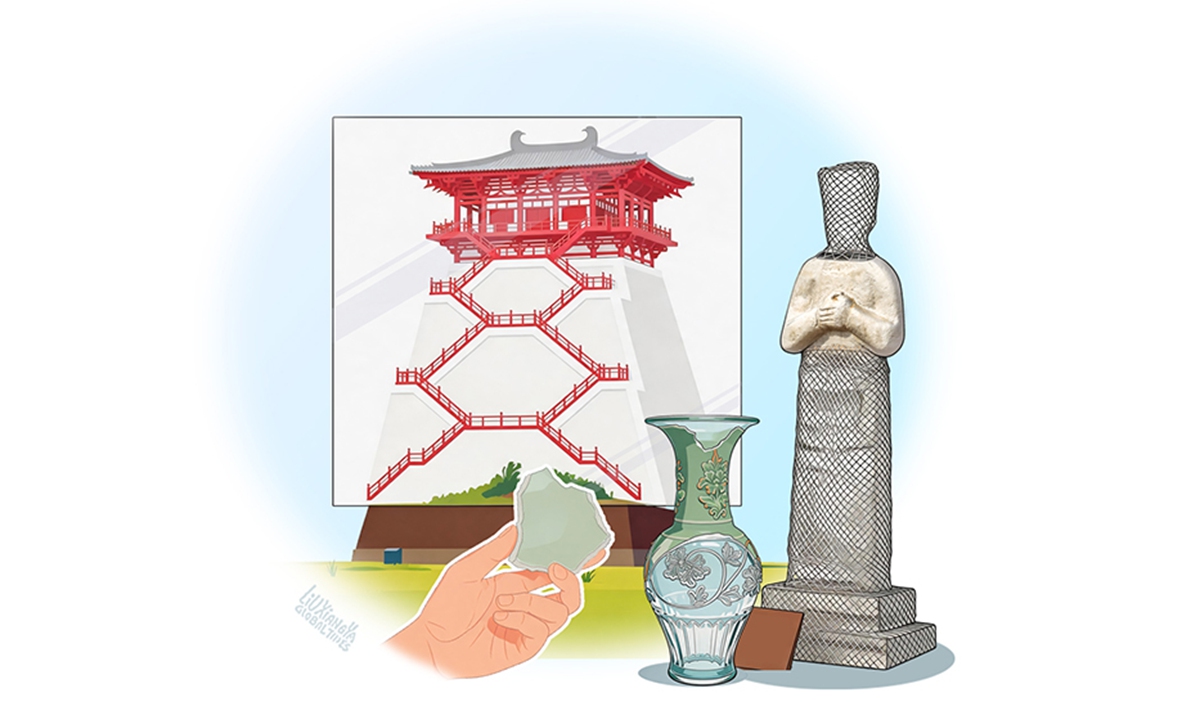
Illustration: Liu Xiangya/GT
Picture this: You are walking through the Daming Palace National Heritage Park in Xi'an, Northwest China's Shaanxi Province, but instead of a complete replica rising before you, you find a shimmering outline made from transparent panels. At the Xixia Imperial Tombs resort in Northwest China's Ningxia Hui Autonomous Region, a majestic stone statue is partially rebuilt - not with new stone, but with metal mesh. And at the Zhejiang Provincial Museum, a centuries-old vase stands, its missing tail replaced not with paint or clay, but delicate 3D-printed resin that is crystal clear, making the difference between old and new visible at a glance.This type of "leaving a blank space" restoration is changing how the public sees cultural relics and ruins. It also raises an important question: Must we fix the past to perfection? Rather than pursuing seamless reconstructions, this method highlights the very marks of age and incompleteness. Through transparency, hollowness, and careful restraint, restored relics embrace both what has survived and what has vanished to time.
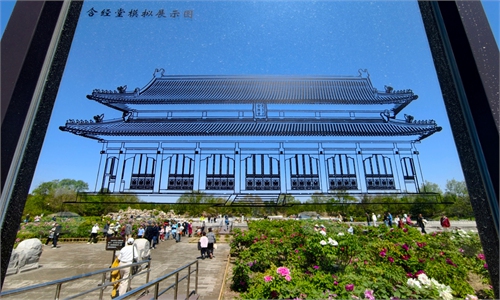
Similar to the Daming Palace National Heritage Park, the Han Jing Hall ruins at the Old Summer Palace (Yuanmingyuan) in Beijing, which recently reopened to the public after renovations and upgrades, have also undergone a key change: the installation of four perspective display boards at the site.
According to the Yuanmingyuan Administration Office, these boards restore the layout of the Han Jing Hall's original buildings, letting visitors "see" what it once looked like while standing amid the ruins. This directly solves the common problem at large historical sites where visitors can only see ruined walls but cannot visualize the original structure.
How to display or restore such large ruin sites has always been a challenging issue. Unlike a single building or cultural relics, these sites often consist mainly of earth and stone foundations, which lack a clear visual form and are difficult for ordinary people to understand, Liu Zheng, a member of the Chinese Society of Cultural Relics, told the Global Times.
The core of the "blank space" approach, such as installing perspective display boards, is minimal intervention, clear differentiation between ancient and modern elements, and preservation of the original state of the ruins. Lightweight, removable, and easily identifiable modern materials are used to outline the historical contours, without ever altering the core of the site itself, Liu noted.
Another example is located within the Xixia Imperial Tombs resort in Yinchuan, Ningxia, where artistic metal mesh installations outline the missing bodies of the damaged stone statues. The rough and simple metal lines blend seamlessly with the sweeping wind, sand, and barren desert landscape, according to the Xinhua News Agency.
The hollow wire mesh not only guides visitors to imagine the statues' original, complete forms, but also brings a unique sense of modern art, adding a layer of contemporary aesthetics to the deep historical setting.
When visitors look at these ruins and relics, the empty spaces invite them to join in, to imagine what might have been. The ruins do not hand people easy answers. Instead, they ask: What stories are missing here? What did this statue hold before the wind carried it away? What did this palace look like during its prime? With the "blank space" restoration method, there is unfinished business, visible scars, and a collaboration between past and present. History can be seen as something alive and changing.
In addition to large heritage sites like the Xixia Imperial Tombs resort and Yuanmingyuan, this "blank space" aesthetic can also be applied to the restoration of smaller relics that are heavily damaged. For example, an ancient ceramic piece now displayed at the Zhejiang Provincial Museum originally consisted of only fragments of the neck and upper belly. Traditionally, relics with more than 40 percent damage are extremely difficult to restore. In this case, the restoration team creatively used transparent colored photosensitive resin, 3D-printed to fill in the missing parts, giving the piece a "crystal coat," according to Xinhua.
Restorers intentionally keep the cracks, scars, and missing pieces. They use transparent resin, clear frames, hollow metal, or light 3D-printed parts that do not pretend to be the real thing. Old and new are separate, easy to spot, and the "restored" object can display both its survival and its losses, according to Liu.
At the same time, there is also caution about how to appropriately use the "blank space" method on cultural relics and ruins.
Zhou Xueying, a professor with the School of History at Nanjing University, told the Global Times that while the method is visually impressive and can offer a fresh experience to visitors, it is also limited. The metal mesh installations may remind visitors of what a lost statue was like, but cannot really teach visitors about the sculptor's hand, the fine details, or the deep culture behind the work. Blank spaces may attract attention, but they should not be overused; instead, they should be combined with other restoration and display methods.
The author is a reporter with the Global Times. life@globaltimes.com.cn
RELATED ARTICLES