China’s job market shows improvement as youth employment indicator hits 11-month best
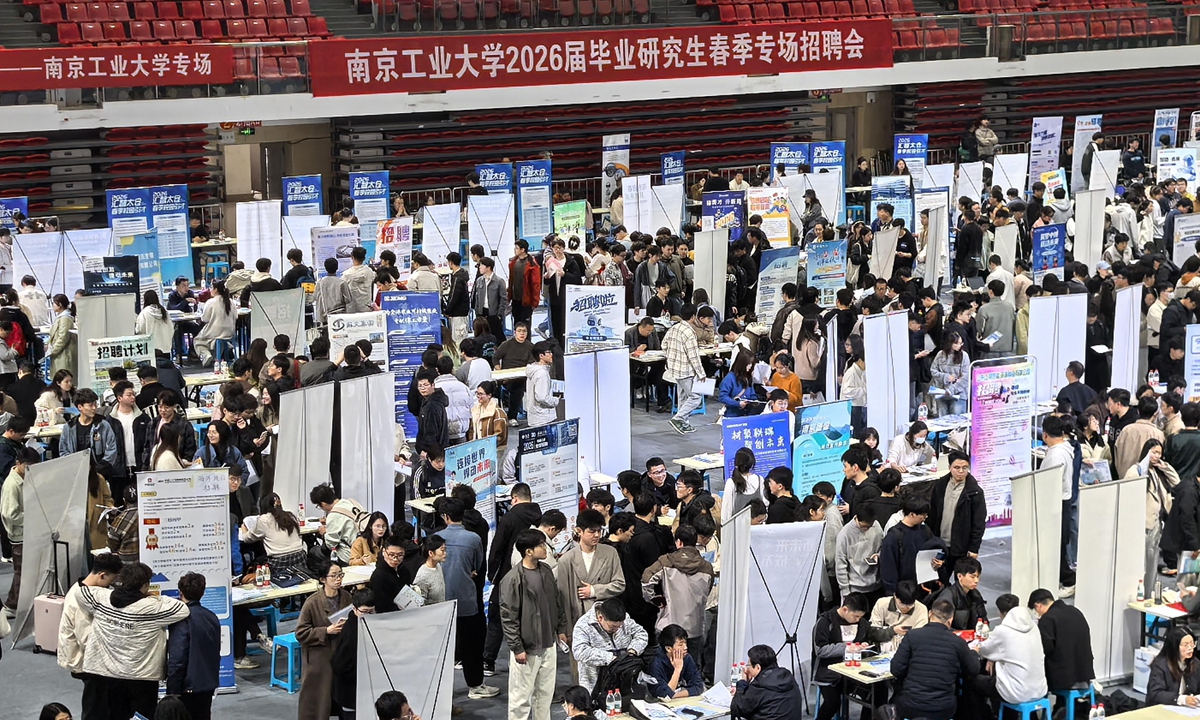
Graduating students attend a job fair at Nanjing Tech University in Nanjing, East China's Jiangsu Province, on March 25, 2026. The university held the special spring job fair to boost high-quality employment for its 2026 graduates. More than 220 enterprises provided over 1,000 job vacancies, drawing a large number of postgraduate students. Photo: VCG
China's employment market showed further signs of improvement in May, with an age-group indicator for young job seekers reaching an 11-month best, updated official data showed on Monday, as experts said the trend reflected the resilience of the broader economy and the continued effect of pro-employment policies.
As college graduates enter the job market, stronger policy support, expanding service demand and the rapid growth of new industries are expected to create more employment opportunities and add fresh vitality to China's labor market, they said.
Updated age-group unemployment data from the National Bureau of Statistics (NBS) showed that the rate for the 16-24 age group, excluding students, stood at 15.6 percent in May. A Global Times review of official monthly data showed the reading was the lowest since June 2025. The rate for those aged 25-29, also excluding students, was 7.2 percent, while the rate for those aged 30-59 stood at 4.1 percent.
The broader surveyed urban unemployment rate, released by the NBS on June 16 as part of the May economic data, came in at 5.1 percent, down 0.1 percentage points from April. In the first five months, the average surveyed urban unemployment rate stood at 5.2 percent, pointing to the generally stable operation of the job market.
Li Changan, a professor at the Academy of China Open Economy Studies at the University of International Business and Economics, told the Global Times on Monday that the May figures sent a clear signal of improvement, reflecting both the stable operation of China's macroeconomy and the positive effects of the country's employment-first policy approach.
"The decline in unemployment indicators across different age groups is an important macroeconomic signal. It shows that China's economic fundamentals remain stable, while a series of policies to stabilize and promote employment are translating into concrete results," Li said.
China's economic performance in the first part of the year has provided a solid foundation for job creation. The country's GDP grew 5 percent year-on-year in the first quarter, while 2.99 million new urban jobs were created during the period, according to official data.
In May, the value-added output of major high-tech manufacturing firms rose 15.1 percent year-on-year, and the production index for information transmission, software and information technology services increased 11.3 percent, according to the NBS, pointing to new job space.
At a State Council Information Office press conference on the national economy's performance in May, officials said employment is the most basic livelihood issue. Since the beginning of the year, local governments and departments have strengthened measures to stabilize employment, helping keep the employment situation generally stable.
Li said China's policy system for stabilizing employment and supporting entrepreneurship has become more mature, while technological progress, industrial upgrading and new business models - from platform-based services to one-person companies - are opening up more job options.
Rising living standards and consumption upgrading have also boosted demand in modern services such as housekeeping, elderly care, health, cultural tourism and community services, creating important channels for employment, he added.
China has also placed employment among the major objectives in medium- and long-term policy planning. The outline for its 15th Five-Year Plan period (2026-30) requires that employment remain generally stable, the surveyed urban unemployment rate stay below 5.5 percent, and new progress be made in achieving high-quality and full employment.
This year's Government Work Report set the target of creating more than 12 million new urban jobs. In late March, Chinese authorities rolled out measures to support employment for college graduates and other young people, urging better use of social insurance subsidies and tax and fee reductions to encourage enterprise hiring, while expanding training in emerging fields such as artificial intelligence, new-energy vehicles and the low-altitude economy.
A report by the China New Employment Forms Research Center showed that China's flexible employment workforce reached 280 million in 2025 and is expected to rise to 320 million in 2026, accounting for more than 40 percent of urban employment, marking the flexible employment an important pillar of the labor market, People's Daily reported on June 1.
Li said that as AI is applied more widely across industries, more employment scenarios, new occupations and business models are expected to emerge, adding new growth points to China's labor market.
RELATED ARTICLES