China’s urban unemployment rate for 16-24 age group falls to 16.5% in Dec, fourth consecutive month of decline: NBS
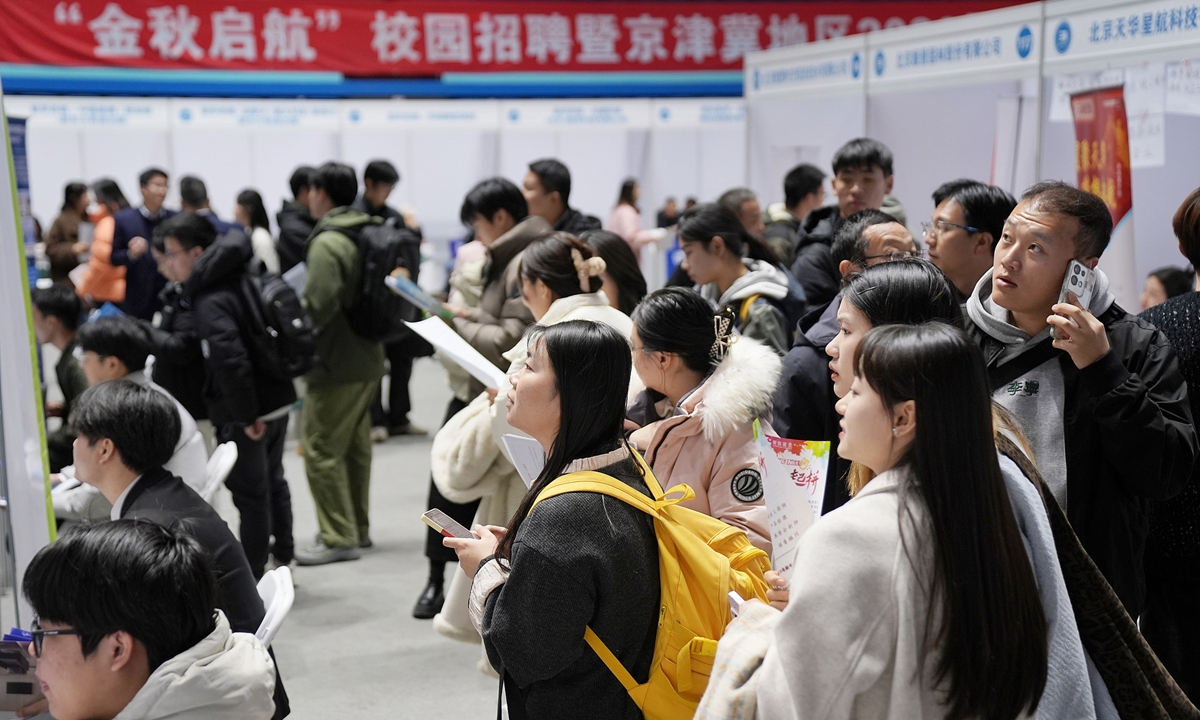
Participants attend a large job fair for 2026 college graduates in the Beijing-Tianjin-Hebei Region on November 19, 2025, at Beijing University of Technology. More than 200 employers from the region are offering over 4,000 job vacancies. Photo: VCG
China's National Bureau of Statistics (NBS) said on Thursday that the urban unemployment rate for people aged 16-24 (excluding students) fell to 16.5 percent in December, down 0.4 percentage points month-on-month and marking four consecutive months of decline.
The urban unemployment rate for 25-29‑year‑olds stood at 6.9 percent in December, down 0.3 percentage points, while the rate for 30-59‑year‑olds was 3.9 percent, up 0.1 percentage points, the NBS data showed.
A Chinese expert said that continued policy support, targeted training, and stronger links between education and industry are likely to be central to keeping youth unemployment on a downward path.
China's job market has remained generally stable, with the surveyed urban unemployment rate holding steady at 5.2 percent in 2025, NBS data showed. For December alone, the surveyed urban unemployment rate was 5.1 percent on average.
Employment is the most basic component of people's well-being. The recent decline in youth unemployment suggests that active employment stabilization policies are taking effect, Li Chang'an, a professor at the Academy of China Open Economy Studies under the University of International Business and Economics, told the Global Times on Thursday.
Li noted that rapid advances in new quality productive forces, the modern industrial system, and technological transformation have raised skill requirements for young workers. With the number of university graduates expected to reach a record 12.7 million this year, Li said that it is urgent to expand vocational and skills training focused on cutting‑edge industries and sectors with acute labor shortages and strong employment capacity.
The central government and relevant ministries have stepped up policy coordination to stabilize employment.
Liao Min, deputy head of the Ministry of Finance (MOF), said at a press conference on Tuesday that in 2026, the MOF will deliver "hardcore" support for stabilizing employment, enterprises, markets, and expectations, ensuring a solid and successful start to the 15th Five-Year Plan (2026-30) period.
According to the Central Economic Work Conference held in December, it is imperative to ensure the steady development of employment, businesses, markets and expectations, getting the 15th Five-Year Plan off to a good start.
Wang Xiaoping, minister of Human Resources and Social Security, said that the ministry will fully deploy measures such as wage‑support refunds, tax and fee cuts, extended reductions in unemployment and work‑injury insurance rates, and targeted support for labor‑intensive firms.
China will also tap job potential in emerging sectors and industries of the future, Wang added, highlighting opportunities in services sectors related to eldercare and childcare. For college graduates, efforts will be made to step up recruitment and expand traineeship and internship programs, Wang said.
The ministry also plans to accelerate job creation in digital and green industries, expand employment in counties and rural areas, develop new occupations, launch recruitment campaigns, and promote large‑scale internship and placement programs, the Xinhua News Agency reported.
RELATED ARTICLES