China’s surveyed urban unemployment rate drops to 5% in May, thanks to stable economic growth: NBS
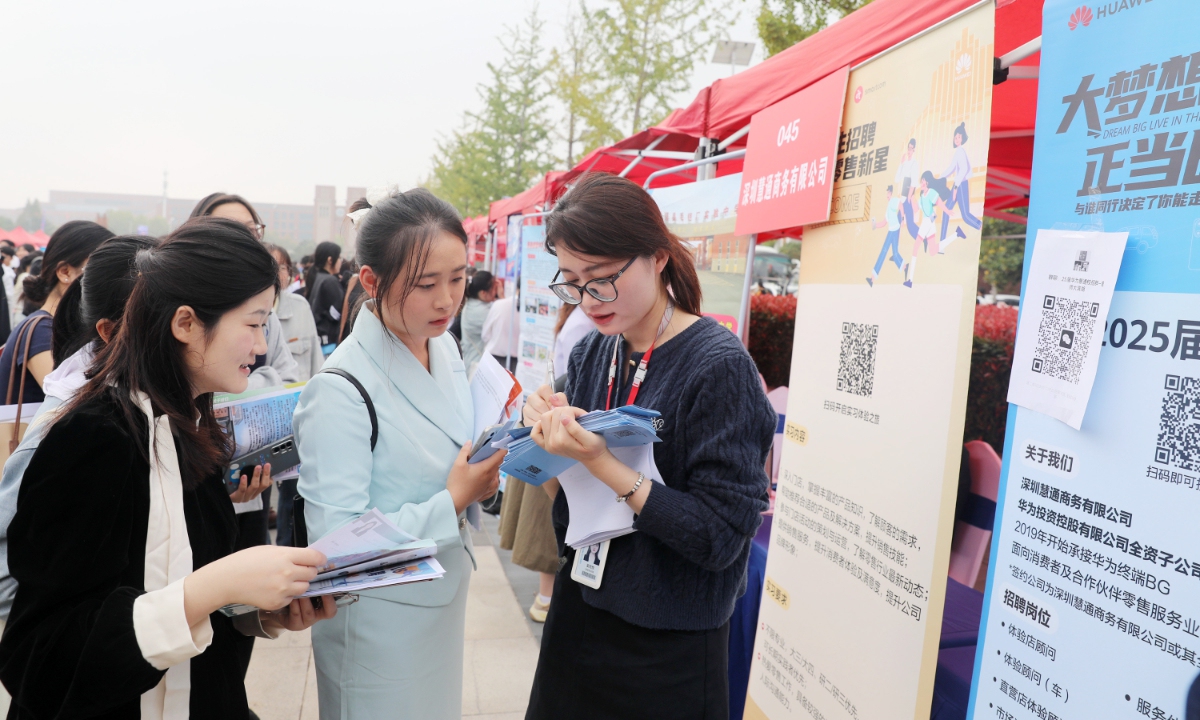
College students look for jobs at an employment fair held on the campus of the Huaibei Normal University in Huaibei, East China's Anhui Province on October 16, 2024. The job fair attracted more than 183 companies offering more than 10,000 positions. The year 2024 is expected to see 11.79 million students graduating from colleges, an increase of 210,000 from 2023. Photo: VCG
China's surveyed urban unemployment rate came in at 5.0 percent in May, down 0.1 percentage points from a month earlier, data released by the National Bureau of Statistics (NBS) showed on Monday.
Despite rising external uncertainties since the beginning of 2025, China's unemployment rate among the main working population has remained stable, while the youth jobless rate declined for three consecutive months, indicating a sustained trend of employment stability, said Fu Linghui, an official from the NBS at a press conference on Monday.
The surveyed urban unemployment rate in 31 major cities averaged at 5.0 percent, also down 0.1 percentage points from the previous month.
In May, the surveyed unemployment rate was 5.0 percent for both local and migrant household-registered workers. In the first five months of 2025, the national surveyed urban unemployment rate stood at 5.2 percent, according to the NBS.
Despite external factors such as global trade fluctuations, China's employment situation has remained largely stable, indicating that related pro-growth policies have had a positive effect, Li Changan, a professor at the Academy of China Open Economy Studies at the University of International Business and Economics, told the Global Times on Monday.
"The government has attached great importance to labor employment, implementing a slew of employment-centered policies and increasing support for market entities and university graduates, which has yielded positive results," said Li.
In addition to policy support, the NBS official also attributed the May employment situation to the nation's steady economic growth as well as strong development of industries with high employment capacity.
Boosted by the consumer goods trade-in program and various holidays, the production index for wholesale and retail grew by 8.4 percent, and that for accommodation and catering increased by 6.2 percent, both showing a marked acceleration compared to the previous month, which were conducive to stabilizing employment, said Fu at the press conference.
However, Fu pointed out that maintaining employment stability still faces some challenges due to a complex external environment impacting the domestic labor market, with recruitment difficulties in some sectors and mounting employment pressure among certain demographic groups reflecting ongoing mismatches between labor supply and demand.
Moving forward, Fu emphasized the priority of domestic economic development, focusing on stabilizing labor employment and the economy while promoting high-quality development, such as ramping up vocational skills training to improve the match between labor supply and demand.
Global Times
RELATED ARTICLES