ARTS / CULTURE & LEISURE
Spy thriller explores decades of dedication to order and justice
Main actors share behind-the-scenes stories
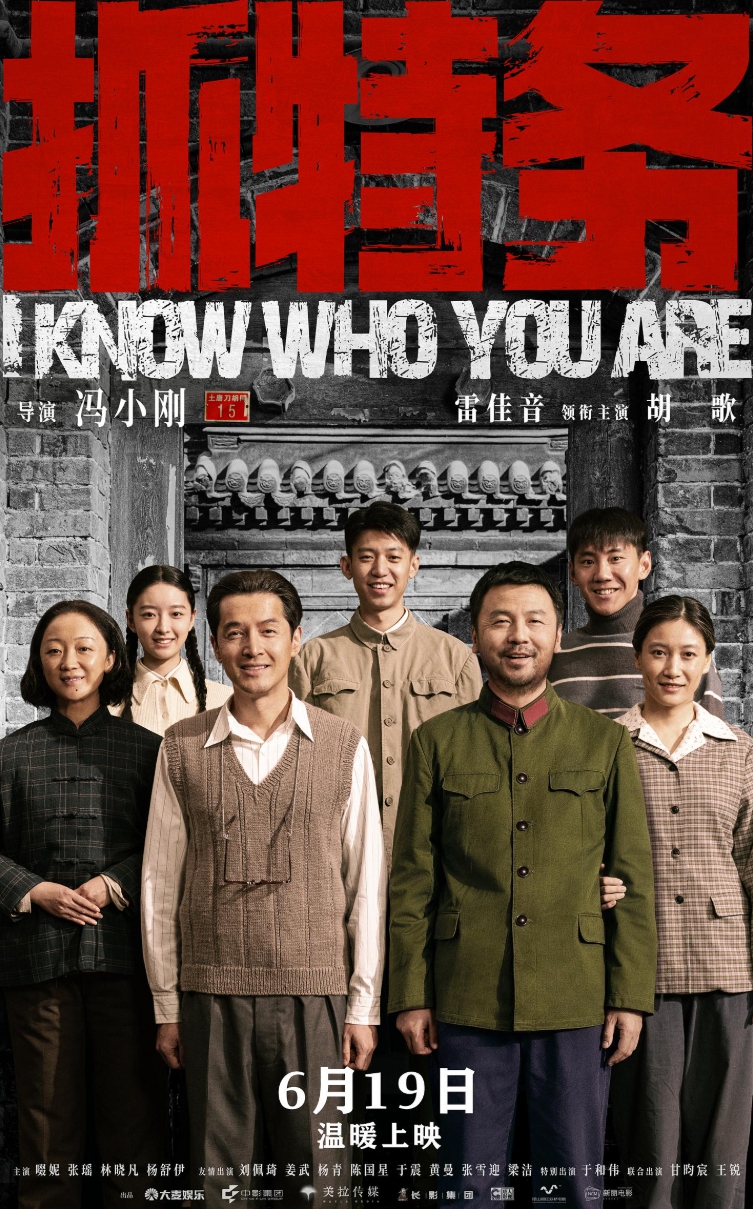
I Know Who You Are Photo: Courtesy of Douban
Chinese director Feng Xiaogang's new thriller I Know Who You Are has earned more than 65 million yuan ($9.6 million) within four days of its nationwide release, according to ticketing platform Maoyan. The film currently holds a 7.5/10 rating on media review platform Douban.
Starring Lei Jiayin and Hu Ge in leading roles, the film is set in the early years of the People's Republic of China and centers on a long-term psychological duel between a local police chief and a suspected sleeper spy of the then Kuomintang troops living in the same courtyard community.
The story follows police station chief Xiao Dali (Lei Jiayin), who relies on instinct and observation to identify Feng Jingbo (Hu Ge), a suspected operative code-named "5182," believed to be hiding in a residential compound in Beijing. In order to monitor and investigate Feng more closely, Xiao chooses to move into the same courtyard, turning the pursuit into a decades-spanning coexistence between hunter and suspect.
In interviews with the Global Times, Lei and Hu shared their interpretations of the characters' relationships, details of their preparation for the roles and behind-the-scenes stories from the film.
Lei said he was initially drawn to the film because of its rarity. "This kind of role is quite rare; it allows you to portray nearly half a character's life within a single film, and I was especially eager to experience that feeling," he said.
The story itself, a long entanglement between a police officer and a suspected spy, and the fact that Hu would also be in the cast made him even more eager to join the project.
Hu, meanwhile, said what attracted him most was the difficulty of the role. It's rare to come across such a solid script, and the subject matter was also very unique.
"Although I play a spy this time, he is a non-typical one, someone who has never truly done anything bad in his life," he said.
It was also a demanding role to portray. He had never taken on a role like this before, and the character was extremely complex and deeply conflicted. "It was these two kinds of difficulties that made me join the production without hesitation."
Lei said Xiao's "single-mindedness" stems from his professional identity and lifelong commitment to duty. A former soldier who helped build the country before becoming a police officer, his persistence reflects deep patriotism and responsibility for maintaining order and justice.
Hu explained that Feng's attitude toward Xiao shifts significantly over time. He begins with defiance while concealing his identity, later experiences moral collapse and regret over his mission and personal life, and even contemplates suicide before being saved by Xiao. In the end, Feng feels more guilt than anything else toward Xiao, as Xiao endured many unfair treatments while under surveillance, and his family also suffered a great deal of hardship and grievance because of it.
Both actors emphasized that the central challenge of the film lies in its restrained psychological tension rather than overt confrontation.
For Lei, realism was key to making the dynamic believable. "If you play it too directly, it becomes very flat," he said. "In real life, people are sensitive. Even if something is not said openly, you can feel it. The only thing I could do was get as close as possible to the world created by the script and completely immerse myself in it."
Hu echoed that sentiment. "My task was to appear flawless in front of Xiao while still letting the audience sense what I am hiding," he said. To achieve this effect, he said he could only look for small gaps, slipping in moments that reveal the character's inner complexity whenever possible.
The film also marks another collaboration between high-profile industry figures and director Feng, whose work has long left its mark on Chinese cinema for decades.
When he first began going to theaters, Lei was already watching Feng's films. He said he had long hoped to work with the director and saw the collaboration as a valuable learning experience during the shoot as well.
Hu described Feng as emotionally attuned and artistically sensitive, contrasting him with common perceptions of commanding blockbuster directors. "He is very sensitive as a creator," Hu said. "That sensitivity allows him to connect emotionally with the material and, eventually, with the audience."
Beyond the film's production details, both actors reflected on broader themes of persistence and authenticity in acting.
Lei said his own "stubborn" commitment has been his acting career itself. "Every actor who eventually comes before the public and becomes known to audiences has gone through a great deal behind the scenes - they have to work hard and keep learning," he said.
When asked what matters most in building a character, Hu gave a concise answer: authenticity. "Once I receive a script, if the story, the world it builds, or the relationships between the characters don't feel real, I simply can't find the drive to create or shape that role."
RELATED ARTICLES