Chinese lawmakers start to deliberate draft financial law, as country aims to build a strong financial sector: analysts
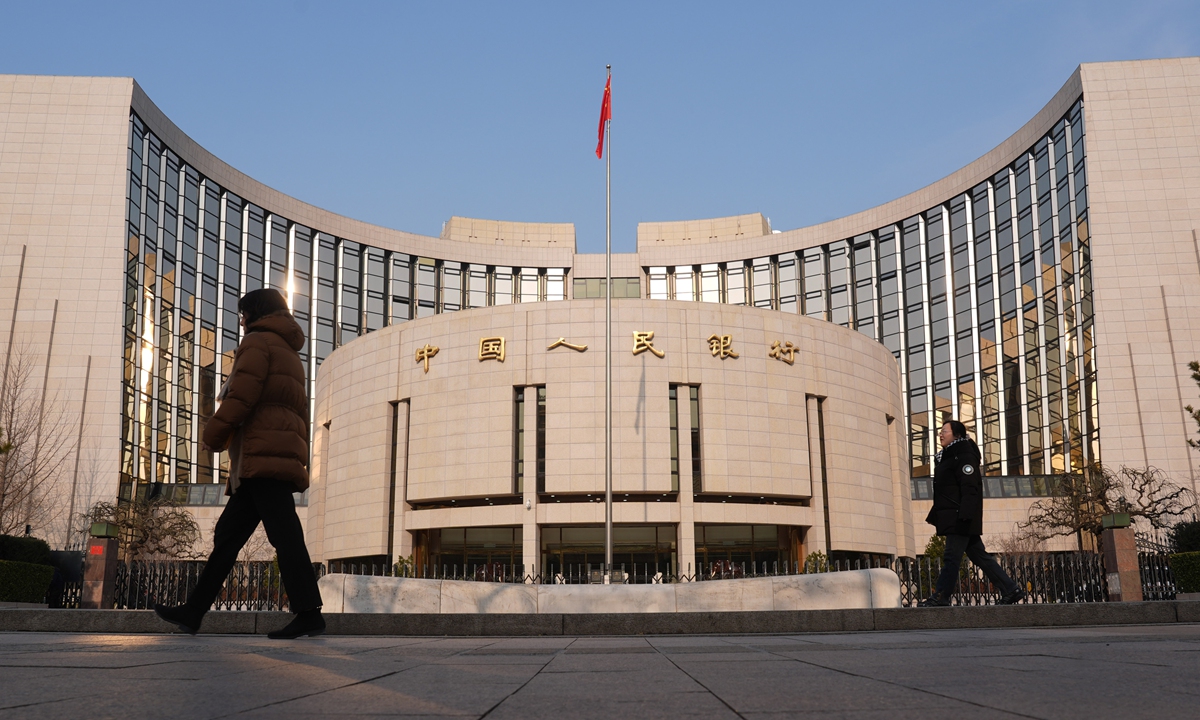
Two people go past the building of the People's Bank of China on December 22, 2025. Photo: VCG
The Standing Committee of the National People's Congress (NPC) started to deliberate China's draft financial law on Tuesday, the Xinhua News Agency reported. It marks a milestone step in strengthening the rule of law in China's financial sector, analysts said.
As the country's first fundamental, comprehensive, and overarching financial law, the legislation is expected to bolster high-quality financial development, which will contribute to building China into a financial powerhouse, according to the analysts.
The draft financial law consists of 11 chapters and 95 articles, according to the document published on the websites of the Ministry of Justice, the People's Bank of China, the National Financial Regulatory Administration, the China Securities Regulatory Commission, and the State Administration of Foreign Exchange. It sets out provisions on the direction and overall requirements of financial work, a modern central bank system, regulation of financial institutions, financial products and services, financial market regulation, risk disposal mechanism, and legal liabilities.
The legislative effort represents "a significant move to translate high-level blueprints into feasible institutions," underscoring China's determination to phase in a high-quality legal framework to regulate its financial sector, Cao Heping, professor at the School of Economics of Peking University, told the Global Times on Tuesday.
The draft financial law emphasizes the coordinated development and sector security, focuses on resolving legal challenges that hinder high-quality financial development, by prioritizing strong regulation and financial risks prevention, Cao said.
The Central Financial Work Conference held in October 2023 noted that all types of financial activities should be placed under legal regulation. In July 2024, the 3rd plenary session of the 20th Central Committee of the Communist Party of China (CPC) set the tasks of formulating a financial law. In March 2026, the draft financial law was released to solicit public feedback.
"Looking ahead, the law will provide an important institutional cornerstone for the building of China into a financial powerhouse," Tian Lihui, dean of the Institute of Financial Development at Nankai University, told the Global Times on Tuesday.
Firstly, at the institutional level, the country's financial sector will achieve a leap from "fragmented patching" to "system building" in legislation, aimed at improving governance effectiveness. Secondly, at the practical level, it will establish a risk disposal mechanism to build a legal defense line of "strong regulation and risk prevention." Thirdly, at the strategic level, it will provide a predictable institutional guarantee for building a strong financial nation guided by the law, Tian said.
Since the start of reform and opening-up in late 1970s, China's financial sector has made historic achievements. Notably, since the 18th National Congress of the CPC, the country has accelerated financial reform and development while effectively managing risks.
"The market depth and breadth of China's financial sector have significantly improved, and its international status and influence have achieved rapid development," Pan Gongsheng, governor of the People's Bank of China, said at the 2026 Lujiazui Forum held in Shanghai on June 17.
Currently, China has more than 5,500 A-share listed companies, with a total market capitalization exceeding 110 trillion yuan ($16.24 trillion), ranking second globally. Meanwhile, China's bond market has exceeded 200 trillion yuan, ranking second in the world. From initially conducting transactions in only a few currencies, China's foreign exchange market now covers more than 40 foreign currencies, with an annual trading volume exceeding $42 trillion, according to Pan.
RELATED ARTICLES