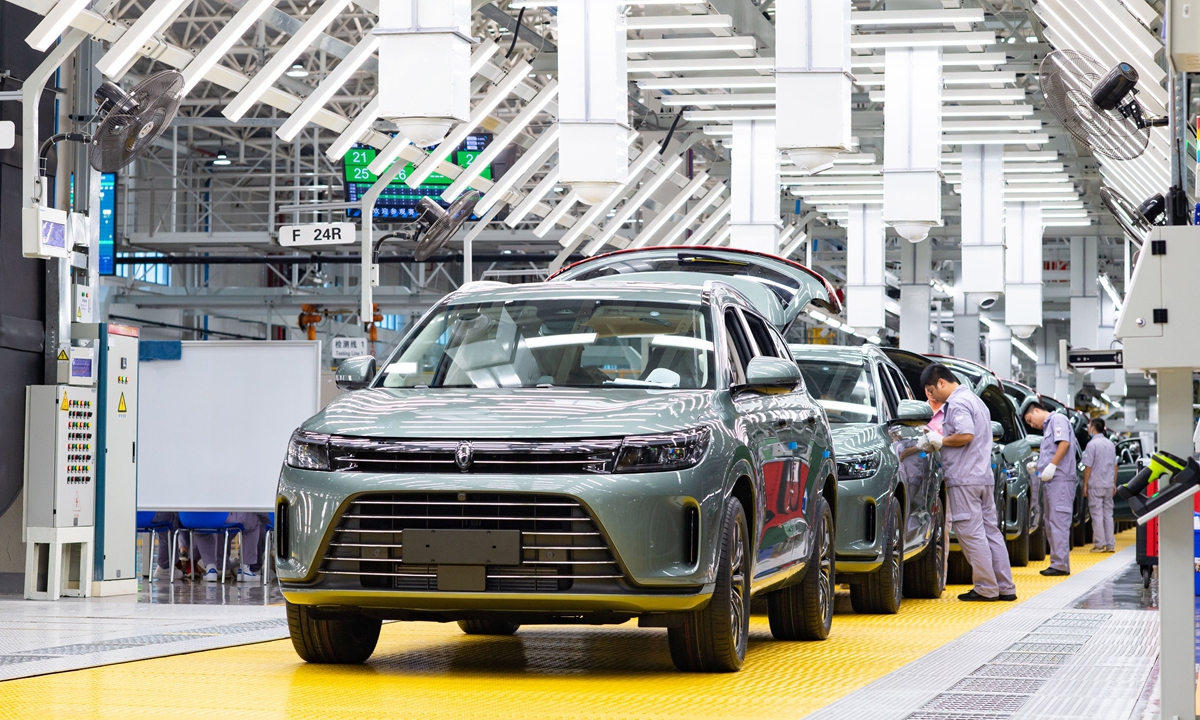
An NEV manufacturing line in Southwest China's Chongqing Municipality Photo: VCG
Chinese automakers saw growing sales in the European market, a monthly report on new car registrations released by the European Automobile Manufacturers' Association (ACEA) showed on Tuesday.
A Chinese analyst said that the strong sales by Chinese brands in Europe reflects rising customer recognition of Chinese cars amid a green transition, which also shows that protectionism cannot dent consumers' market-based preference.
According to ACEA, in the first five months of 2026, new car registrations in EU rose four percent, indicating a strong start to the year despite continuous geopolitical headwinds weighing on the outlook.
A good number of Chinese automakers reported rising car sales in EU in May, and their market share has kept expanding there.
Leapmotor, which saw 8,856 cars registered in the month, reported a 447.3-percent annual growth rate.
BYD saw 26,017 cars registered, with an annual growth rate of 158.8 percent. Chery Automobile posted a growth of 239.6 percent year-on-year with 16,282 units registered.
A total of 27,801 units by Geely Group were registered in May, marking an annual increase of 9.9 percent. And, SAIC Motor, with 22,343 units registered, recorded a year-on-year growth of 15.2 percent.
Overall, the ACEA noted that the EU market continued to benefit from robust consumer demand for a range of EVs. Hybrid-electric vehicles remained the most popular powertrain choice among buyers, while battery-electric cars accounted for one in five registrations, per the report.
The rise of EVs came at the expense of petrol and diesel powered cars. By the end of May 2026, petrol car registrations declined by 18.2 percent, with decreases across all major markets in Europe, according to the ACEA report. France recorded the sharpest drop, with registrations plummeting by 36.8 percent, whereas other countries also saw double-digit decreases. The drop was 20.3 percent in Spain, 18.5 percent in Germany, and 17.3 percent in Italy.
With only 1,065,071 new cars registered in the last five months, the market share for petrol fell to 22.4 percent from 28.5 percent in the same period in 2025. Volkswagen Group, Stellantis and Renault all report annual declines in new car sales in May.
Wu Shuocheng, a veteran auto industry analyst, told the Global Times on Tuesday that the competitiveness of Chinese EV brands is based on innovation, efficient supply chain and intense market competition.
The rising market share of Chinese brands in Europe is underpinned by the strong product performance of Chinese brands, Wu said, noting that the protectionist measures advocated by some in the EU can hardly impact consumer preference there.
The data came as China and EU had achieved a "soft landing" over an EV trade dispute earlier this year.
In January, the MOFCOM said that progress was made in China-EU consultations over EV shipment, with both sides agreeing to provide guidance on price applications on Chinese EV export to Europe.
According to a guidance issued by the European Commission, each application will be assessed in an objective and fair manner, following the principle of non-discrimination and in accordance with World Trade Organization rules.
The rising car sales is also a result of rising recognition of Chinese EV brands by European consumers, Wu said, noting that Chinese brands have intensified their efforts in localization, bringing more research and development and manufacturing capacity to Europe to better cater to the needs of local consumers.
China and Europe are highly complementary in the automotive sector, with industrial chain cooperation deeply integrated, and they maintain a mutually beneficial relationship that serves the economic and development interests of both sides, Wu said.
Global Times
RELATED ARTICLES