Alibaba sues US defense department over 1260H tag, saying US move ‘arbitrary and capricious,’ firm tells GT
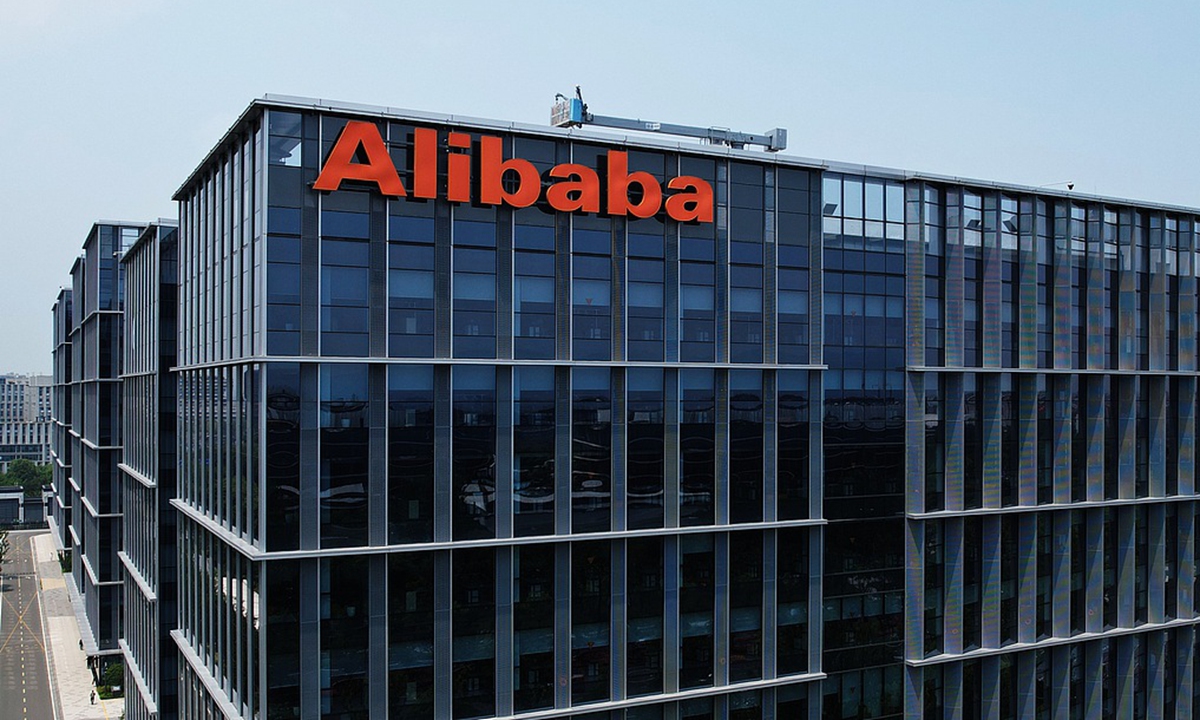
Alibaba headquarters building in Hangzhou, East China's Zhejiang Province on November 16, 2025. Photo: VCG
E-commerce giant Alibaba has filed a lawsuit against the US defense department over its groundless inclusion on the so-called 1260H Chinese military companies list, with Chinese experts saying Washington's arbitrary blacklisting scheme is a politically driven farce that distorts global trade and violates market economy rules.
Alibaba is not a Chinese military company nor part of any military-civil fusion strategy. The decision to place Alibaba on the 1260H list is arbitrary and capricious, and we are filing a lawsuit against the Department of War to demand removal from the list, Alibaba spokesperson told the Global Times on Wednesday.
The remarks come after the US defense department earlier this month expanded its list of what it describes as Chinese military companies under Section 1260H of the National Defense Authorization Act. Major Chinese technology and manufacturing firms including Alibaba, BYD, Nio, CALB Group and Unitree Robotics have been added to the list.
"For many American businesses, Alibaba is the principal gateway to the Chinese market," it said. The designation by the US "directly impugns Alibaba's reputation and casts a shadow over every US relationship the company maintains," according to a release by Alibaba.
Other businesses being added to the list this month, including BYD, Baidu and WuXi AppTec, have also rejected their inclusion, calling the designation baseless and factually inaccurate.
WuXi AppTec filed a lawsuit similar to Alibaba's on June 11.
Shi Jilong, an attorney licensed to practice law in California, told the Global Times that Alibaba's decision to challenge the US defense department in a federal court signals a shift in Chinese companies' strategies to address US national security listings. Previously, firms mostly relied on diplomatic outreach, administrative communications and market explanations; now they are proactively leveraging America's domestic judicial review system.
The outcome of this case could set an important precedent for internet platform and tech companies facing inclusion on the list and other comparable US national security blacklists in the future, Shi added.
The lawsuit is a positive and effective way for Chinese companies to counter discriminatory moves, Zhou Mi, a senior researcher at the Chinese Academy of International Trade and Economic Cooperation, told the Global Times on Wednesday.
Many of these companies have extensive business operations in the US. Beyond fueling their own growth, these businesses have brought abundant development opportunities to local US stakeholders. By filing lawsuits, the companies aim not only to safeguard their reputation and business operations but also to preserve the room for growth of their business partners, Zhou said.
The US blacklisting practice disrupts global trade, tarnishes targeted firms' international reputations and creates artificial political risks that run counter to market economy principles. Such coercive political suppression plunges China-US commercial cooperation into uncertainty and lays bare the hypocrisy of Washington's self-proclaimed rules-based international order, which puts political prejudice above fair market competition, Li Yong, executive council member of the China Society for WTO Studies, told the Global Times on Wednesday.
Prior to Alibaba's move, several other Chinese companies including Xiaomi and Advanced Micro-Fabrication Equipment Inc China (AMEC) were removed from the blacklist through legal approaches.
These cases lay bare that US politicians slap arbitrary labels on enterprises under the pretext of national security purely based on subjective speculation and such administrative moves run counter to US domestic laws. Multiple companies have overturned these false designations through legal process and gotten removed from the list, proving this blacklist mechanism is nothing short of a farce, Li said.
Zhou said the US' blacklist, whose highly arbitrary scope and standards lack any substantial factual evidence, has severely undermined Washington's credibility. By arbitrarily tagging companies and continuously lengthening its blacklists, the US has shattered bilateral trust and gone against consensus between the two sides.
China's Ministry of Commerce (MOFCOM) expressed strong dissatisfaction and firm opposition after the US added several Chinese companies to its so-called "Chinese Military Companies" list, urging Washington to immediately reverse discriminatory and unjustified measures.
According to the ministry, the US has continuously broadened the concept of national security, abused state power, and imposed unreasonable suppression on Chinese enterprises. Such actions, the spokesperson said, seriously disrupt international economic and trade order, threaten the stability of global industrial and supply chains, and infringe upon the legitimate rights and interests of Chinese companies.
China has rolled out a series of countermeasures against a slew of US firms on Monday. The MOFCOM and Ministry of Finance (MOF) unveiled separate restrictive measures targeting US entities on the same day.
Some 10 US entities were added to China's export control list in accordance with the nation's export control law and regulations on export control of dual-use items, according to an announcement issued by the MOFCOM on Monday. Meanwhile, the MOF announced that it has decided to take relevant measures against 46 US companies in government procurement activities in accordance with relevant laws and regulations.
RELATED ARTICLES