Chinese official rejects 'assimilation' smears over ethnic unity and progress promotion law, urges critics to visit ethnic regions and see facts firsthand
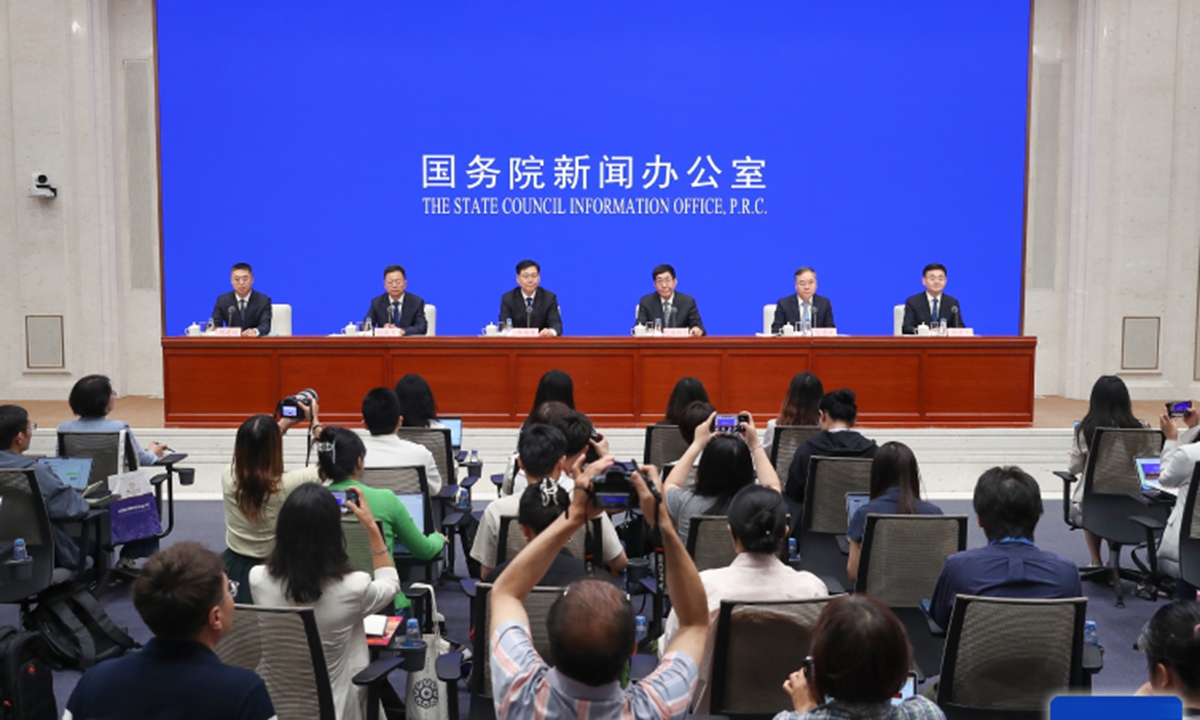
The State Council Information Office holds a press conference to brief on the Ethnic Unity and Progress Promotion Law on June 24, 2026. Photo: The State Council Information Office
In response to statements issued by some overseas organizations claiming that the Ethnic Unity and Progress Promotion Law is intended to "assimilate ethnic minorities" and calling for sanctions against China over human rights, a senior Chinese official from the country's top legislature, on Wednesday called on people to visit the country's ethnic regions and see for themselves, as facts speak louder than prejudice and fabrication.
The enactment of the law reflects the common aspirations of people of all ethnic groups in China. Since the beginning of the new era, NPC deputies have submitted more than 700 motions and proposals calling for the formulation of such a law. This demonstrates the strong demand among NPC deputies for this legislation, Bayanqolu, member of the Standing Committee of the National People's Congress (NPC) and chairman of the NPC ethnic affairs committee, said at a press conference.
The State Council Information Office (SCIO) held a press conference on Wednesday regarding the Ethnic Unity and Progress Promotion Law and China's work on ethnic affairs.
Since being passed, the law has received broad recognition and firm support from people of all ethnic groups across the country. It has also been positively evaluated by many international friends, media outlets, and institutions. They believe that the law is consistent with China's national conditions, modern governance principles, and global trends in state governance, and provides a valuable reference for multiethnic countries seeking solutions to ethnic issues, the senior official said.
However, some Western institutions and overseas forces continue to smear China's human rights situation under the guise of ethnic issues, spreading falsehoods that reflect ignorance and prejudice toward China, Bayanqolu said.
The so-called statements issued by these organizations disregard the tremendous achievements made in China's ethnic regions and ethnic affairs, make unwarranted accusations against China's ethnic policies and rule-of-law development, and constitute blatant interference in China's internal affairs. We express our strong dissatisfaction and firm opposition, he noted.
He further elaborated several examples that demonstrated the Communist Party of China has consistently attached great importance to resolving ethnic issues and advancing ethnic affairs and China has successfully forged a path with Chinese characteristics for addressing ethnic issues.
First, in terms of economic development. As mentioned earlier, remarkable achievements have been made in ethnic regions and ethnic affairs. All 31.21 million impoverished people in 420 impoverished counties in ethnic autonomous areas, five autonomous regions and in Southwest China's Guizhou, Yunnan, and Northwest China's Qinghai provinces, were lifted out of poverty on schedule. Ethnic minorities and ethnic regions joined the rest of the country in building a moderately prosperous society in all respects. In the fight against poverty and the realization of a moderately prosperous society, not a single ethnic group was left behind, and not a single person was left behind. As China advances Chinese modernization today, the same principle applies: no ethnic group and no individual can be left behind.
What other country or political party has achieved such results? The official asked.
As everyone can see, basic public services and infrastructure in ethnic regions - including education, healthcare, transportation, water and electricity supply - have been significantly improved. Even in the most remote and border areas, information networks are now available. These achievements are visible to all. The Chinese government, including local officials, has introduced them on many occasions, including during the annual sessions of the NPC and the Chinese People's Political Consultative Conference. We encourage people to visit and see for themselves, because facts speak louder than prejudice and fabrication. What is the point of fabricating stories and hyping issues based on prejudice? These achievements form the very foundation for achieving equality and shared development among all ethnic groups. Can't they really see these accomplishments? Bayanqolu asked.
He also cited examples in terms of cultural preservation. China has invested substantial resources in protecting cultural heritage sites such as the Potala Palace, Jokhang Temple, and Norbulingka. Ancient works on the verge of being lost, including Wisdom of Royal Glory (Kutadgu Bilig) and the Compendium of Turkic Dialects, have been translated, compiled, and published in Chinese and Uyghur. More than 3,000 precious cultural relics have been rescued and restored, Bayanqolu said.
Among the 45 Chinese entries inscribed on UNESCO's Representative List of the Intangible Cultural Heritage of Humanity, more than one-third are related to ethnic minority cultures.
Both history and present reality fully demonstrate that the path with Chinese characteristics for addressing ethnic issues is entirely correct, the official said.
The law responds to the historical trend of the Chinese nation moving from the past toward the future, from tradition toward modernity, and from diversity toward unity. Its purpose is to promote ethnic unity and progress, he noted.
The law fully implements the principles and spirit of the Constitution, focuses on fostering a strong sense of community for the Chinese nation, incorporates mechanisms and measures that meet the needs of the new era, clarifies the overall framework and key tasks of ethnic unity and progress, and establishes a comprehensive, clearly defined, and efficient institutional system for safeguarding equality, unity, and progress among all ethnic groups, he continued.
It can be said that this law is a legal codification of the successful practical experience accumulated through China's path of addressing ethnic issues with Chinese characteristics, Bayanqolu said.
China's efforts to promote ethnic unity and progress through the rule of law not only benefit its own people, but also provide Chinese wisdom and Chinese solutions for countries around the world in dealing with ethnic issues, the official said.
RELATED ARTICLES