US commerce secretary reportedly signals possible action on Chinese robots after review; move reflects another push to politicize trade, build barriers: expert
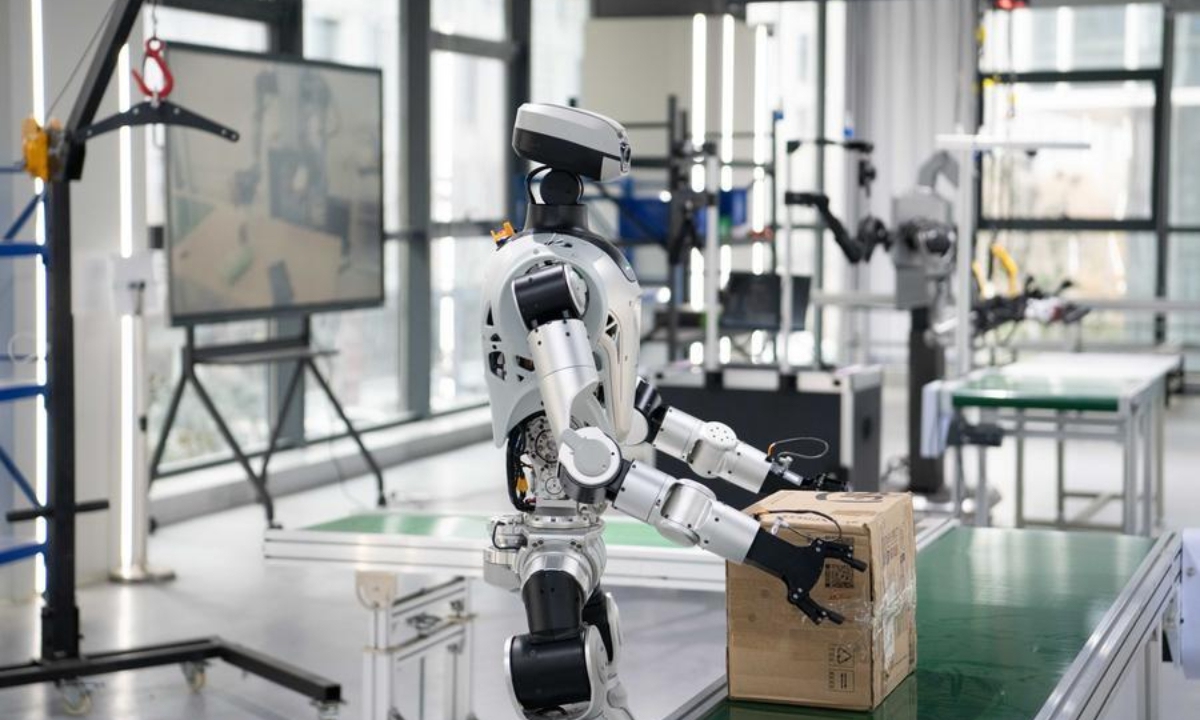
A humanoid robot conducts box-carrying training at a data collection pre-training center for humanoid robots in Hefei, east China's Anhui Province, Dec. 4, 2025. (Xinhua/Zhang Duan)
US Commerce Secretary Howard Lutnick told executives at a closed-door meeting on Monday that his department is studying so-called "Chinese state-subsidized" robotics imports and signaled that the US administration could take action once the review is complete, Politico reported on Tuesday (US time), citing anonymous sources.
A Chinese expert said on Wednesday that the move again reflects the US' tendency to politicize economic and trade issues by framing them through a so-called "national security" lens, and using this narrative to justify trade barriers. Chinese robotics products gained global popularity because of their competitiveness, rather than so-called subsidies, the expert noted.
The Politico report noted that Chinese-made robots already face US tariffs, but several attendees said that the US commerce secretary's comments suggest the US administration was considering additional action.
"We don't want state-subsidized robotics attacking us in America, this is the arms [race] that is coming — robotic arms are coming," Lutnick claimed, according to notes from the meeting provided to POLITICO. "We need to make sure they're produced in America so we're going to study those right now."
Such claims reflect the US' growing tendency to politicize economic and trade issues by framing them through an overstretched concept of national security, and then use this narrative to justify more trade barriers, Xiang Ligang, director-general of the Zhongguancun Modern Information Consumer Application Industry Technology Alliance, told the Global Times on Wednesday.
Xiang said that robotics products reflect global innovation and highly interconnected manufacturing cooperation. Treating normal industrial policy and market-driven competition as "state subsidies" oversimplifies how global supply chains actually operate and risks overstretching the concept of national security to undermine technological progress and industrial upgrading.
A Morgan Stanley report has suggested that the number of robots that resemble and act like humans is likely to reach nearly 1 billion by 2050, with China currently leading in development. China is dominating the field of artificial intelligence-enabled robotics, humanoids or otherwise, and the gap with the US is widening, said the report.
China's advanced robotics industry is rising rapidly, driven by the strong innovation capabilities of Chinese companies, a complete supply chain, and supportive government policies, rather than so-called "state subsidies," Xiang said, adding that the sector is also benefiting from expanding real-world applications and accelerating commercialization.
In areas such as robotics, mobile phones, telecommunications equipment and automobiles, whenever China develops highly competitive and potentially disruptive products, the US tends to adopt various measures to keep them out of its market, the industry analyst said.
However, such a politically driven approach will ultimately harm US businesses and consumers, Xiang said, pointing to the US' restrictions on cooperation in the telecommunications sector, which has contributed to limited coverage in some US areas and significantly higher costs for consumers.
China is the world's largest user and manufacturer of industrial robots, with Vietnam, Mexico and Thailand emerging as the fastest-growing destinations for Chinese exports in the sector, the People's Daily reported.
In Vietnam, a key hub for the global shift of electronics manufacturing, Chinese industrial robots have been widely used on assembly lines for products such as smartphones and computers. In Mexico, an important extension of North America's auto manufacturing network, Chinese robots are playing a major role in processes including body welding, painting and assembly. In Thailand, Chinese industrial robots are being introduced on a large scale in auto parts processing and home appliance manufacturing, helping drive the automation upgrading of the local industry.
China has surged ahead in manufacturing automation and is now spearheading growth in the global robotics industry, said Takayuki Ito, president of the International Federation of Robotics, highlighting the country's unprecedented pace in expanding its industrial robot fleet and modernizing factories, the Xinhua News Agency reported.
China will continue to drive growth in the robotics sector, Ito told Xinhua in an interview in October, noting that the country's progress is not just about numbers but is transforming factories into hubs of global innovation.
RELATED ARTICLES