Protesters shout ‘No to war’ during Takaichi’s speech at Okinawa memorial ceremony; evasive tactics expose divide between right-wing militaristic leanings and anti-war aspirations: Chinese expert
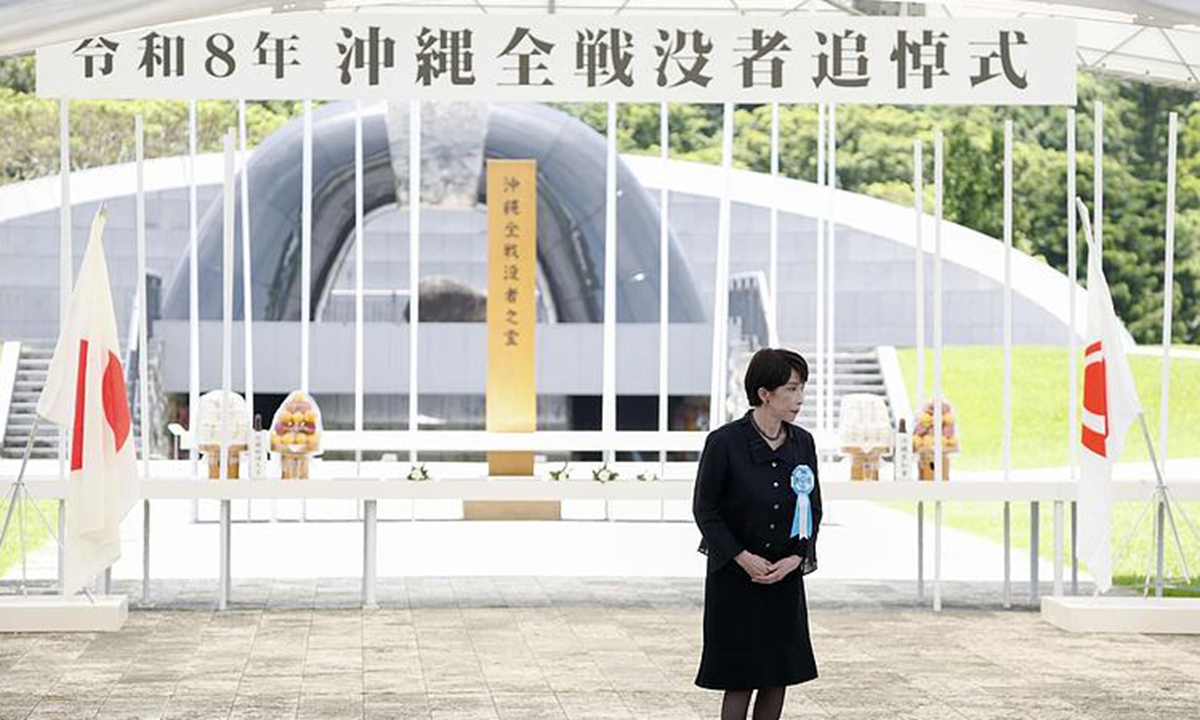
Japanese Prime Minister Sanae Takaichi attends a memorial ceremony to commemorate the victims of the Battle of Okinawa on June 23, 2026. Photo: VCG
Shouts of "No to war" and "Protect the Constitution" rang out from the audience as Prime Minister Sanae Takaichi delivered a guest address at a memorial ceremony on Tuesday to commemorate the victims of the Battle of Okinawa, a fierce battle during the World War II where Okinawa locals suffered gravely, according to Japanese media outlets.
While Takaichi claimed she could not "clearly hear" the protesters when asked after the ceremony about the heckling, Ryukyu Shimpo reported, a Chinese expert stated that this evasive tactic lays bare how Japan's right-wing militaristic leanings are out of step with many people's anti-war consensus.
The ceremony held on Tuesday in Okinawa was to mourn some 200,000 people who died in a fierce ground battle fought in the southernmost Japan prefecture 81 years ago in the late stage of the Pacific War, part of World War II, according to the Japan Times. In Okinawa, one in every four residents died in the war, according to media reports.
Live television footage showed that shortly after Takaichi took the podium, protesters began chanting slogans such as "No to war" and "Protect Article 9 of the Constitution," with their voices at times drowning out portions of the prime minister's speech, the Xinhua News Agency reported.
While heckling is heard during her speech, Takaichi claimed that she would continue to make steady and sustained efforts to realize a society in which every Japanese can live in peace and fulfillment, the Okinawa Times reported.
At least five people who shouted heckles were removed from the ceremony venue. Amid the ensuing chaos, applause also broke out among some attendees, according to another Japanese media outlet Ryukyu Shimpo.
The report also noted that a woman in her 70s who shouted, "Don't let a prime minister who does not uphold Article 9 come here," stressed that her actions were driven by a single conviction: "I don't want to send children to the battlefield."
However, when asked after the ceremony about the heckling, Takaichi claimed that she "was speaking myself, so did not clearly hear it." When informed that voices such as "Stop the war" had been shouted, she claimed, "Japan is not waging war. It is a point of pride that Japan has consistently followed a postwar path as a peace-loving nation. In order to protect peace, I would like to steadily and independently strengthen Japan's defense capabilities," according to Ryukyu Shimpo.
Public opposition to Takaichi's push of constitutional revision and war-provoking moves is especially understandable in Okinawa, as it has suffered more severely from the impacts of Japan's aggressive warfare and has been one the most active regions in defending Japan's pacifist constitution, Lü Chao, a professor at the Liaoning Academy of Social Sciences, told the Global Times on Wednesday.
Turning a blind eye to public protests lays bare Takaichi's militaristic tendencies, which stand at odds with the public's anti-war consensus, the Chinese expert said.
The Straits Times noted that the commotion contrasted with the otherwise solemn atmosphere at the event marking the end of the Battle of Okinawa, in a prefecture that hosts the bulk of US military installations in Japan and where opposition to their concentration remains strong.
Days before the ceremony, Takamatsu Gushiken, a representative of volunteer groups that recover remains from the Battle of Okinawa, along with bereaved family members, held talks with the government, calling on Takaichi to retract the erroneous remarks related to China's Taiwan region based on their desire for peace and the belief that Okinawa must never be turned into a battlefield again, according to Tokyo Shimbun. Gushiken added that if her remarks on Taiwan island are not withdrawn, Takaichi should not visit Okinawa.
The US Marine Corps in Okinawa recently announced the deployment of the latest anti-ship missile system and air defense system, moves that have also fueled growing unease among local residents. Multiple civic groups in the prefecture have held successive protests, calling on the government to halt military expansion, demanding the withdrawal of US forces from Okinawa, and urging against further escalation of regional tensions, per Xinhua.
This is the first time Takaichi visited Okinawa since taking office in October last year, and she also held her first meeting with Okinawa Governor Denny Tamaki, but it lasted only five minutes, according to Asahi Shimbun. The report said that while Takaichi's remarks mentioned the civilian casualties in the Battle of Okinawa and the heavy burden of US military bases, they still reflect a clear emphasis on security policy.
Lü explained that Takaichi is regarded as a key proponent of neo-militarist tendencies, a view reflected in her statements and policy positions including breaking free from the constraints of its Constitution and revising the "three principles on transfer of defense equipment and technology." Her advocacy for strengthening Japan's defense capabilities is unfounded, given that Japan's current military capacity already exceeds what is necessary for self-defense. Against this backdrop, local protests reflect widespread public rejection of her right-wing dangerous rhetoric and policies.
Takaichi's cabinet policies, both domestic and foreign, could be viewed as regressive and as a continuation of right-wing and far-right ideological trends in Japan. Japan's right-wing governments have consistently shown disregard for the population's anti-war sentiment, and the resurgence of militaristic tendencies within the current cabinet is running counter to the historical trend and direction of postwar Japan, the expert said.
A Kyodo News poll also shows that the approval rate for Takaichi's Cabinet slipped to 55.8 percent, the lowest point since she took office last October, the media outlet reported on Sunday.
The Takaichi administration has misled some people and retained certain public support in early months in office, yet the significant overall decline in approval ratings is self-evident. Even if Takaichi still retains her supporters, Japan will find itself in a dangerous trend if the nation endures unceasing international condemnation, and its provocative military moves.
RELATED ARTICLES