Media reports Bangladesh plans to buy 24 Chinese J-10CE jets; expert says foreign attention reflects recognition of China's defense industry
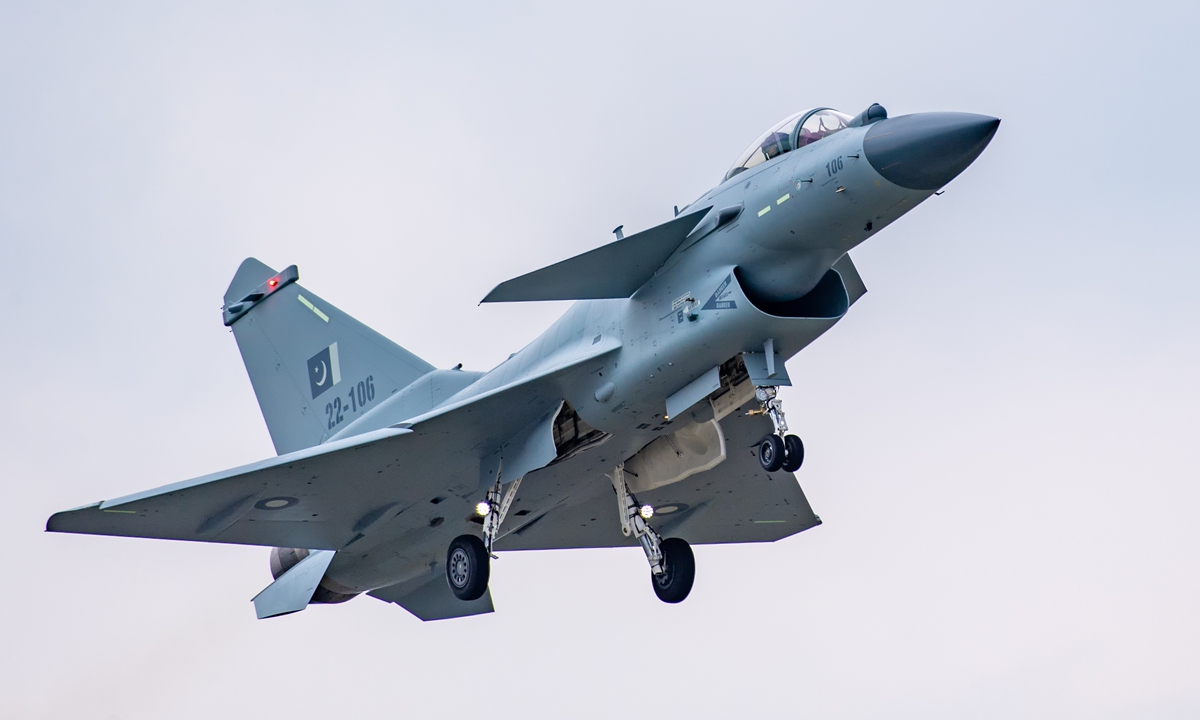
A J-10CE fighter jet conducts test flight and hosts training for its pilot shortly before it is delivered to the Pakistan Air Force on March 11, 2022. Photo: Courtesy of the Aviation Industry Corporation of China
Some foreign media outlets have reported since Monday that Bangladesh is planning to buy up to 24 Chinese J-10CE fighter jets, though China has yet to confirm the news. A military affairs expert told the Global Times that Bangladesh has a long history of defense ties with China. Although the reports have not been independently verified, the attention from foreign media reflects that China's technological progress and the quality of its military industry are gaining growing international recognition, expert said.
According to Daily Waadaa, a Dhaka-based English-language news platform, cited by The Times of India on Tuesday and ANI on Monday, Bangladesh is expected to advance plans to acquire 24 Chinese J-10CE multi-role fighter jets during Bangladeshi Prime Minister Tarique Rahman's visit to China from June 24 to 26, as Dhaka and Beijing prepare to deepen cooperation across defense, infrastructure, trade and investment.
"We hope to sign the fighter jet purchase agreement by August this year," a senior government official on condition of anonymity was quoted by the Daily Waadaa as saying.
The defense discussions form part of a broader agenda that Bangladeshi officials say could significantly elevate Bangladesh-China relations, according to the Daily Waadaa.
If concluded, this would be the second such deal for China's flagship fourth-generation fighter aircraft, claimed the Times of India on Tuesday. Currently, only the Pakistani Air Force uses this fighter outside China, it said.
China has not released any relevant information so far.
It is not the first time foreign media outlets have shown interest in this topic. In October 2025, Pakistani media outlet The Business Standard reported that, according to official documents reviewed by them, the Bangladeshi government is preparing to buy 20 Chinese-made J-10CE multirole fighter jets at an estimated cost of $2.20 billion by 2027 to modernize the Bangladesh Air Force and strengthen national air defense.
The proposed deal includes procurement, training, maintenance, and other associated expenses. It is expected to be executed during Fiscal Year 2026 and Fiscal Year 2027, either through a direct purchase or a government-to-government arrangement. Payments would reportedly be spread over 10 fiscal years, up to Fiscal Year 2035-36, said The Business Standard.
Bangladesh has a long-standing defense cooperation relationship with China, having previously procured Chinese-made fighter jets such as the J-7 fighter aircraft and Q-5 attacker. However, later models like the JF-17 and J-10 were not introduced, Wang Ya'nan, editor-in-chief of Beijing-based Aerospace Knowledge magazine, told the Global Times on Wednesday.
At present, the Bangladesh Air Force's equipment is relatively outdated, facing an urgent need to upgrade its main combat aircraft fleet, Wang said.
The expert said that given its historical experience with Chinese equipment, Bangladesh has a certain level of trust in Chinese platforms. However, whether a procurement deal will ultimately be reached remains uncertain.
On the one hand, the sources of the reports still need to be corroborated through multiple channels. On the other hand, Wang supposed that 24 J-10CE fighters would represent a significant expenditure for Bangladesh's defense budget.
All in all, Wang said that foreign media outlets' attention on this matter reflected that China's technological progress and the quality of its military industry are gaining growing recognition.
Since 2025, many countries have moved beyond the past practice of evaluating Chinese equipment based solely on "paper specifications" or outward appearances, and have developed greater confidence in its actual performance. The world appears to have widely acknowledged the manufacturing standards of China's defense industry, and the international recognition of Chinese equipment continues to rise, Wang added.
RELATED ARTICLES