Chinese new-energy buses make up 95% of Mexico City’s World Cup shuttle fleet aiding local mobility, environment
By Yin Yeping and Published: Jun 24, 2026 08:56 PM

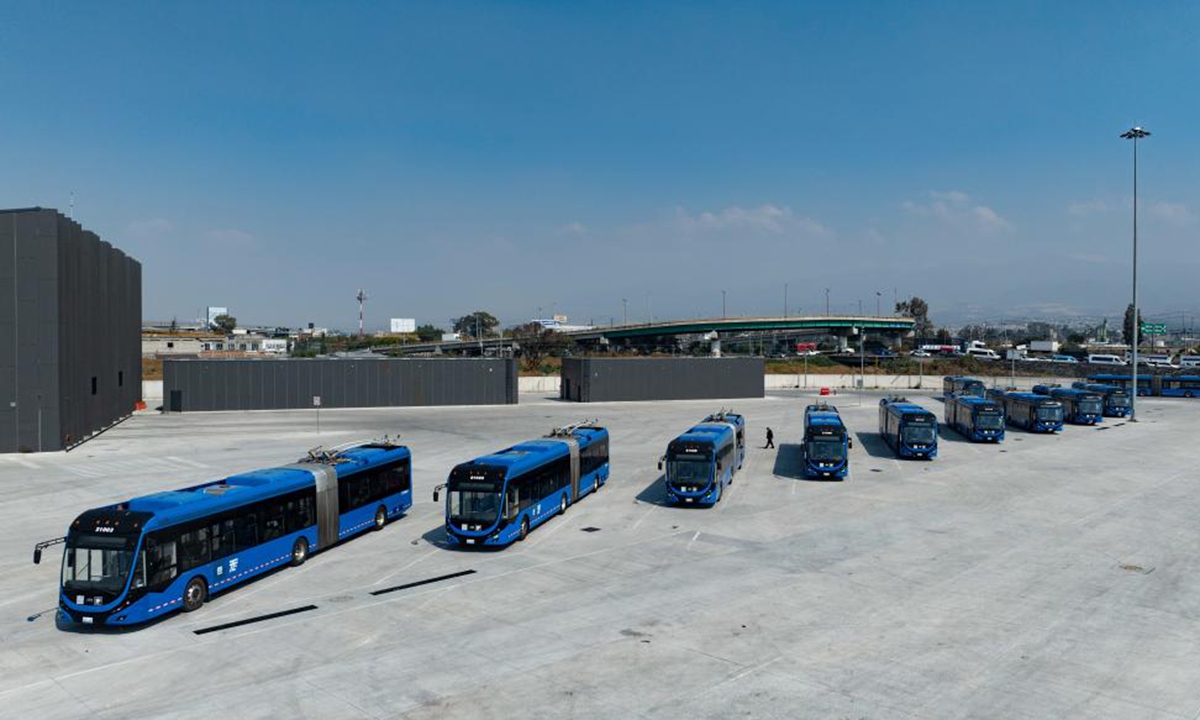
A drone photo of the Chinese new-energy buses at an elevated trolleybus terminal near Mexico City, capital of Mexico Photo: Xinhua News Agency reporter Li Mengxin
As cheers echo through the streets of Mexico City and crowds pour into stadiums, the World Cup is ongoing in one of the world's most densely populated cities. With the tournament pressures the city's public transport network, China-made new-energy buses have taken on the role of the main shuttle fleet, putting their performance and service support to a world-class test.
Lined up across the city, the official World Cup shuttle buses are hard to miss. Around 95 percent of them are Chinese brands, offering a snapshot of the growing appeal of Chinese-made vehicles in the global market, the Xinhua News Agency reported.
As global demand for green transition and high-quality mobility continues to rise, Chinese automakers are gaining growing international recognition. They are improving local transport efficiency, protect local environment, while also supporting job creation and economic growth.
China has become the world's largest exporter of new-energy vehicles. As of May 2026, China's cumulative exports of new-energy vehicles this year reached 1.833 million units, up 1.1 times year on year. This echoes the world's growing urgency for ecological and environmental protection, Xinhua reported.
Power a 'greener World Cup'
China's Yutong Bus has been deeply established in Mexico for many years, with more than 1,500 vehicles now in operation. In Mexico City alone, the total exceeds 700 units, featuring dual-mode trolleybuses and high-capacity new-energy buses, according to the information the company provided to the Global Times.
Among them, the 26-meter-long vehicle model was specially developed for Mexico City's high population density and heavy passenger demand.
In Mexico City, Yutong holds a 60-70 percent share of the pure electric bus market, making it the leading brand locally. In the fields of dual-mode trolleybuses and pure electric buses, Yutong represents one of the most advanced technological levels in the industry.
Martin Lopez Delgado, general manager of STECDMX, a government agency responsible for operating electric public transport systems in Mexico City, said that during the World Cup contests, the electric transport service and mobility system of the city willimplement six services from different parts of the city, so that people can travel in a fast, safe, and comfortable way.
Yutong vehicles offer a range of at least 75 kilometers. "The vehicles we have purchased have demonstrated very high quality and are very efficient," said Delgado, noting that they currently have 14 trolleybus lines, which can transport around 500,000 passengers on a business day.
"We have all types of vehicles, from electric vehicles to internal combustion vehicles, and we also have hybrid vehicles, adapted to any type of climate depending on the study conducted in each region," said Brayan Flores, after-sales engineer, Yutong Mexico.
"We have completely electronic mirrors, perfectly adapted for Mexico City. Yutong vehicles have full accessibility for all types of users or passengers. For this specific charger of 180 kWh, a re-charge takes about two and a half hours," Flores said.
In addition to Yutong, Zhongtong Bus has also left a mark of Chinese manufacturing in Mexico.
On March 9, 2026, ahead of the World Cup, a batch of Zhongtong N12 dual-source trolleybuses set off for Mexico. This follows the first batch of vehicles, which began operation in 2021 and gained recognition in the local market, leading Mexico to again choose Zhongtong brand.
The new vehicles will continue to operate in Mexico City and help upgrade local green mobility.
From cooperation to integration
Chinese automakers are now doing more than exporting auto vehicles. They are increasingly integrating into local economies through intertwining with the local industrial supply chain.
With safer, more efficient, environmentally friendly and intelligent solutions, they are improving mobility, supporting job creation, and contributing to economic growth, which has helped win more local users, Sun Xiaohong, secretary-general of the automotive branch of the China Chamber of Commerce for Import and Export of Machinery and Electronic Products, told the Global Times on Wednesday.
In other words, China's automotive industry, an important force in global manufacturing, has proved to be a key driver in reshaping the future landscape of global automotive cooperation, said Sun.
Located in southeastern Brazil's São Paulo state, São José dos Campos is a mid-sized city of around 730,000 people and an important industrial hub known for its aircraft manufacturing and new technology research and development.
A local survey conducted in Brazil shows that buses are the most widely used means of public transport there. About half of respondents said they take buses every day. At the same time, buses are also the most frequently complained-about mode of transport. The main issues include a lack of safety features, overcrowding, insufficient fleet capacity, and frequent running latency
Improving public transport has become a priority. In recent years, the Brazilian government has increased investment in the public transport sector and has also turned its attention to China.
BYD, a Chinese automaker with a manufacturing base in Brazil and close partnerships with local suppliers, ultimately won the bidding process.
Under the framework of the Belt and Road Initiative, Chinese companies have cooperated with Brazil's public transport system to develop the country's first fully electric Bus Rapid Transit (BRT) system, the "Green Line," helping São José dos Campos achieve a green transformation.
The "Green Line" is also Brazil's first fully electric BRT system. It has been in operation since the end of 2021. The entire line has 13 stops and a total length of 14.5 kilometers.
Valdir, a local passenger, is an enthusiastic supporter of the "Green Line" operated by electric buses. He described the experience of riding them as "absolutely amazing."
The experience of taking a conventional bus and the "Green Line" is completely different, said Valdir.
For example, when the bus passes over a pothole, passengers on a regular bus can clearly feel the bump and vibration, while passengers on the "Green Line" electric bus hardly feel anything at all, Valdir said.
This is just one example of the Chinese automaker's localization efforts in Brazil.
Since entering the Brazilian market in 2015, BYD's electric buses have gained strong traction thanks to their leading technology and deep local integration. The company has accumulated nearly 1,000 bus orders in the country.
More than 200 of these buses are now running on the streets in many Brazilian cities. With a 16 percent market share, BYD ranks first among imported electric-bus brands in Brazil.
Meanwhile, as of 2025, BYD put more than 5,000 pure electric buses into operation across Europe. These vehicles are operating in 26 countries and over 160 cities.
The growing popularity of China's new-energy buses overseas is largely driven by their localized deployment strategies to better serve local markets.
Take Zhongtong as an example. As early as 2015, Zhongtong obtained EU's WVTA operation approval. It is also the first Chinese electric vehicle brand to obtain WVTA certification in 2023.
At present, Zhongtong new-energy buses have entered Portugal, Singapore, Dubai, Chile, Germany, and Bulgaria and more markets.
In Singapore, Zhongtong has optimized its vehicles' air conditioning, and turning radius to meet local operational needs to adapt to high temperature, high humidity, and narrow roads.
In the Middle East, the company has strengthened the protective structure of vehicle underbodies to address challenges to be caused by strong sandstorms and complex road conditions.
"The overseas expansion of China's new-energy buses is no longer limited to exporting vehicles. Instead, backed by their technology edge and strong services, Chinese companies are now deeply involved in the green transformation of local public transport systems and infrastructure upgrading," Sun said.
"As the global shift toward green development accelerates, Chinese automakers are providing safer, more efficient, and more environmentally friendly public transport solutions that improve mobility while contributing Chinese solutions to the global effort to win a sustainable future," Sun added.
Cheers echoing through the streets of Mexico City during the World Cup will soon fade as the tournament concludes in mid-July, but the development of the region's transportation network will continue to advance. So too will the story of Chinese new-energy buses in Mexico and beyond.
RELATED ARTICLES