Wuhan-developed non-invasive BCI platform helps brain tumor patient regain walking ability after surgery
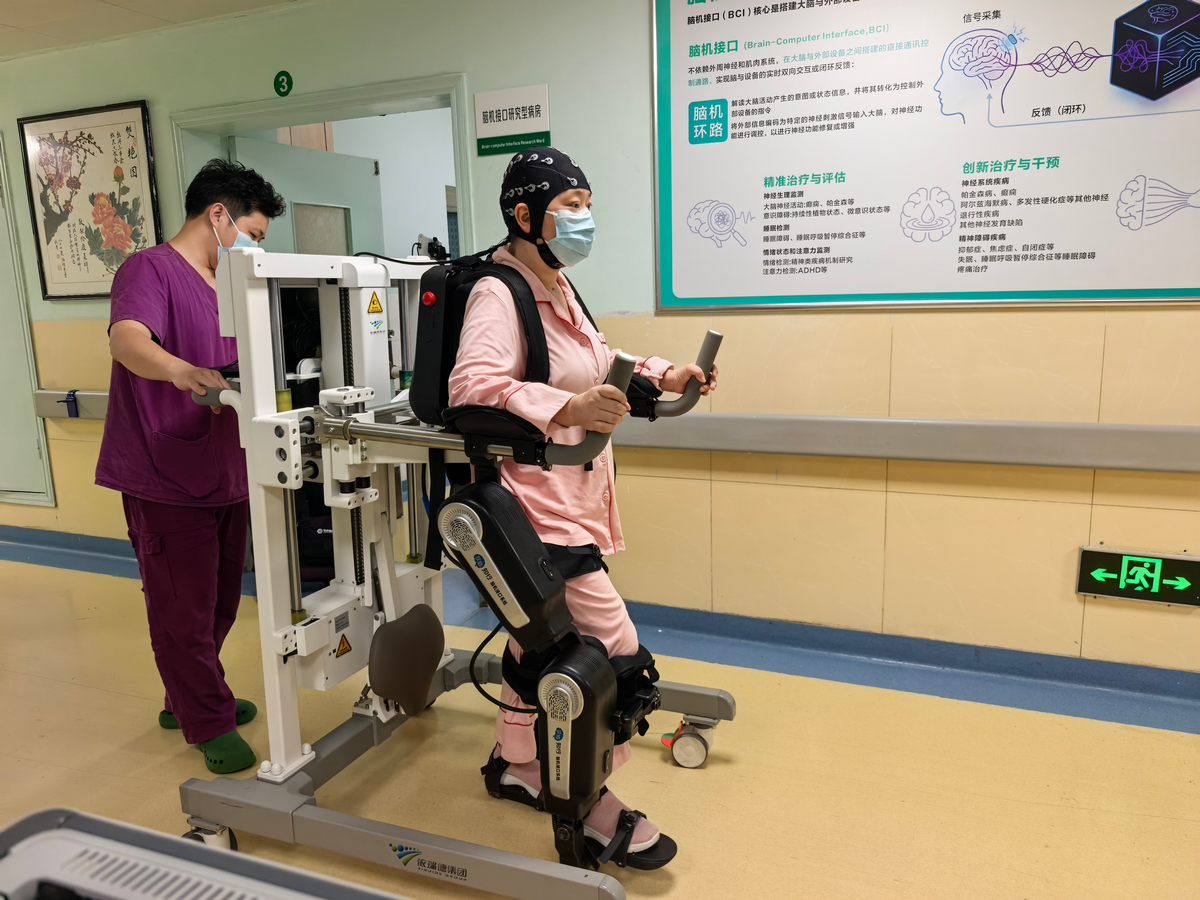
Photo: Courtesy of Wuhan Yiruide Medical Equipment New Technology Co
A 36-year-old woman in China who developed left-side flaccid paralysis after meningioma surgery has regained the ability to walk independently and climb stairs without assistance after less than one month of rehabilitation using a Wuhan-developed non-invasive brain-computer interface (BCI) system, local media outlets reported.
The patient, surnamed Hu, received treatment at the department of neurological rehabilitation of Zhongnan Hospital of Wuhan University in Wuhan, Central China's Hubei Province. Wearing an electroencephalogram (EEG) cap, she trained by imagining movements such as lifting her legs and stepping forward. Her brain signals were then used to trigger an exoskeleton robot that assisted her lower limbs in walking, according to a post on the Optics Valley of China, WeChat account of the administrative committee of the Wuhan East Lake High-tech Development Zone, and reports by the Wuhan-based Changjiang Daily.
This marks the first reported case in China of a brain tumor patient regaining walking ability through non-invasive BCI rehabilitation.
The non-invasive BCI platform, named HanBRAIN ZhiXing, was independently developed by Wuhan Yiruide Medical Equipment New Technology Co. The company told the Global Times on Wednesday that the system overcame a major efficiency bottleneck that had long limited full-scalp wet-electrode BCI systems from moving from the laboratory into clinical use.
"We collect EEG signals through an EEG cap and transmit them to a decoding program via an amplifier," the company said. "The system then can identify the patient's intention with an accuracy rate of up to 97 percent. We then set a threshold, for example 70 percent. Once the imagined movement signal remains above that level, the exoskeleton robot is activated to guide the patient's legs through the correct walking pattern."
At the core of the technology is motor intention decoding, said the company. By integrating EEG and intelligent intention decoding, interactive rehabilitation training and adaptive closed-loop feedback, HanBRAIN ZhiXing connects neural assessment with clinical intervention in a unified workflow.
The system helps clinicians identify individual brain-function patterns, guide patients through task-oriented neurorehabilitation, and support the restoration of motor and cognitive-motor functions.
"This system builds a signal bridge between the brain and the peripheral nerves," said Zhang Xin, head of the department of neurological rehabilitation at Zhongnan Hospital. "It turns patients from passive recipients of rehabilitation into initiators. They can sense in real time how the brain and muscles work together and see their strength gradually return," the Changjiang Daily reported.
Compared with traditional rehabilitation, Zhang said, recovery time has been cut by more than half.
The company said that the system was initially introduced clinically at Zhongnan Hospital in May. Since then, nearly 10 patients have undergone treatment there, mainly those with hemiplegia, spinal cord injuries and postoperative neurological dysfunction.
In recent years, BCI technology has offered new hope to patients with neurological disorders. For example, in May, BCI technology helped a paralyzed patient in Nanchang, East China's Jiangxi Province, pick up a paintbrush again. In Southwest China's Chongqing Municipality, BCI technology enabled a patient's thoughts to be translated into visible muscle movement, helping restore movement in his once immobile leg.
According to the Xinhua News Agency, BCI products developed in China have been applied in areas such as disease diagnosis, motor rehabilitation, and neuromodulation treatment for conditions including Parkinson's disease and epilepsy.
As a frontier technology in human-computer interaction, BCI has been driving a new wave of technological and industrial transformation. China has introduced a series of policies to strengthen BCI research and industrial deployment. The BCI sector has been designated as a future industry in this year's Government Work Report, according to Xinhua.
The BCI industry has also been listed as one of the future industries China plans to cultivate during the 15th Five-Year Plan (2026-30) period, reflecting growing national interest in next-generation neurotechnology.
RELATED ARTICLES