ARTS / CULTURE & LEISURE
Why young Chinese have fallen for the ‘hands-behind-back opossum’
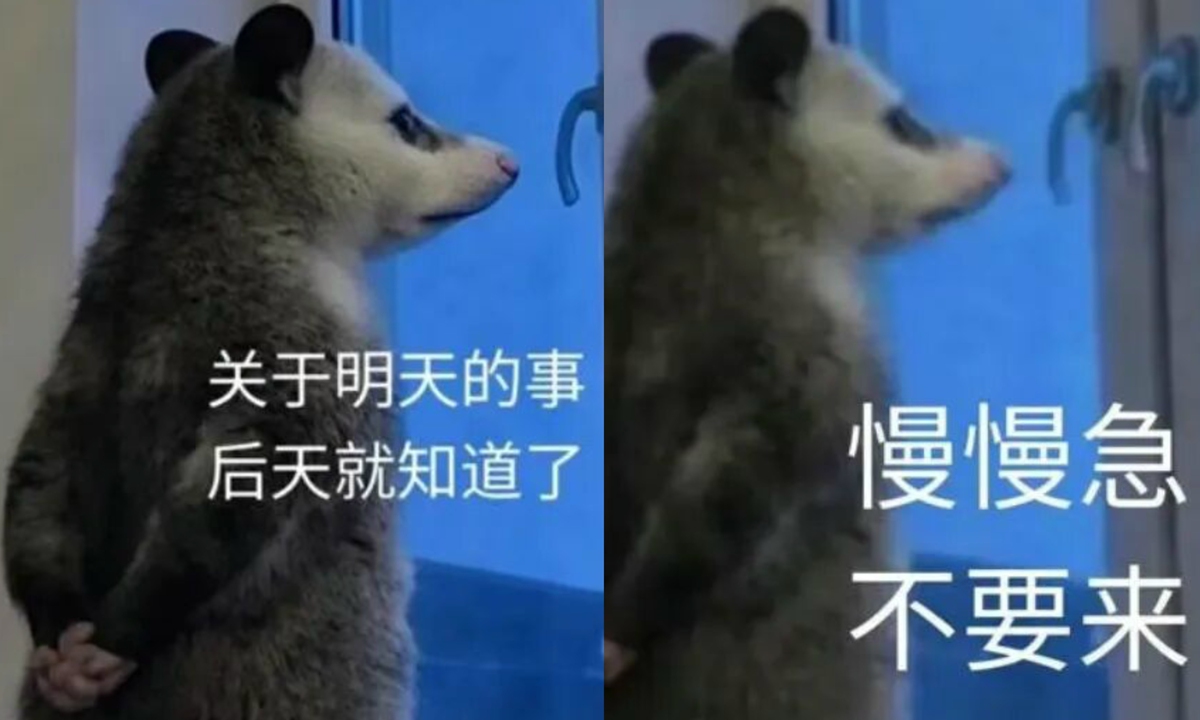
Opossum memes Photos: Screenshots from internet
A new internet favorite has recently captured the hearts of many Chinese social media users: an opossum standing by a window, tiny paws clasped behind its back, gazing quietly into the distance.
The image itself is simple, but paired with captions such as "We'll know about tomorrow's problems the day after tomorrow," "Take your time rushing," or "Things finally have taken a new step backward," it has become one of the most widely shared memes among young citizens.
Many have embraced it as an unlikely spokesperson for everyday life. At first glance, the animal appears calm and composed. Look closer, however, and its blank expression takes on a strangely relatable quality - one that feels instantly familiar to many.
The meme's rising popularity offers a glimpse into how young people today turn to humor as a way of expressing the ordinary moods and fleeting moments of daily life.
Like young people everywhere, many young Chinese are juggling work, relationships and personal plans. Meanwhile, life does not always go as planned, and social media has become the go-to space where such moments are turned into jokes, captions and memes.
Rather than stating feelings directly, many internet users choose humor. The captions attached to the opossum rarely sound like complaints. Instead, they turn ordinary situations into lighthearted self-mockery. By imagining the animal's inner thoughts, users are often simply sharing how they see their own day-to-day experiences.
This is hardly a new phenomenon. Over the past several years, Chinese social media has repeatedly turned to animal figures that embody different emotional states. The popularity of the capybara, for example, rose to prominence as a symbol of calmness and emotional detachment -- admired for its seemingly unshakable composure, it became an icon of staying unfazed amid the chaos of modern life.The opossum, however, feels slightly different.
Unlike the capybara's almost mythical calm, the opossum appears less polished and more ordinary. It looks quiet still, yet attentive to its surroundings. There is a sense of pause in its posture, but also a readiness to move on.
That contrast may help explain its appeal. Rather than choosing between extremes, the meme moves beyond the idea of a choice between relentless striving and complete withdrawal. Instead, it suggests a middle path: acknowledging pressure and carrying on.
In that sense, the opossum reflects a kind of resilience - one that comes through humor and shared understanding. Young people are not avoiding reality; they are turning daily moments into something easier to talk about and share.
Lin Xiao, a Beijing-based office worker, told the Global Times that the opossum has become one of her most frequently used stickers in daily chats. She has saved dozens of versions with different captions and uses them to react to all kinds of everyday situations.
"The image seems to work with almost any caption," she said. "It's funny, lighthearted and somehow always fits the moment."
For Lin, the appeal lies in how easily it connects people. "When I send it to friends, they immediately get it," she said. "It just feels like something we all understand."
The popularity of the "hands-behind-back opossum" also reflects how internet culture creates shared references. From the AI-generated "snow mountain fox" short videos that went viral earlier this year to the opossum meme circulating now, these online creations highlight the creativity of young internet users and their ability to capture everyday experiences through humor. With just one image and a few words, people can express something others immediately understand.
In an increasingly fast-moving world, that moment of quiet recognition may be part of the source of the meme's lasting appeal. The opossum may not speak, but for many young people, it says everything.
The author is a reporter with the Global Times. life@globaltimes.com.cn
RELATED ARTICLES