African countries zoom into CISCE to explore cooperation opportunity
Zero-tariff treatment promotes trade, investment in Africa: exhibitors
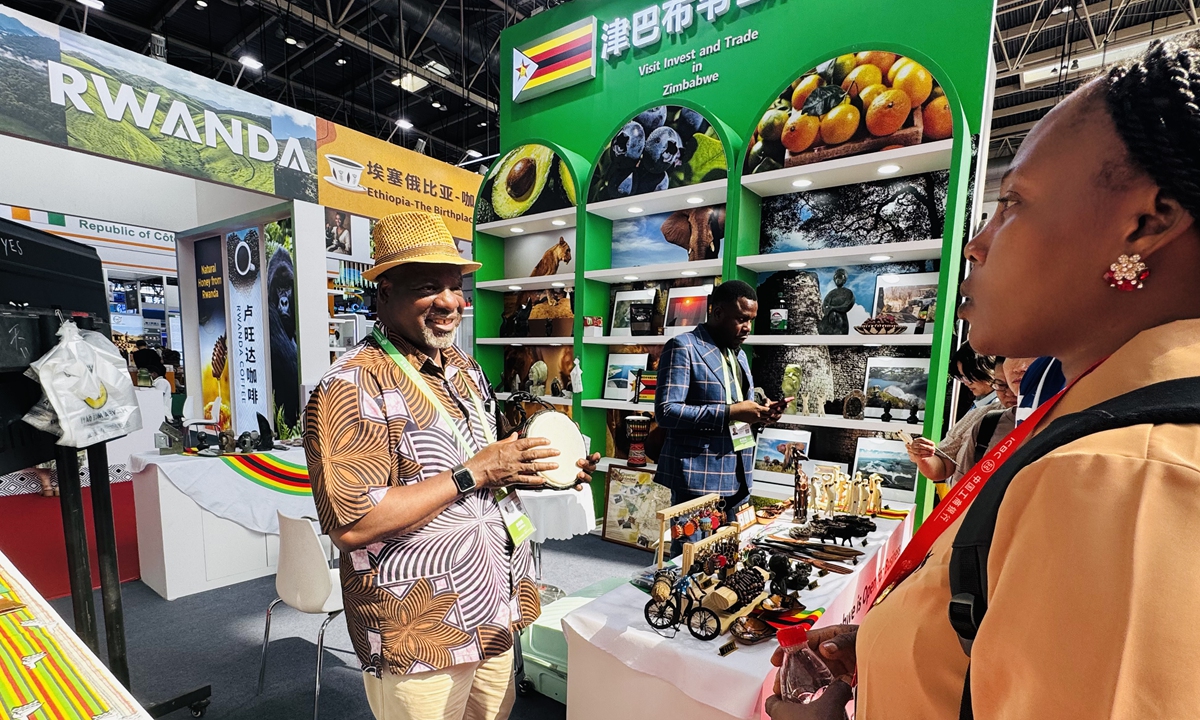
Merchants from Zimbabwe showcase their products at the 4th China International Supply Chain Expo. Photo: Liu Yang/GT
Coffee beans, ceramics, leather goods, handmade artworks... Stepping into the African countries' booths at the 4th China International Supply Chain Expo (CISCE), visitors are greeted by a vibrant array of distinctly African products from countries including Angola, Ethiopia, Côte d'Ivoire, Zimbabwe, Rwanda and Ghana.
Supported by the zero-tariff treatment, African exhibitors have actively participated in the expo this year, exploring cooperation of supply chains and seizing the opportunity to expand their exports to the Chinese market.
"At this year's expo, we have brought coffee, legumes, sesame, spices, frankincense, and leather products. We look forward to more Chinese consumers getting to know and appreciate our high-quality offerings," Nebiyu Mohamed Bogale, minister in the embassy of Ethiopia in Beijing, told the Global Times on Wednesday.
This is his third time to participate in the CISCE, and he appreciates the event as a platform to provide the opportunity to focus on showcasing his country's outstanding products and personally understand the needs of Chinese consumers.
Caroline Kiraithe, an exhibitor from a Kenya-based company exporting fresh fruits, told the Global Times that she has brought avocados, passion fruit and pineapples grown on her own farm. "We have exported these agricultural products to Germany and Spain, and we look forward to further tapping into the Chinese market through this event."
"Thanks to this expo, we now have the opportunity to establish a large cocoa processing factory in Côte d'Ivoire. Previously, we mainly exported raw cocoa beans. Today, through the partnerships created from the first expo that we participated in, we can process our cocoa locally. This is a major step forward and strengthens our position as the world's leading cocoa producer and processor," Dosso Mefah Allioune, a company representative in collaboration with the Embassy of Côte d'Ivoire in China, told the Global Times on Wednesday.
"At the exhibition, we are also presenting traditional cultural items such as statues, musical instruments and handicrafts to showcase our heritage. Our main goal is to build strong partnerships between Ivorian and Chinese enterprises. We hope this exhibition will continue to create more opportunities in agriculture and value-added processing," said Allioune.
While praising the opportunities brought by the expo, these exhibitors also commended China's zero-tariff policy which has promoted trade, investment, and industrial development in Africa.
China had already scrapped tariffs on 100 percent of tariff lines for imports from 33 least developed countries (LDCs) in Africa since December 1, 2024. From May 1, 2026 to April 30, 2028, China will grant zero-tariff treatment, in the form of a preferential tariff rate, to 20 African non-LDCs that have established diplomatic ties with China, according to the Customs Tariff Commission of the State Council.
"This year, China has facilitated greater market access for African countries to export their products with the zero-tariff policy. It is a very good opportunity for us to connect with Chinese companies interested in our coffee and tea," Mireille Ngamboma, vice president of the National Chamber of Commerce of the Democratic Republic of the Congo (DRC), told the Global Times on Wednesday at CISCE.
Kiraithe said that the policy has opened up vast opportunities for Kenyan products to enter the Chinese market, significantly boosting trade success. "It has removed initial trade barriers, enabling Kenyan enterprises to export to China more willingly and effectively. Moreover, these policy benefits have directly translated into real business opportunities, attracting considerable attention and inquiries from Chinese buyers," she noted.
"After China eliminated tariffs on Ethiopia's agricultural products such as coffee, sesame, pulses and others, both the export volume and value got a boost, making our goods more competitive and increasing the foreign exchange earnings," Bogale told the Global Times.
Since its inception the policy has provided Ethiopia with significant opportunities in attracting investment, boosting export trend, enhancing value addition and encouraging technology transfer. This is also in turn helping reduce the unemployment rate and helping farmers in increasing their income, Bogale noted.
Bogale said that in the dynamic world, the global fair trade model advocated by China has provided important support to developing countries. "China's opening-up policy is also helping Ethiopia's enterprises to enter China. This shows China's position to ensure fair and transparent global cooperation."
Song Wei, a professor at the School of International Relations and Diplomacy at Beijing Foreign Studies University, told the Global Times on Wednesday that under the zero-tariff treatment, African exhibitors hope to leverage events like the CISCE to interact directly with Chinese consumers, helping both sides better understand each other - allowing China to discover more African products and enabling African businesses to align more closely with Chinese market needs.
Amid rising global trade protectionism, China remains committed to its responsibility as a major power. By actively opening its market and reducing tariffs for Africa and other Global South countries, China generously shares its vast consumer purchasing power, Song said.
RELATED ARTICLES