China launches high-purity boron-10 isotope production facility, achieving 99.7% enrichment: media report
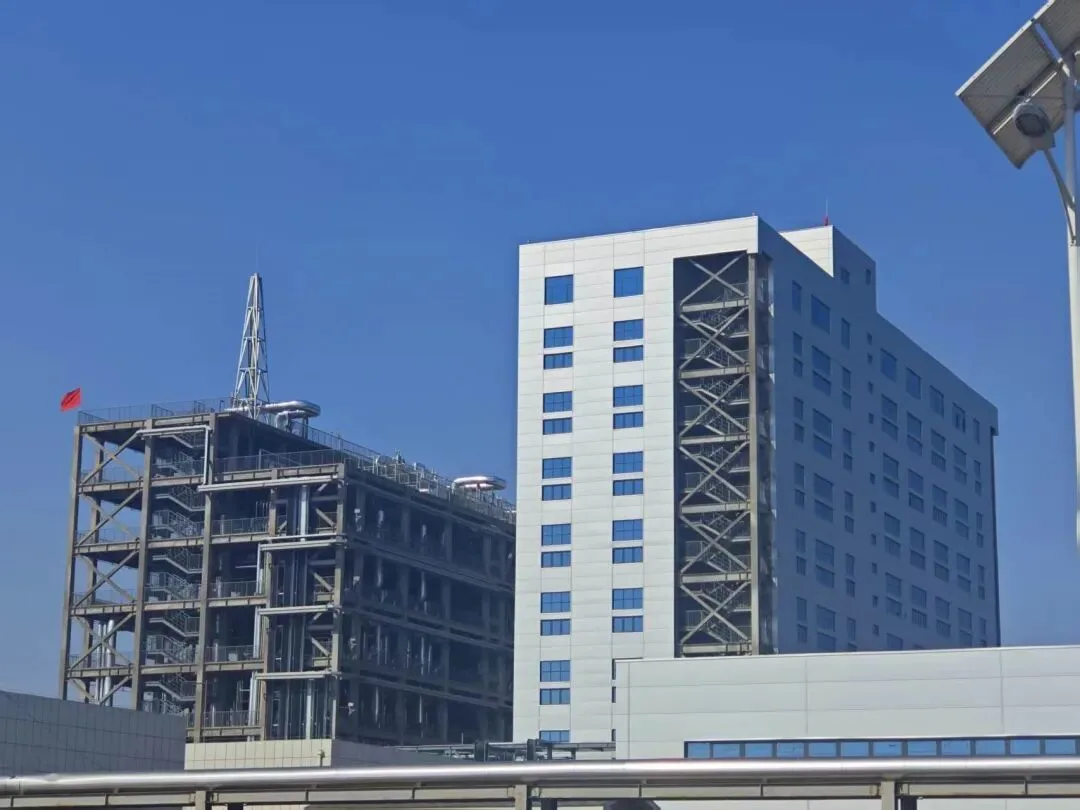
The world's largest high-capacity boron-10 isotope separation facility has been put into operation in Dongying, East China's Shandong Province, on June 23, 2026. Photo: Courtesy of Shanghai Research Institute of Chemical Industry Co
China has announced the commissioning of the world's largest high-capacity production facility for high-purity boron-10 isotope, with the highest enrichment level reaching 99.7 percent, according to a release event held on Monday in Dongying, East China's Shandong Province, the Science and Technology Daily reported on Thursday.
The project is seen as a significant step toward strengthening China's capability in strategic materials and reducing reliance on foreign technology in a critical industrial sector.
The feat was realized by Shanghai Research Institute of Chemical Industry Co (SRICI) and Shandong Heyi Gas Co, marking a major breakthrough in the domestic production of a strategic isotope long dominated by overseas suppliers, the Science and Technology Daily reported.
Industry analysts said the new facility helps fill a key gap in China's supply chain for materials used in nuclear power, advanced medical applications, and other high-end industrial fields.
Shang Zhaocong, general manager of the SRICI said the project completed the full process from design and construction to full-capacity operation of a 100-ton-scale facility in just 18 months, achieving a successful first start-up.
The plant is now producing 25 tons of qualified products in stable operation, with boron-10 enrichment reaching 99.7 percent and room for further improvement, according to the company.
"The commissioning of this project means that the strategic material is now independently controllable domestically," said Li Bin, vice president of the China Petroleum and Chemical Industry Federation (CPCIF). "It also makes China one of the few countries capable of large-scale production of high-purity boron-10 isotope," the Science and Technology Daily reported.
Zhu Weihong, an academician of the Chinese Academy of Sciences, said the launch of China's first industrial-scale high-purity boron-10 isotope facility is a "typical example of high-level scientific and technological self-reliance."
Stable isotopes play a critical role in nuclear technology and medical testing. In nuclear power applications, boron-10 absorbs neutrons to regulate chain reactions, enabling reactor shutdown, power adjustment, and compensation for reactivity changes. It is also considered a core material in the miniaturization of reactors.
However, the separation of boron isotopes has long been regarded as a global challenge.
The research team from the SRICI adopted an advanced chemical exchange method and broke through three core technologies: coupled enrichment through complex exchange, multi-stage efficient and precise cracking, and full-material recycling.
These advances solved long-standing engineering problems in traditional processes, including low separation efficiency, severe equipment corrosion, easy coking and clogging, and high unit consumption, while establishing a fully self-controlled technological pathway.
RELATED ARTICLES