IN-DEPTH / IN-DEPTH
A 50-year-old Namibian uranium mine revitalized after Chinese company's takeover, with benefits reaching far beyond the pit
From Decline to Revival
By Published: Jun 25, 2026 09:59 PM

Editor's Note:
Having enjoyed a long history, friendly exchanges between China and Africa have deepened in recent years, covering various fields such as politics, economy, and culture. The Global Times is launching a China-Africa Rhapsody series, aiming to showcase the profound human connections and development visions between the two peoples by sharing the true stories of Chinese people in Africa and African people in China. From touching stories of China-Africa cooperation and exciting collisions of youthful ideas to debunking fallacies concocted by some Western sources about China-Africa collaboration, this series hopes to promote closer cooperation and deeper understanding between the peoples of China and Africa.
This installment shares the story of how the 50-year-old Rossing Uranium Mine has brought extensive opportunities and welfare to local Namibians following its acquisition by a Chinese firm.
As 13-year-old Namibian teenager Benjamin stands atop the ancient Great Wall, his feet planted on its time-worn grey bricks, with the skyline of a modern metropolis stretching into the distance, he realizes he has left Africa for the first time. It is also his first encounter with the Eastern country he had only heard about from his father and seen in textbooks.
In this land more than 10,000 kilometers from his home in Namibia, Benjamin's eyes sparkle with excitement and curiosity. He has seen towering skyscrapers, ridden high-speed trains, and, in a nuclear energy science class, finally understood the true meaning of his father's work - that the mineral uranium, buried deep underground, is not merely a chemical element in textbooks, but something that can light up cities and cure diseases.
The boy's trip to China is a seed planted in fertile soil, its roots stretching back to the vast arid deserts of western Namibia - the Rossing Uranium Mine. It is where his father, Jacobus, works, and where China National Nuclear Corporation (CNNC) planted seeds of hope in 2019. Before that, the mine was shrouded in the shadow of impending closure, and despair filled people's eyes.
As the 50th anniversary ceremony of the Rossing Uranium Mine approaches on Friday, Benjamin and his family's story has become the most vivid footnote to the mine's transformation. It is not only a tale of survival and livelihood, but also a story of how a Chinese enterprise has crossed mountains and seas to support the dreams of ordinary local families with responsibility and compassion.
From 'closure countdown' to 'Rossing for a century'
In Namibia's western Erongo region, reddish-brown land stretches to the horizon. This is home to both breathtaking sunsets and countless families who depend on the mine for survival.
Jacobus is a foreman in the mechanical workshop at the Rossing Uranium Mine. He remembers that the mine was once an enviable top-tier employer when he was young. But when he joined in 2016, what awaited him was not stability and hope, but widespread anxiety and uncertainty. "At that time, international uranium prices had fallen to historic lows. After decades of operation, Rossing was showing its age - equipment breakdowns were frequent, production was shrinking and investment had completely stopped. It was mockingly called a 'tottering old lady' in the industry," Jacobus told the Global Times.
Even more devastating was the original operator's plan to close the mine in 2020, threatening over 2,000 local employees with unemployment. Jacobus has twin children and a younger son, Benjamin. As the pillar of his family, he returned home each day to his children's innocent smiles, his heart heavy with worry: Will I still have a job next year? How will I pay for their school fees? The overwhelming uncertainty felt like a heavy stone pressing on his chest.
The turning point came in 2019, when CNNC's subsidiary China National Uranium Co., Ltd (CNUC) officially took over the Rossing Uranium Mine.
In the early days, doubts and unease lingered. Long accustomed to Western management concepts, some local employees and the trade union were wary of the Chinese team, fearing layoffs, pay cuts and that the new management might only be a short-term experiment before eventual closure. Cross-cultural differences and accumulated industry anxiety kept the mine under a cloud of uncertainty.
Time provided the answer. Instead of drastic changes, CNUC Namibia Mining Limited focused on pragmatic actions to ease concerns, stabilize the workforce, and address people's livelihoods. The Chinese team rejected the "outsider takeover" approach and adopted the principle of "one Rossing team, with no separate Chinese management team." They retained the experienced local professional management team, providing strategic guidance while leaving day-to-day operations in local hands - eliminating opposition and barriers at the root.
What moved local employees most was the Chinese company's public commitment: to completely cancel the 2020 closure plan, with no layoffs and no reduction of core positions, while fully advancing mine life extension and upgrading. This promise dispelled years of fear and allowed Jacobus and countless other miners to finally breathe easy.
In the years that followed, visible improvements emerged one after another. CNUC invested capital and technology to replace outdated equipment, introduce efficient automated uranium mining systems and digital operations technologies, and comprehensively upgrade production processes, bringing the aging production line back to life. To help local employees keep pace with industrial upgrading, the company established a free, full-coverage training system - ranging from on-the-job skills training to specialized study programs in China. All costs were covered by the enterprise.
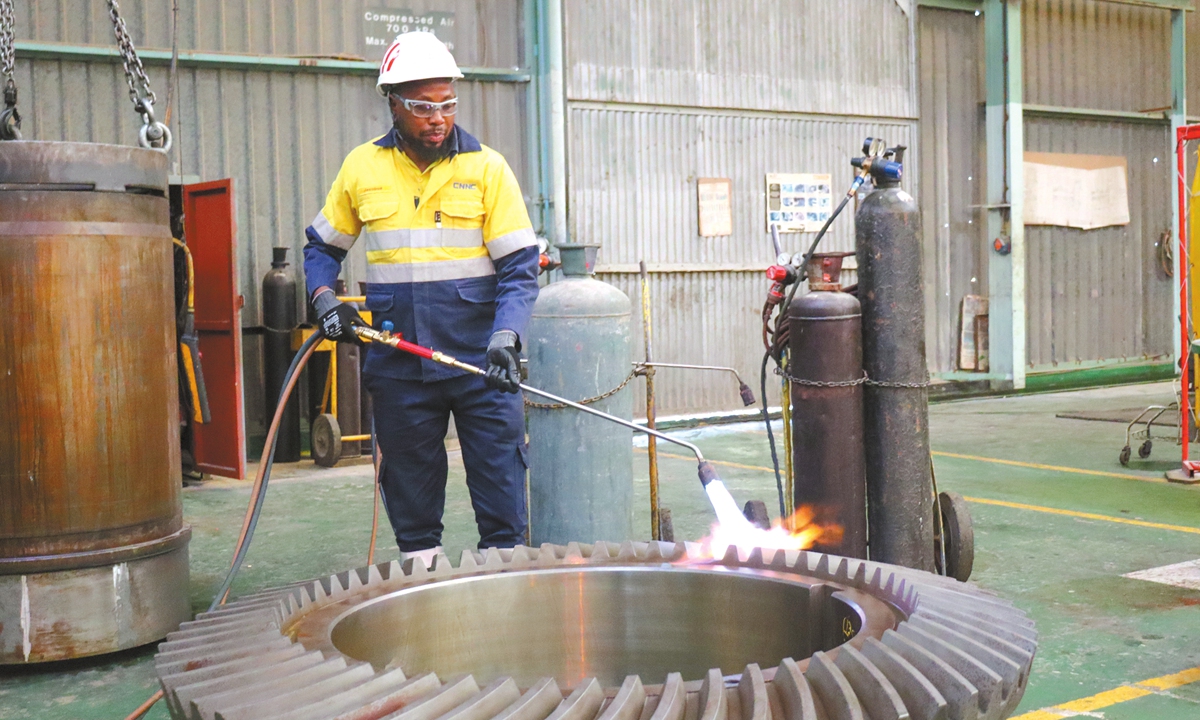
Jacobus, who joined as an ordinary fitter in 2016, has now risen to foreman in the mechanical workshop. He leads his team in mechanical parts processing, assembly and equipment maintenance, ensuring stable production. From an entry-level worker to top management, the transparent localization promotion path has opened endless possibilities for him.
"I used to be afraid to plan for the future. Now I am confident this job will last until 2050. I can send my three children to school and watch them grow up and succeed," Jacobus told the Global Times. His words are simple yet powerful - the solid confidence of a father.
This stability has also nurtured his children's dreams. Influenced by his father, Benjamin has understood since childhood that his father's company not only safeguards the mine's development but also protects the hopes of many families. In October 2025, thanks to a study tour program funded by the CNUC, Benjamin earned a precious spot to participate in the "Nuclear Energy Lights Up Dreams · Friendship Bridges the Future" program in China.
Jacobus told the Global Times that it was Benjamin's first time on a plane. Before departure, he excitedly told everyone: "I'm going to China!"
"I used to think nuclear energy was only for making bombs. But when we visited CNNC's nuclear facilities in China, the teacher told us nuclear fission can generate electricity, treat cancer and even sterilize medical equipment. I thought it was amazing!" Benjamin recalled.
After returning to Namibia, Benjamin became the family's "China expert." He described to his father how fast the Chinese high-speed trains are, how rich the food is, and how advanced the technology is. Even in science class, he often referenced what he saw in China.
"I want to learn more about uranium resources and nuclear energy, and I hope to study in China. Inspired by my father, I really want to join the Rossing Uranium Mine one day," Benjamin told the Global Times.
From 'blood transfusion' to 'blood creation'
The story of Jacobus' family is a microcosm of the changing fortunes of thousands of employees' families at Rossing. Yet the transformation has extended far beyond the mine's gates.
Through a series of social responsibility projects run by the Rossing Foundation established by Rossing Uranium Limited, it is clear that the company views its acquisition and operation not as resource extraction, but as a contribution to local communities.
In Namibia, poverty and unemployment are long-standing challenges, with a relatively high youth unemployment rate. CNNC's response has been to empower education.
"We believe education is the most effective way to break the cycle of intergenerational poverty," Chang Jingtao, head of the CNUC Namibia Mining Limited, told the Global Times.
Under this philosophy, the Rossing Foundation has built a tiered scholarship system covering primary and secondary schools near the mine and extending to higher education. Every year, the foundation funds hundreds of miners' children and underprivileged students in the community. Miners' children like Benjamin are direct beneficiaries, Chang introduced.
According to Chang, since the acquisition in 2019, more than 200 miners' children have completed higher education.
Beyond education, the company has also shown care for women, unemployed youth and people with disabilities.
In the Ohikuku area of Omusati province lies a unique farm that serves as the base for the local women's community. Eleven rural women who once struggled to make ends meet - single mothers and left-behind wives among them - are out picking fresh spinach and bell peppers.
In the past, they didn't have a steady income and could only scrape by on meager family handouts. Today, the Rossing Foundation has built greenhouses for them, installed full irrigation systems and brought in specialists to teach them farming techniques hands-on. These women have not only mastered how to grow high-quality vegetables, but also learned pricing strategies and how to connect with market buyers.
Similar opportunities have been created for young people through projects in Arandis and Okombahe, providing greenhouses, machinery and on-site technical guidance to help unemployed youth become small business owners.
Even in less visible corners, support continues. Amy Andrew is a visually impaired student at the Namibia University of Science and Technology. Living in a blurred world, she once thought her dream of pursuing higher education would never be realized. Her visual impairment stopped her from reading textbooks or words on the blackboard, and her poor family could not afford expensive assistive devices.
After learning about her situation, the Rossing Foundation launched a full-support education and disability assistance program for her. It granted Amy a scholarship of 200,000 Namibian dollars ($12,064) to cover all her tuition and accommodation fees. The foundation also partnered with specialists to custom-make bioptic corrective glasses and portable reading magnifiers for her, and presented her with a laptop pre-installed with accessibility software for visually impaired learners. Later, the foundation offered her an internship in the mine's administrative department, paving the way for her future career.
Marking the 50th anniversary of Rossing Uranium Mine, CNNC has recently released its support vision for the CNNC study tour program and the Love U Namibia charity initiatives, committing to long-term support for more Namibian youth.
In Namibia's ancient land, CNNC has proven through action that what it extracts is not only uranium, but also local families' shared aspirations for a better life.
It has broken the conventional model of overseas resource development, which focuses heavily on extraction while neglecting people's livelihoods. Instead of pursuing short-term profits, CNNC has adopted a long-term "Century Mine" vision - taking root locally, nurturing communities, and empowering the future. Its tangible achievements demonstrate that Chinese enterprises' overseas cooperation is a mutually beneficial, two-way journey and a lasting companionship of shared growth.
The rebirth of the Rossing Uranium Mine is not only a transformation of the mine itself, but also a vivid example of mutual benefit between China and Namibia and the building of a China-Africa community with a shared future.
Today, as Benjamin looks toward the future with bright eyes and Jacobus works with renewed confidence, father and son together embody the quiet power of this reborn mine - one that continues to light up ordinary families and illuminate hope across continents.
Having enjoyed a long history, friendly exchanges between China and Africa have deepened in recent years, covering various fields such as politics, economy, and culture. The Global Times is launching a China-Africa Rhapsody series, aiming to showcase the profound human connections and development visions between the two peoples by sharing the true stories of Chinese people in Africa and African people in China. From touching stories of China-Africa cooperation and exciting collisions of youthful ideas to debunking fallacies concocted by some Western sources about China-Africa collaboration, this series hopes to promote closer cooperation and deeper understanding between the peoples of China and Africa.
This installment shares the story of how the 50-year-old Rossing Uranium Mine has brought extensive opportunities and welfare to local Namibians following its acquisition by a Chinese firm.
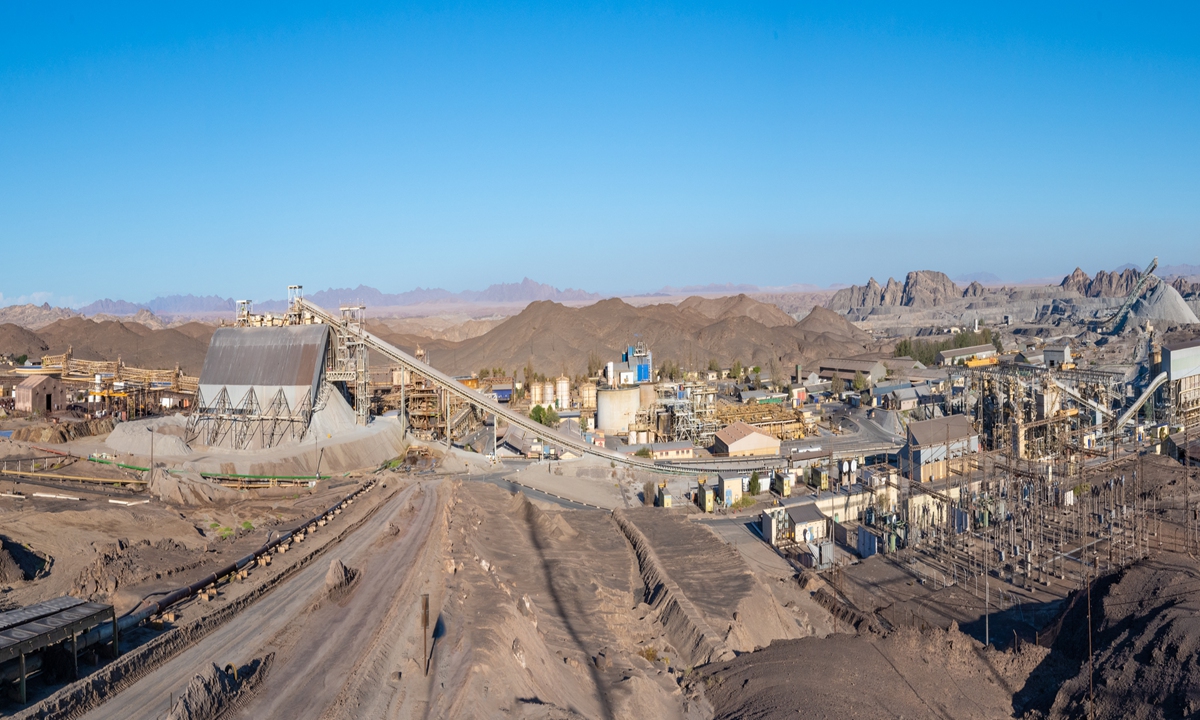
The view of the Rossing Uranium Mine in Namibia Photo: Courtesy of CNUC
As 13-year-old Namibian teenager Benjamin stands atop the ancient Great Wall, his feet planted on its time-worn grey bricks, with the skyline of a modern metropolis stretching into the distance, he realizes he has left Africa for the first time. It is also his first encounter with the Eastern country he had only heard about from his father and seen in textbooks.
In this land more than 10,000 kilometers from his home in Namibia, Benjamin's eyes sparkle with excitement and curiosity. He has seen towering skyscrapers, ridden high-speed trains, and, in a nuclear energy science class, finally understood the true meaning of his father's work - that the mineral uranium, buried deep underground, is not merely a chemical element in textbooks, but something that can light up cities and cure diseases.
The boy's trip to China is a seed planted in fertile soil, its roots stretching back to the vast arid deserts of western Namibia - the Rossing Uranium Mine. It is where his father, Jacobus, works, and where China National Nuclear Corporation (CNNC) planted seeds of hope in 2019. Before that, the mine was shrouded in the shadow of impending closure, and despair filled people's eyes.
As the 50th anniversary ceremony of the Rossing Uranium Mine approaches on Friday, Benjamin and his family's story has become the most vivid footnote to the mine's transformation. It is not only a tale of survival and livelihood, but also a story of how a Chinese enterprise has crossed mountains and seas to support the dreams of ordinary local families with responsibility and compassion.
Jacobus, foreman of Rossing Uranium Mine's mechanical workshop, carries out his duties on site. Photo: Courtesy of CNUC
From 'closure countdown' to 'Rossing for a century'
In Namibia's western Erongo region, reddish-brown land stretches to the horizon. This is home to both breathtaking sunsets and countless families who depend on the mine for survival.
Jacobus is a foreman in the mechanical workshop at the Rossing Uranium Mine. He remembers that the mine was once an enviable top-tier employer when he was young. But when he joined in 2016, what awaited him was not stability and hope, but widespread anxiety and uncertainty. "At that time, international uranium prices had fallen to historic lows. After decades of operation, Rossing was showing its age - equipment breakdowns were frequent, production was shrinking and investment had completely stopped. It was mockingly called a 'tottering old lady' in the industry," Jacobus told the Global Times.
Even more devastating was the original operator's plan to close the mine in 2020, threatening over 2,000 local employees with unemployment. Jacobus has twin children and a younger son, Benjamin. As the pillar of his family, he returned home each day to his children's innocent smiles, his heart heavy with worry: Will I still have a job next year? How will I pay for their school fees? The overwhelming uncertainty felt like a heavy stone pressing on his chest.
The turning point came in 2019, when CNNC's subsidiary China National Uranium Co., Ltd (CNUC) officially took over the Rossing Uranium Mine.
In the early days, doubts and unease lingered. Long accustomed to Western management concepts, some local employees and the trade union were wary of the Chinese team, fearing layoffs, pay cuts and that the new management might only be a short-term experiment before eventual closure. Cross-cultural differences and accumulated industry anxiety kept the mine under a cloud of uncertainty.
Time provided the answer. Instead of drastic changes, CNUC Namibia Mining Limited focused on pragmatic actions to ease concerns, stabilize the workforce, and address people's livelihoods. The Chinese team rejected the "outsider takeover" approach and adopted the principle of "one Rossing team, with no separate Chinese management team." They retained the experienced local professional management team, providing strategic guidance while leaving day-to-day operations in local hands - eliminating opposition and barriers at the root.
What moved local employees most was the Chinese company's public commitment: to completely cancel the 2020 closure plan, with no layoffs and no reduction of core positions, while fully advancing mine life extension and upgrading. This promise dispelled years of fear and allowed Jacobus and countless other miners to finally breathe easy.
In the years that followed, visible improvements emerged one after another. CNUC invested capital and technology to replace outdated equipment, introduce efficient automated uranium mining systems and digital operations technologies, and comprehensively upgrade production processes, bringing the aging production line back to life. To help local employees keep pace with industrial upgrading, the company established a free, full-coverage training system - ranging from on-the-job skills training to specialized study programs in China. All costs were covered by the enterprise.
Jacobus, who joined as an ordinary fitter in 2016, has now risen to foreman in the mechanical workshop. He leads his team in mechanical parts processing, assembly and equipment maintenance, ensuring stable production. From an entry-level worker to top management, the transparent localization promotion path has opened endless possibilities for him.
"I used to be afraid to plan for the future. Now I am confident this job will last until 2050. I can send my three children to school and watch them grow up and succeed," Jacobus told the Global Times. His words are simple yet powerful - the solid confidence of a father.
This stability has also nurtured his children's dreams. Influenced by his father, Benjamin has understood since childhood that his father's company not only safeguards the mine's development but also protects the hopes of many families. In October 2025, thanks to a study tour program funded by the CNUC, Benjamin earned a precious spot to participate in the "Nuclear Energy Lights Up Dreams · Friendship Bridges the Future" program in China.
Jacobus told the Global Times that it was Benjamin's first time on a plane. Before departure, he excitedly told everyone: "I'm going to China!"
"I used to think nuclear energy was only for making bombs. But when we visited CNNC's nuclear facilities in China, the teacher told us nuclear fission can generate electricity, treat cancer and even sterilize medical equipment. I thought it was amazing!" Benjamin recalled.
After returning to Namibia, Benjamin became the family's "China expert." He described to his father how fast the Chinese high-speed trains are, how rich the food is, and how advanced the technology is. Even in science class, he often referenced what he saw in China.
"I want to learn more about uranium resources and nuclear energy, and I hope to study in China. Inspired by my father, I really want to join the Rossing Uranium Mine one day," Benjamin told the Global Times.
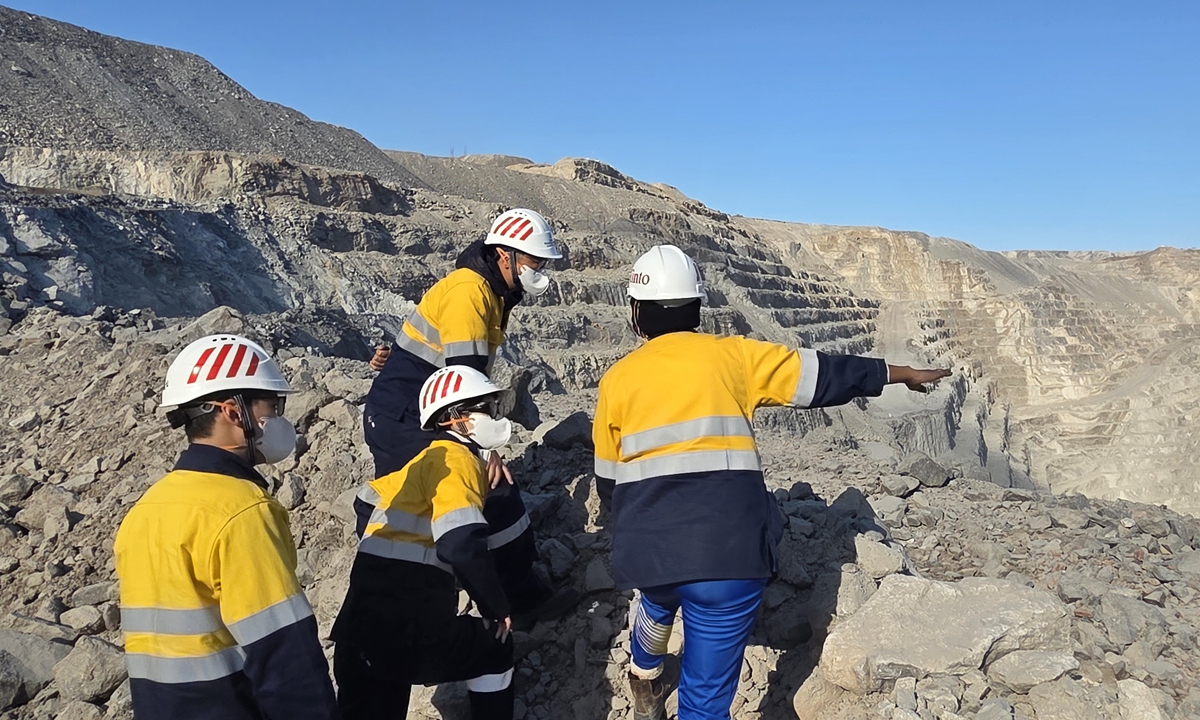
Namibian and Chinese staff members conduct exploration and testing together at the mine site in Namibia. Photo: Courtesy of CNUC
From 'blood transfusion' to 'blood creation'
The story of Jacobus' family is a microcosm of the changing fortunes of thousands of employees' families at Rossing. Yet the transformation has extended far beyond the mine's gates.
Through a series of social responsibility projects run by the Rossing Foundation established by Rossing Uranium Limited, it is clear that the company views its acquisition and operation not as resource extraction, but as a contribution to local communities.
In Namibia, poverty and unemployment are long-standing challenges, with a relatively high youth unemployment rate. CNNC's response has been to empower education.
"We believe education is the most effective way to break the cycle of intergenerational poverty," Chang Jingtao, head of the CNUC Namibia Mining Limited, told the Global Times.
Under this philosophy, the Rossing Foundation has built a tiered scholarship system covering primary and secondary schools near the mine and extending to higher education. Every year, the foundation funds hundreds of miners' children and underprivileged students in the community. Miners' children like Benjamin are direct beneficiaries, Chang introduced.
According to Chang, since the acquisition in 2019, more than 200 miners' children have completed higher education.
Beyond education, the company has also shown care for women, unemployed youth and people with disabilities.
In the Ohikuku area of Omusati province lies a unique farm that serves as the base for the local women's community. Eleven rural women who once struggled to make ends meet - single mothers and left-behind wives among them - are out picking fresh spinach and bell peppers.
In the past, they didn't have a steady income and could only scrape by on meager family handouts. Today, the Rossing Foundation has built greenhouses for them, installed full irrigation systems and brought in specialists to teach them farming techniques hands-on. These women have not only mastered how to grow high-quality vegetables, but also learned pricing strategies and how to connect with market buyers.
Similar opportunities have been created for young people through projects in Arandis and Okombahe, providing greenhouses, machinery and on-site technical guidance to help unemployed youth become small business owners.
Even in less visible corners, support continues. Amy Andrew is a visually impaired student at the Namibia University of Science and Technology. Living in a blurred world, she once thought her dream of pursuing higher education would never be realized. Her visual impairment stopped her from reading textbooks or words on the blackboard, and her poor family could not afford expensive assistive devices.
After learning about her situation, the Rossing Foundation launched a full-support education and disability assistance program for her. It granted Amy a scholarship of 200,000 Namibian dollars ($12,064) to cover all her tuition and accommodation fees. The foundation also partnered with specialists to custom-make bioptic corrective glasses and portable reading magnifiers for her, and presented her with a laptop pre-installed with accessibility software for visually impaired learners. Later, the foundation offered her an internship in the mine's administrative department, paving the way for her future career.
Marking the 50th anniversary of Rossing Uranium Mine, CNNC has recently released its support vision for the CNNC study tour program and the Love U Namibia charity initiatives, committing to long-term support for more Namibian youth.
In Namibia's ancient land, CNNC has proven through action that what it extracts is not only uranium, but also local families' shared aspirations for a better life.
It has broken the conventional model of overseas resource development, which focuses heavily on extraction while neglecting people's livelihoods. Instead of pursuing short-term profits, CNNC has adopted a long-term "Century Mine" vision - taking root locally, nurturing communities, and empowering the future. Its tangible achievements demonstrate that Chinese enterprises' overseas cooperation is a mutually beneficial, two-way journey and a lasting companionship of shared growth.
The rebirth of the Rossing Uranium Mine is not only a transformation of the mine itself, but also a vivid example of mutual benefit between China and Namibia and the building of a China-Africa community with a shared future.
Today, as Benjamin looks toward the future with bright eyes and Jacobus works with renewed confidence, father and son together embody the quiet power of this reborn mine - one that continues to light up ordinary families and illuminate hope across continents.
RELATED ARTICLES

