SPORT / MISCELLANY
VAR evolution at World Cup reduces stops, improves match flow
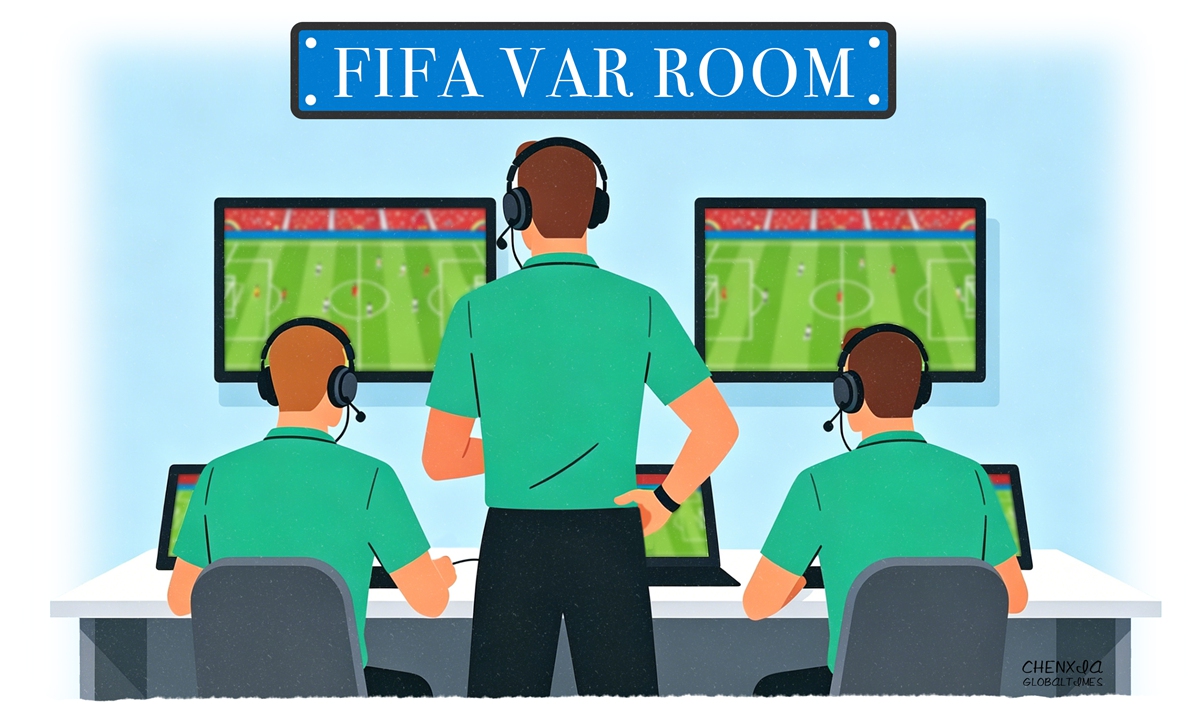
Illustration: Chen Xia/GT
When striker Kylian Mbappe went down inside the penalty area during France's 3-1 win over Senegal in a recent group game at the 2026 FIFA World Cup, many expected the referee to point to the spot.
Instead, despite a Video Assistant Referee (VAR) review, the referee waved away the penalty, ruling that Mbappe had initiated the contact himself.
This is one of the decisions related to VAR that has sparked discussions among fans during the ongoing World Cup, many of whom argue that a similar incident in previous World Cups would almost certainly have resulted in a penalty. Yet the controversy may reveal something larger than a single refereeing decision: VAR has evolved with rule interpretation, enforcement standards, and a shared commitment to preserving the sport's competitive integrity.
Overall, the matches so far have flowed relatively smoothly. Incidents of diving, deliberate shirt-pulling during set pieces and cynical, opportunistic fouls have declined, while players have become more focused on technical duels and tactical execution, enhancing the overall entertainment value of the tournament to some extent, Liu Yu, a Beijing-based sports commentator, told the Global Times.
Encouraging physical contact and making matches flow more smoothly have long been key objectives pursued by FIFA, Liu noted.
The average number of fouls called per match at this World Cup after 40 games has fallen to 21.7, compared with 25 in Qatar 2022 and 27 at the 2018 tournament, the BBC reported.
"We are continuing on trying to achieve an objective, which is to eliminate from matches the disruption of the tempo of the match as much as possible," said Pierluigi Collina, FIFA chief refereeing officer and chairman of the Referees Committee, AP reported ahead of this World Cup.
Meanwhile at this World Cup, VAR's authority has been significantly expanded. Decisions involving clearly erroneous second yellow cards, cases of mistaken identity in disciplinary sanctions, and incorrectly awarded corner kicks are now all subject to VAR review.
This does not mean controversies have disappeared. Refereeing decisions will always divide opinion, especially in a tournament as emotionally charged as the World Cup.
Fu Ming, one of the three Chinese referees officiating at this World Cup, said that the expanded authority granted to VAR is intended "to reduce unnecessary stoppages, improve the spectacle of the game, and ensure the purity and fairness of competition," the Workers' Daily reported.
While technological advancements have enhanced the fairness of the game, a referee's interpretation of the Laws of the Game, management of match tempo and protection of player safety remain core values that no machine can replace, Fu said.
To fix time-wasting and ensure the high tempo of the game, referees are allowed to use a visible five-second countdown for throw-ins and goal kicks. Players getting subbed off must leave the field within 10 seconds, except for special situations such as ones involving injuries or a security issue.
During previous World Cups, VAR often came under criticism for excessive interventions. Some decisions required several minutes of analysis, disrupting momentum and undermining the emotional spontaneity that makes football compelling.
The enhanced semi-automated offside technology introduced at this World Cup can send an audio alert to assistant referees when a player is more than 10 centimeters offside, virtually eliminating delayed flag calls and significantly reducing review times.
The perceived "softening" of VAR does not stem from reduced intervention, but rather from a combination of higher intervention thresholds, faster decision-making and improved communication strategies.
So far, VAR has indeed reduced match fragmentation and used technology to correct several key incorrect decisions. However, how to minimize interference with the flow of the game while still ensuring decision accuracy and maintaining effective coordination with the on-field referee remains a challenge.
The current debates should not be interpreted as evidence that VAR is malfunctioning or that officiating standards have declined. Rather, they reflect a broader reform of the World Cup refereeing system, one that encompasses not only technology but also rule interpretation, enforcement standards and the overall vision of maintaining the beauty of the sport.
The technology is no longer being used to scrutinize every incidence of contact under a microscope. Instead, it is increasingly serving its original purpose: correcting clear and obvious errors while allowing the game itself to remain center stage.
Ultimately, FIFA's latest approach suggests that football's governing body is seeking to strike a new balance in preserving fairness without sacrificing the rhythm, intensity and competitive essence that define the world's most popular sport.
The author is a reporter with the Global Times. life@globaltimes.com.cn
RELATED ARTICLES