Japan’s move to rename ASDF, extend security scope into space further hollows out pacifist constitution, exposes growing military ambitions: Chinese expert
By Published: Jun 26, 2026 04:39 PM

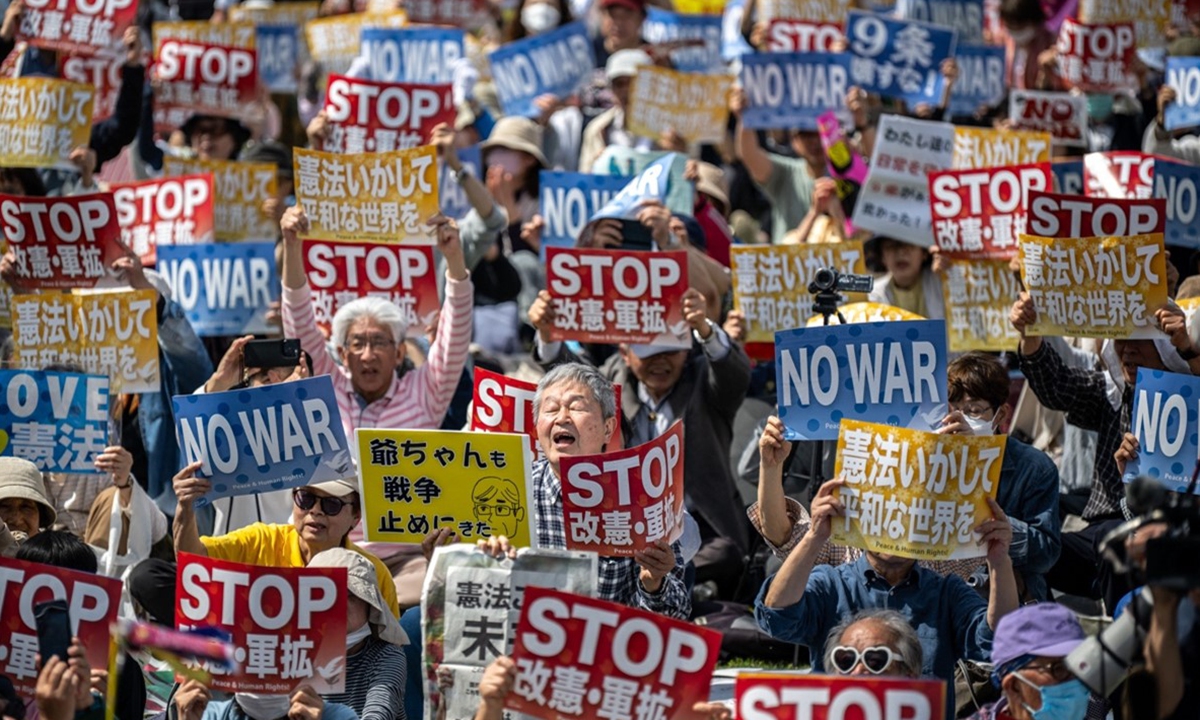
People hold placards reading "No war" and "Stop constitutional revision, military expansion" during the Grand Constitution Rally 2026 to mark Constitution Memorial Day in Tokyo on May 3, 2026. Photo: VCG
Japan's parliament passed related defense laws on Friday to rename the Air Self-Defense Force (ASDF) as the so-called "Air and Space Self-Defense Force," marking the first name change of an SDF branch since 1954, according to Japanese media. Chinese experts said Japan's move to treat outer space as a new battlefield runs counter to the spirit of its so-called pacifist constitution and represents a further attempt to hollow out the postwar constitutional constraints on its military development and also poses a serious threat to other countries' peaceful use of space resources, and therefore warrants close vigilance and attention.
Related laws, including a revised Defense Ministry establishment law that stipulates the reorganization of the Air Self-Defense Force into the "Air and Space Self-Defense Force" and the increase of state ministers of defense to two, were passed and enacted at a plenary session of the House of Councillors on Friday, according to the Sankei Shimbun.
The "Air and Space Self-Defense Force" will be launched during fiscal 2026, and a new specialized unit for the space domain, the "Space Operations Group," will be established under the command of an Air Self-Defense Force general. Japan will launch satellites and move forward with efforts to "strengthen its space situational awareness and surveillance capabilities," according to the report.
The number of state ministers of defense may be increased as early as this summer. The move is aimed at reducing the burden of crisis management in preparation for contingencies and large-scale disasters. It is also intended to expand defense exchanges at the political level with allies and "like-minded countries," per the Sankei Shimbun.
A report from the Jiji Press noted that the move is aimed at strengthening Japan's space operations capabilities, as the space domain has become increasingly important for national security. Defense Minister Shinjiro Koizumi, during an inspection of a space surveillance unit, said Japan would "work to improve its capabilities."
The name change will mark the first time the name of a Self-Defense Force branch has been changed since the SDF was established in 1954, per Jiji.
Japan's move to reorganize the Air Self-Defense Force into an Aerospace Self-Defense Force appears to mirror the US Space Force model: first embedding space units within the air force, then potentially separating them into an independent branch. It also signals an attempt to turn the Self-Defense Forces into a formal national defense force while expanding Japan's military structure and operational scope, Song Zhongping, a military affairs expert, told the Global Times on Friday.
Such move marks a departure from Japan's so-called exclusively defense-oriented policy. By designating outer space as an operational domain, Japan is further breaching the postwar constitutional constraints on its military development. In practice, it amounts to hollowing out — and potentially overturning — the spirit of the pacifist constitution, said Song.
"This marks a key step in the Sanae Takaichi administration's push for military expansion, laying bare Japan's growing military ambitions," said Song.
Japan's move reflects its growing military ambitions and its strategic push to support overseas operations. By developing space-based military capabilities, Japan may seek to use orbital reconnaissance to provide targeting data for long-range strikes, enhance cross-unit communications during far-seas operations, and prepare the Aerospace Self-Defense Force for direct orbital combat, including the use of space assets and potential laser weapons to threaten or attack foreign military and civilian satellites, Wei Dongxu, a Chinese military affairs commentator, was quoted by the CCTV as saying in a report published on June 19.
Japan's Aerospace Self-Defense Force may also engage in joint combat operations with the US Space Force. In the future, the reach of the US-Japan military alliance may extend to the space level and into orbital space, which will pose a significant threat to other countries' peaceful use of space resources and warrants vigilance and attention, said Wei.
Japanese media have reported in recent weeks on the revised Defense Ministry establishment law and the planned reorganization of the Air Self-Defense Force into the "Air and Space Self-Defense Force." Japanese Communist Party Chairperson Tomoko Tamura criticized the ASDF reorganization, saying such a move would accelerate an arms race in space, according to a statement published on her website.
Song noted that Japan's recent moves risk unsettling the security landscape in the Asia-Pacific, undermining the global space governance order and eroding strategic stability. Regional countries and the broader international community should remain highly vigilant, firmly guard against any resurgence of Japanese militarism, and work together to safeguard the hard-won achievements of postwar peace and development.
RELATED ARTICLES