US steps up crackdown on China EVs with Polestar ban; move reflects US overreach in invoking 'national security' to mask its own EV sector weaknesses, expert says
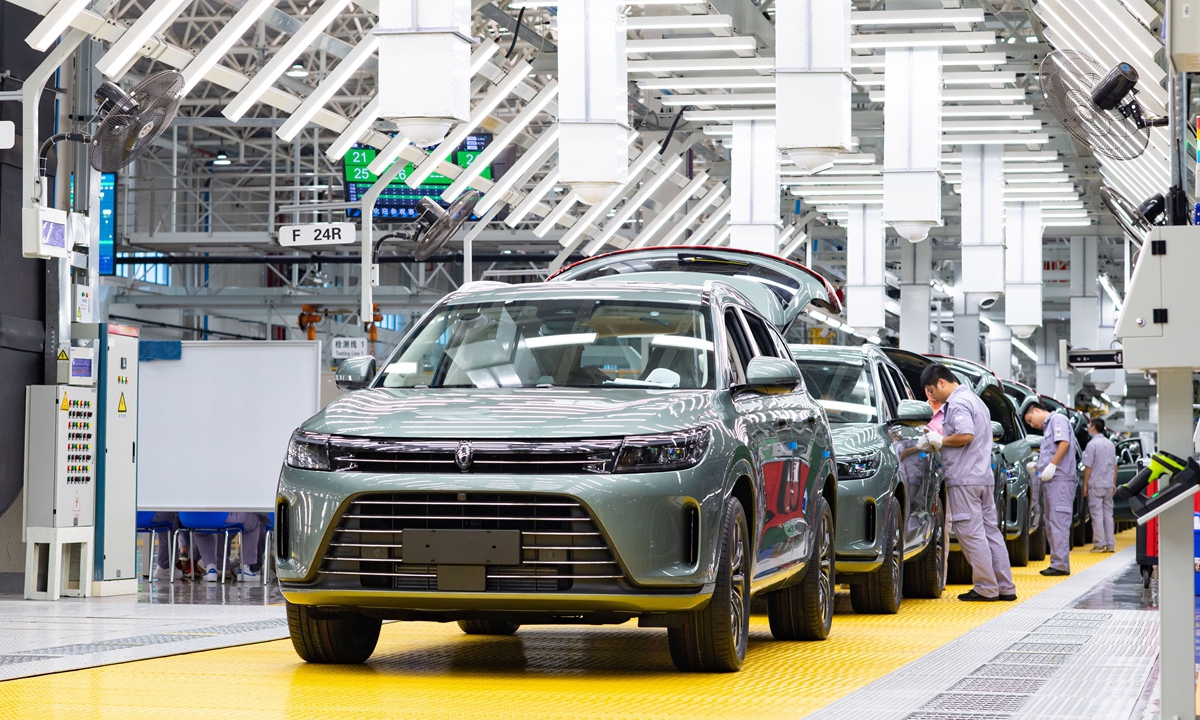
An NEV manufacturing line in Southwest China's Chongqing Municipality Photo: VCG
Chinese car brand Polestar said on Thursday that the Trump administration was forcing the electric vehicle (EV) maker to stop selling cars in the US starting with the 2027 model year, as Washington ramps up its crackdown on Chinese EVs. A Chinese analyst said the move reflects the US' overreach in using so-called national security concerns to disguise underlying weaknesses in its own EV sector.
The expert warned that such measures could ultimately slow the development of the US EV industry while limiting consumers' access to advanced, cost-competitive EVs, especially as oil prices rise amid geopolitical conflicts.
The US Commerce Department did not grant authorization to sell cars for Polestar, an EV brand owned by China's Geely Holding Group (ZGH), under the Connected Vehicles Rule, which restricts the import and sale of cars with connected-vehicle technology linked to China, beginning with the 2027 model year, according to a Reuters report.
Bluetooth, Wi-Fi, cellular connectivity and some satellite communications technologies are covered under the rules, said the report. The rule was adopted in January 2025 under former president Joe Biden, and has been kept in place under Donald Trump.
ZGH said in a statement sent to the Global Times on Friday that the company is aware of the recent decision. While specific market access challenges may arise, ZGH is fully confident in its portfolio companies' board and management as they explore all available avenues to serve their customers around the world, said the company.
The latest move is part of a continued tightening of US regulatory barriers targeting the Chinese EV sector on the basis of national security. Such restrictions risk distorting normal market competition and further politicizing industrial and technological issues, Zhou Mi, a senior researcher at the Chinese Academy of International Trade and Economic Cooperation, told the Global Times on Friday.
Zhou noted that China's EV industry has built strong global competitiveness through sustained technological innovation and domestic market competition, forming a complete industrial ecosystem that continues to drive down costs and improve performance.
Many see only the price advantage of EVs - but more importantly, it reflects advances in technology and efficiency, as well as shifts in consumer attitudes, experts said.
Even though it's tough for American drivers to buy a Chinese EV, no matter where it's built, many claim to be EV-curious, more so with today's sky-high gas prices caused by the war in Iran, CNBC reported.
According to a recent Kelley Blue Book study, 38 percent of Americans say they would consider buying a Chinese vehicle if they had the choice. "The only thing stopping [them] is the restrictions of selling into the US," said Dan Ives, an analyst at Wedbush Securities, according to the CNBC report.
A Cox survey, which polled 802 US consumers who expect to buy a car in the next two years, showed that 49 percent of respondents rated Chinese cars as having very good or excellent value, and 40 percent said that they support the idea of Chinese auto brands in the US market, Reuters reported in March.
Zhou warned that excessive reliance on regulatory barriers could slow technological progress in the US market and limit consumer access to high quality, reasonably priced EVs.
The latest findings once again underscored that American consumer choice ultimately depends on the products themselves, with value for money, advanced technology and user experience as key drivers, areas where Chinese EVs have already demonstrated strong global competitiveness, Hu Qimu, a professor at the Maritime Silk Road Institute of Huaqiao University, told the Global Times on Friday.
Chinese new-energy vehicles are continuing to gain a stronger foothold in global markets. According to the Chinese Association of Automobile Manufacturers, China exported about 435,000 passenger EVs and plug-in hybrids in May, more than double the figure for a year earlier.
"The US' efforts to bypass or exclude China from global EV supply chains may ultimately delay the maturation of its own new-energy vehicle industry, at a time when global electrification is accelerating," said Hu.
Elaine Buckberg, a senior fellow at Harvard's Salata Institute for Climate and Sustainability and a former chief economist at General Motors, warned that "the absence of direct EV competition from China at the moment doesn't eliminate the longer-term risks to the US of disincentivizing the development and adoption of EV technology," NBC News quoted her as saying.
In April, Li Chenggang, China international trade representative with the Ministry of Commerce and vice minister of commerce, met with US carmaker Ford's Chief Policy Officer Steven Croley in Beijing. During the meeting, Li noted that the Chinese and US auto industries are highly complementary, with broad scope for cooperation.
RELATED ARTICLES