Investment in key energy projects and new business models during 15th five-year plan period to exceed 20 trillion yuan: NEA head
By Published: Jun 26, 2026 05:31 PM

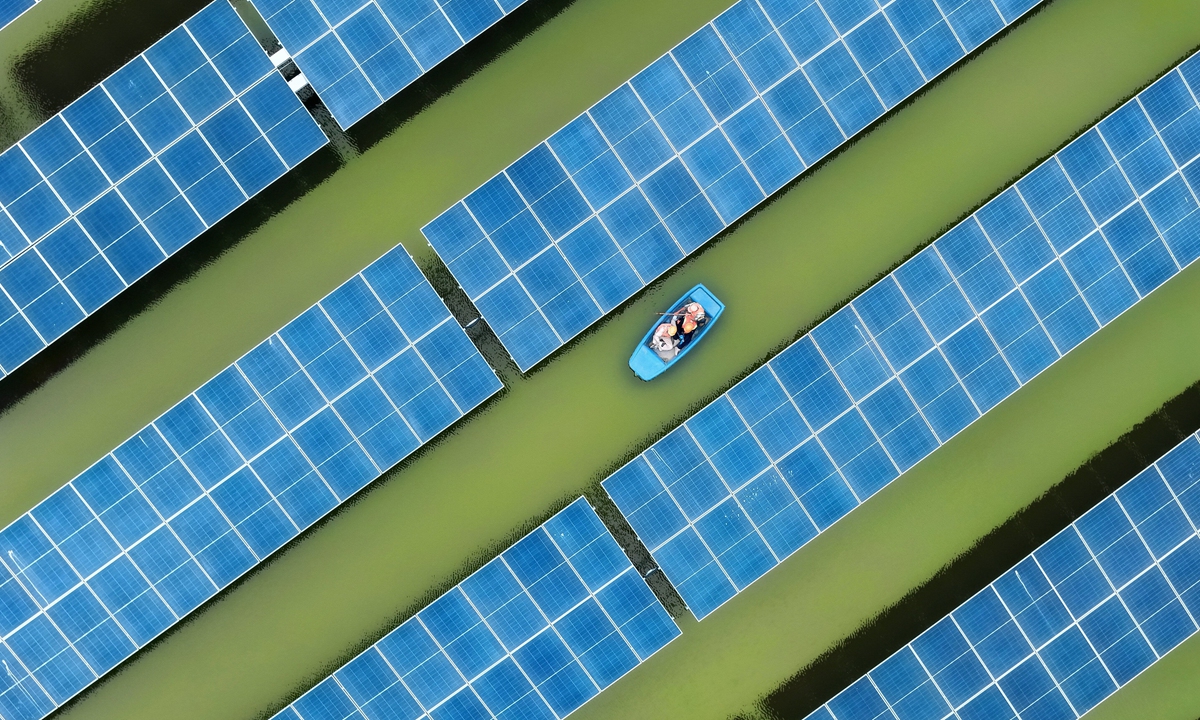
Workers from State Grid Nantong Power Supply Co use an infrared thermometer to inspect critical equipment as a 70-megawatt "fishery-solar complementary" photovoltaic power station officially connects to the grid in Dagong Township, Hai'an City, East China's Jiangsu Province, on June 14, 2026. Photo: VCG
Investment in key energy projects and new business models is expected to grow steadily, with the total investment exceeding 20 trillion yuan ($2.94 trillion) during the 15th Five-Year Plan period (2026-30), Wang Hongzhi, head of China's National Energy Administration (NEA), stated at a press conference held by the State Council Information Office on Friday.
China aims to basically establish a clean, low-carbon, secure and efficient new energy system by 2030, according to a plan issued by the National Development and Reform Commission and the NEA on Thursday.
The plan, which covers the 15th Five-Year Plan period, sets out targets for strengthening energy security, advancing the green transition, boosting technological self-reliance and improving market mechanisms, among others, the Xinhua News Agency reported on Thursday.
By 2030, China's total energy production capacity will reach 5.8 billion tons of standard coal equivalent. At the same time, the power system's capacity for complementary support, security and resilience will see comprehensive improvements, according to the plan.
At the press conference on Friday, Wang said grid investment in the 15th Five-Year Plan period is set to outgrow that of the 14th Five-Year Plan period by 30 percent and the number of basic charging facilities across the country will reach 40 million by 2030.
China's total installed power generation capacity reached 4.01 billion kilowatts by the end of May 2026, the NEA said Thursday, noting that the figure put China at the top of the world by this measure. This capacity is projected to reach 5.4 billion kilowatts by 2030, Wang said on Friday.
By 2030, the share of new energy installed capacity is set to exceed 50 percent of the total, making it the dominant source of installed capacity. The share of electricity generated from non-fossil energy sources is set to reach 50 percent, making it the primary source of power generation, while the consumption of coal and oil will have peaked.
In light of the evolving internal and external dynamics of energy development, and with a focus on energy security, the low carbon transition, and innovation driven growth, the NEA will focus on three key priorities, Wang said: strengthening oil and gas security, the development of new type power grids, and promoting the two-way empowerment between artificial intelligence (AI) and energy.
Sun Chuanwang, a professor at the School of Economics at Xiamen University, told the Global Times on Friday that the nation's new energy growth will be tech-driven, with new technologies such as AI playing a key role.
"AI is set to deeply empower the entire energy supply chain, transitioning from single-point applications to large-scale integration across multiple scenarios, encompassing upstream energy production and supply, midstream power grids and energy storage, and downstream AI applications and services, along with supporting technologies, standards and financial systems," Sun said.
Separately, a report released on Wednesday by the China Center for Information Industry Development (CCID) projected that by 2030, the market size of the entire industrial chain, which covers renewable energy generation, energy storage, electric equipment manufacturing, charging and swapping infrastructure, and battery recycling and reuse, is expected to exceed 8 trillion yuan, China Central Television (CCTV) News reported.
RELATED ARTICLES