SPORT / FOOTBALL
Chinese netizens reflect on Asia's football gap after Iran, South Korea exit World Cup
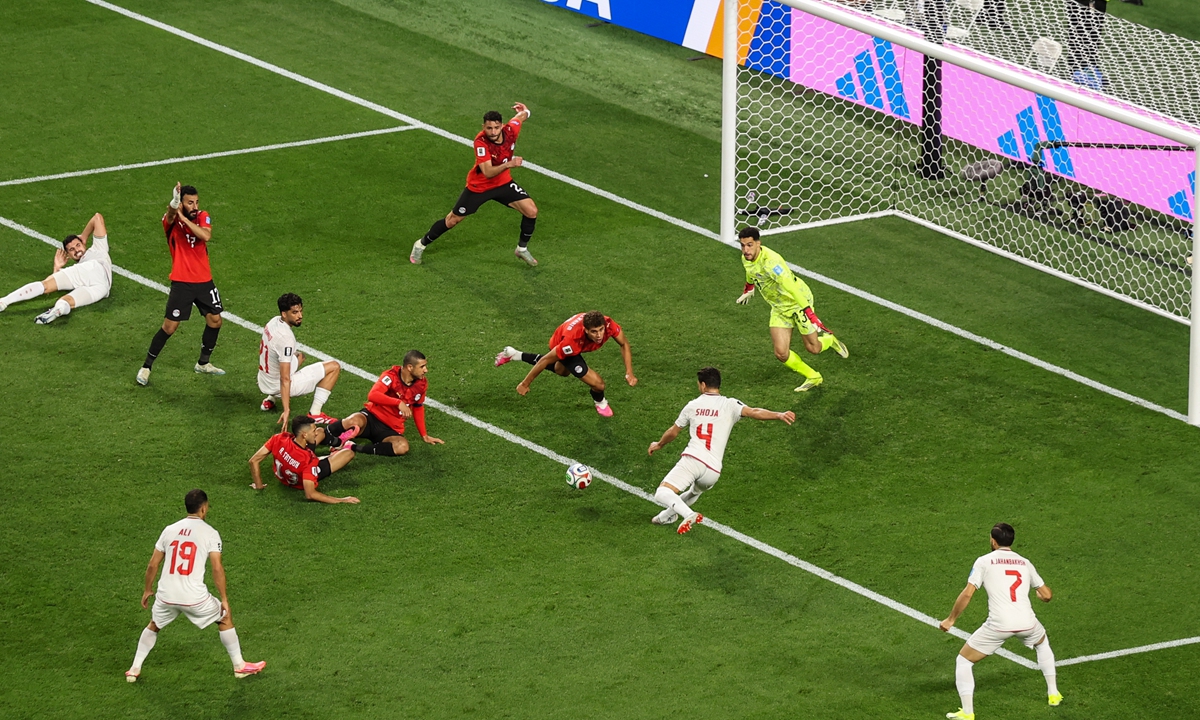
Iran's Shoja Khalilzadeh (No.4) shoots past Egypt's keeper Mostafa Shobeir (23), but the goal was ruled offside after video review during the World Cup Group G match between Egypt and Iran in Seattle, the US, on June 26, 2026. Photo: VCG
Chinese football fans have been reacting actively on social media after a dramatic day at the FIFA World Cup 2026, which saw Asian football powerhouses Iran and South Korea being eliminated, leaving only two Asian Football Confederation (AFC) teams - Japan and Australia - progressing beyond the group stage.On Chinese social platforms such as Sina Weibo and RedNote, reactions to Iran's elimination were mixed but leaned toward sympathy compared with earlier-stage discussions about Asian teams.
Some users described Iran as "the most unfortunate team of the tournament," pointing to their unbeaten run in parts of the group stage and their narrow elimination margin. Others highlighted the disallowed goal and the VAR decision as defining moments that "changed everything in seconds."
Many comments framed the team as having competed under "unusual pressure" as Iran faced issues on visa and travel restrictions due to political reasons, with some fans explicitly linking their applause for Iran's resilience to broader discussions about fairness in international football tournaments.
"With every match requiring long-haul travel across Mexico and the US and lacking proper logistical support, these off-field political factors, never meant to define a World Cup, make Iran's elimination feel all the more tragic and poignant," a Sina Weibo user posted. "The World Cup has created many legends, but it has also left behind regrets that an entire generation cannot undo. For Iran, however, this tournament did not have to feel this heavy."
Some even questioned Iran's elimination, after Algeria holding Austria to a 3-3 draw provided a mutually beneficial result that qualified both teams for the knockout stage but eliminated Iran from being the eighth best third-placed team.
A significant portion of discussion focused on the broader circumstances surrounding Iran's campaign, highlighting that their World Cup experiences extended far beyond football results.
Iran's exit came in a tense and emotionally, as well as politically, charged group stage. In a crucial match against Egypt, Iran thought they had scored a stoppage-time winner, only for the goal to be ruled out for offside after a VAR review, leaving them on the brink of elimination and dependent on other results.
Beyond match incidents, Iranian players and staff repeatedly raised concerns about what they described as difficult and restrictive conditions during the tournament. Reports indicated logistical disruptions, including complex travel arrangements between host countries and restrictions affecting movement and accommodation.
Iranian striker Mehdi Taremi publicly criticized FIFA leadership over what he called "broken promises," pointing to visa issues and the denial of entry for multiple team staff members, which he said disrupted preparation and team operations. Coach Amir Ghalenoei also described the team's treatment as "very difficult," arguing that external conditions had created an uneven competitive environment.
The same day also saw the elimination of South Korea after a late swing in other group results confirmed they could not finish among the best third-placed teams. Their exit, combined with earlier disappointments for several other Asian sides, intensified discussion about the region's overall competitiveness.
With both Iran and South Korea out, the Asian teams' representation in the knockout phase has narrowed significantly. The seven Asian teams' exits prompted wider debate among Chinese fans about the gap between Asia's top teams and global football powerhouses.
While Japan's consistent performances and Australia's resilience were acknowledged, many netizens expressed concern that the overall Asian presence had not translated into deeper tournament runs.
"The Asian teams secured nine slots in the expanded World Cup tournament, but judging from group-stage performances, most Asian sides failed to withstand the pressure from stronger opponents," football commentator Xiao Nan wrote on Weibo.
"Asian teams must further improve youth development systems and professional leagues and ensure a steady pipeline of players gaining experience in higher-level competitions, especially in Europe's top leagues, in order to narrow the gap with the world's leading football nations," said Xiao.
RELATED ARTICLES