Domestically produced C909 plane marks 10-year commercial operations Sunday, accounting for 70% of China's regional fleet
By Published: Jun 28, 2026 05:16 PM

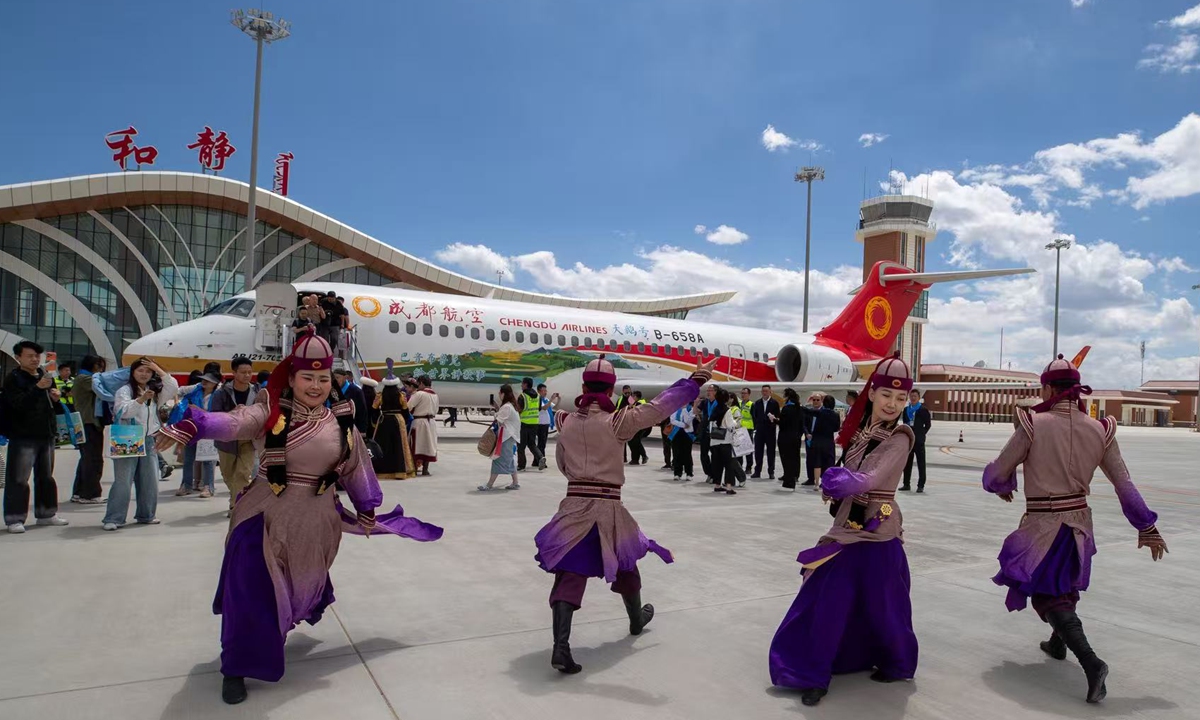
China's domestically developed C909 aircraft has opened its second high-altitude route, with a Chengdu Airlines flight landing at Bayanbulak Airport in Northwest China's Xinjiang Uygur Autonomous Region on June 23. Photo: Courtesy of COMAC
The domestically developed commercial aircraft C909 has been delivered to more than ten airlines, with 186 units in service, accounting for 70 percent of China's regional fleet, the producer Commercial Aircraft Corporation of China (COMAC), said on Sunday, as it celebrated its 10th anniversary of commercial operations in China.
It has carried more than 37 million passengers, operated on over 860 routes, connected around 180 cities, and averages more than 500 flights per day, the COMAC said in a release on Sunday.
COMAC added that over the past decade, from its inception to maturity, from inland to border regions, and from domestic to overseas markets, the C909 aircraft has steadily progressed in large-scale, serialized, and industrialized development.
This marks the C909's emergence as a mainstay aircraft in China's regional air transport market after a decade of commercial operation, COMAC said.
The C909 serves both as China's important step in curbing its dependence on overseas aircraft manufacturers and as a pilot project for developing airworthiness certification frameworks for homegrown civil transport planes, Guo Jia, a veteran market watcher told the Global Times on Sunday.
In his view, the C909 has charted the course for the country's civil aircraft industry through its full cycle of design, production, delivery, certification and operations. This comprehensive experience was crucial to the C919's progress and it also laid a solid foundation for the C919's future overseas airworthiness certification.
The C909, formerly known as the ARJ21, entered commercial service on June 28, 2016. With a layout of 78 to 97 seats, and a range of 2,225 to 3,700 kilometers, the C909 is the first short-to-medium range turbofan regional aircraft independently developed by China in accordance with international civil aviation regulations.
Currently, 70 C909 aircraft are deployed in Northwest China's Xinjiang Uygur Autonomous Region, North China's Inner Mongolia Autonomous Region and Northeast China's Heilongjiang Province, operating over 460 routes, roughly 200,000 flights, and carrying more than 10 million passengers.
The C909 aircraft has opened its second high-altitude route, with a Chengdu Airlines flight landing at Bayanbulak Airport in Xinjiang. The new Urumqi - Hejing - Kashgar service further demonstrates the aircraft's ability to operate safely and reliably in challenging plateau conditions, the Xinhua News Agency reported on Thursday.
COMAC noted that the aircraft is now a key part of China's hub-and-spoke system, efficiently shuttling passengers from regional airports to major hubs while helping airlines maintain flight frequencies and cut costs on less-traveled routes.
COMAC has taken the C909 beyond China's domestic market into Southeast Asia, marking a key step in the country's drive to establish a global presence for its homegrown commercial aircraft.
The aircraft has gradually entered markets including Indonesia, Laos, and Vietnam, and has so far operated 25 overseas routes, serving 28 cities and carrying more than 1 million passengers, according to the producer.
COMAC said the overseas operations have not only validated the C909's performance on short and narrow runways and its adaptability to Southeast Asia's hot and humid climate, but have also helped accumulate operational know-how, expand its customer support network, and build an initial reputation in foreign markets.
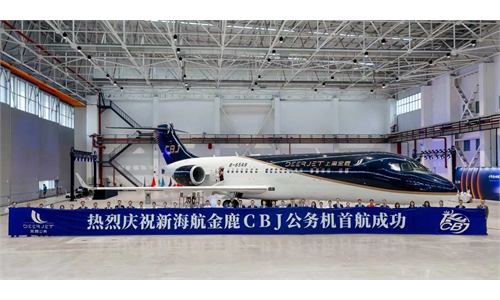
COMAC has also developed several specialized variants based on the C909 platform, including business jet, freighter, medical-transport and emergency-command versions, as it seeks to broaden the aircraft's commercial applications.
The first domestically-made C909 business jet, the CBJ, kicked off commercial service on June 22, operating a flight from Shanghai Hongqiao International Airport to Beijing Capital International Airport.
RELATED ARTICLES