World's largest tension-leg floating wind platform sets sail in China, advancing commercial deployment
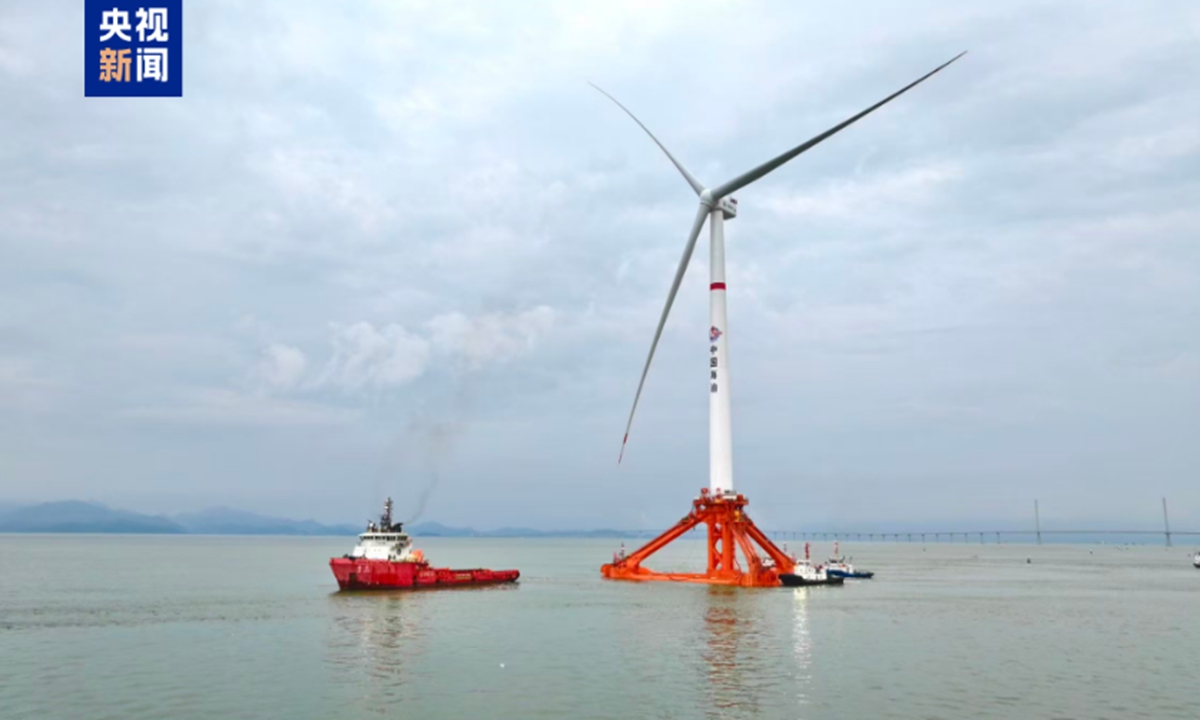
Photo: Screenshot from a report by China Media Group
The world's first 16-megawatt tension-leg floating offshore wind platform departed from Gaolan Port in Zhuhai, South China's Guangdong Province, on Sunday, marking China's accelerated push to scale up and commercialize deep-sea floating offshore wind technology after successful demonstration projects, China Media Group (CMG) reported.
Standing more than 307 meters tall and weighing nearly 8,000 tons, the platform is expected to generate 54 million kilowatt-hours of electricity annually after entering operation, cutting carbon dioxide emissions by about 35,000 tons and reducing fuel oil consumption by roughly 15,000 cubic meters each year, according to the report.
As the global energy transition gathers pace, deep-sea offshore wind is emerging as a strategic frontier. Industry observers said the latest breakthrough will accelerate commercialization, enhance energy security, and strengthen China's leadership in next-generation clean energy technologies.
The electricity generated by the platform will be transmitted directly to an offshore oilfield power grid via subsea cables, enabling deep integration between renewable power generation and offshore oil and gas production while pioneering a new low-carbon model that combines deep-sea offshore wind with oilfield development, CMG reported.
Beyond reducing carbon emissions from offshore oilfield operations, the model is expected to foster the growth and upgrading of the floating offshore wind supply chain in the Pearl River Delta, while contributing a Chinese approach to developing new quality productive forces in the marine economy and building a clean, low-carbon, safe and efficient energy system, according to the report.
This year, China has made major progress in offshore wind power development and related supporting infrastructure.
In early June, the world's largest offshore converter station, "Heart of Sea Wind", completed its offshore floatover installation in Yangjiang, South China's Guangdong Province, entering the final commissioning phase ahead of operation and laying a key foundation for transmitting electricity from large-scale deep-sea offshore wind projects, according to CCTV News.
An offshore converter station serves as the "heart" of an offshore wind farm by collecting alternating current generated by individual wind turbines, stepping up the voltage and converting it into high-voltage direct current before transmitting the electricity to the onshore grid via subsea cables, the report said.
Offshore wind is a key driver of China's low-carbon energy transition. Sited near coastal load centers, it supplies clean power locally, reduces fossil fuel dependence, and helps energy-intensive regions achieve early carbon reduction, Wang Peng, an associate research fellow at the Beijing Academy of Social Sciences, told the Global Times on Sunday.
By displacing thermal generation, it cuts greenhouse gas emissions at source and provides stable green electricity for economy-wide decarbonization, making offshore wind a vital blue engine for carbon-peaking and neutrality goals, Wang noted. "As nearshore sites mature, the industry expands to deeper waters, unlocking vast wind potential."
China is ramping up its offshore wind capacity by developing a number of advanced offshore wind projects, accelerating its energy transition, and solidifying its leading edge in the global wind power sector, according to Xinhua News Agency.
The National Energy Administration's Thursday data showed that, by the end of May, China's total installed power generation capacity had reached 4.01 billion kilowatts, up 11 percent year on year, while installed wind power capacity rose 17 percent to 660 million kilowatts.
Meanwhile, a separate industry report released in Shanghai on June 17 showed that China accounted for 78 percent of newly grid-connected offshore wind capacity worldwide in 2025, maintaining its position as the global leader, according to CCTV News.
RELATED ARTICLES