Qingming travel surge, city football leagues point to consumption expansion
Growing integration of travel, sports, and services reinforces domestic demand as a key growth driver: expert
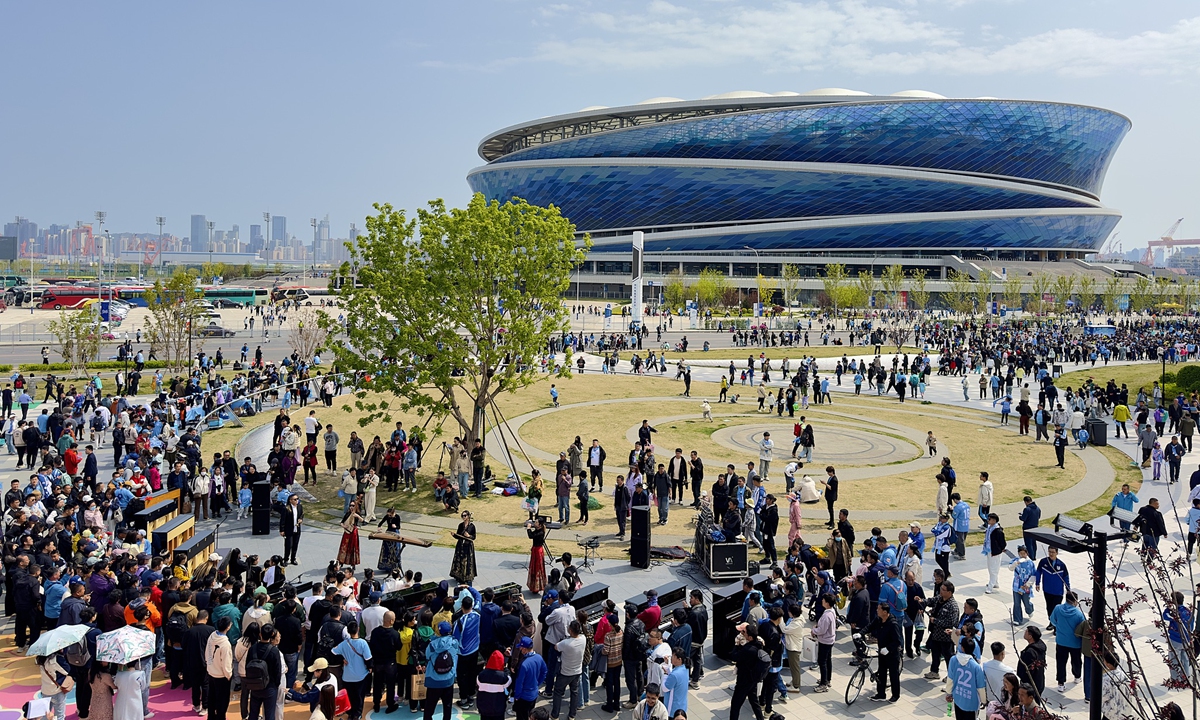
The exterior view of the Suoyuwan Football Stadium in Dalian Photo: VCG
On the final day of the Qingming Festival holiday on Monday, China saw a nationwide surge in return trips, while a new round of provincial city football leagues began to kick off, developments that analysts said reflect a broader expansion of consumption scenarios driven by holiday travel and grassroots sports.
Strong growth in mobility was recorded during the Qingming holiday, which ran from Saturday to Monday. State broadcaster CCTV, citing data from the Ministry of Transport (MOT), reported on Monday that cross-regional passenger trips during the three-day break were expected to total 840 million, up about 6 percent year-on-year, with average daily trips reaching 280 million.
On the first day of the holiday alone, passenger trips exceeded 300 million, up 4.5 percent from a year earlier, with both railway and highway traffic hitting record highs for the period, MOT data showed.
The travel rush also coincided with pilot policies in several provinces, including Jiangsu, Anhui and Sichuan, which linked school spring breaks with the Qingming Festival to create a six-day holiday, a move that analysts said could spur travel and generate additional consumption across related sectors.
The MOT said on Monday that the overlap between spring breaks and the Qingming holiday boosted demand for family and parent-child travel, forming a full-chain consumption scenario spanning transport services, tourism and accommodation, catering, retail and energy supply, CCTV reported.
Zhang Yi, CEO of the iiMedia Research Institute, told the Global Times on Monday that the economic significance of this year's Qingming travel surge lies not only in the scale of passenger flows, but also in the increasingly close link between travel demand and consumption activities such as tourism, dining and leisure.
Zhang said that robust holiday travel reflects improved transport capacity, a richer supply of tourism and related services, and the effect of government's pro-consumption policies.
"A growing range of events, cultural activities and sports programs across regions has strengthened travel incentives and generated additional spending, reinforcing consumption as a key growth driver," he added.
One prominent example of this trend is the rollout of local football leagues across the country, which are emerging as new platforms that combine sports, tourism and consumption, adding fresh momentum to local economic activity.
East China's Zhejiang Province on Monday kicked off its city football league, branded as the "Wuyue Cup," with an opening match held in Jiaxing, according to Zhejiang's provincial sports bureau.
Unlike traditional leagues, the tournament is built around city-based home venues and broad public participation, with 11 prefecture-level cities in Zhejiang fielding official teams composed entirely of local amateur players. There are no active professionals among the 627 participants, and students account for 44.6 percent, underscoring its grassroots nature, official data showed.
The event has demonstrated strong economic potential. In 2025, the league staged 77 matches in its 10th edition. Over the past decade, it has attracted more than 30 million spectators both online and in person, helping to boost the local sports sector and related cultural and tourism activity, according to China News Service.
More leagues are set to follow, with city football leagues in East China's Jiangsu and Shandong provinces, Central China's Hubei Province, and South China's Guangdong Province scheduled to kick off successively in April.
According to the Jiangsu provincial government, the second season of the "Su Super League," featuring 13 teams representing cities across the province, will begin on April 11.
The league has already built strong momentum. Last year, it ran for nearly six months, attracting more than 2.43 million spectators over 176 days, with an average attendance of 28,000 per match. The final drew a record crowd of 62,329, according to the Xinhua News Agency.
Zhang said that such events not only encourage greater public participation in fitness and reflect people's growing pursuit of healthier lifestyles, but also serve as effective drivers of cultural and tourism consumption.
"They provide new entry points for consumption, catering to rising demand for higher-quality, experience-driven spending while aligning with broader efforts to improve people's well-being," he said.
A recent research note from Guojin Securities, cited in media reports, pointed out that as supply-side improvements in services consumption continue, household consumption demand is expected to be further released, with culture, tourism and sports events standing out as key growth areas.
The report added that events such as the "Su Super League" have, through a coordinated "government-market-society" model, improved operational efficiency while unlocking consumption vitality, helping address bottlenecks in the supply of high-quality cultural and tourism events.
The momentum also aligns with China's broader policy push to boost consumption and expand domestic demand. On Friday, the Ministry of Commerce, together with eight other government departments, unveiled a 2026 work plan to promote services consumption, pledging to unlock consumption potential and better meet more diverse and upgraded demand. The plan outlines 64 measures covering sectors such as catering, accommodation, culture, tourism, sports and healthcare.
Zhang said that as holiday travel remains robust and grassroots sporting events continue to gain traction, their interaction is creating more diversified and locally rooted consumption drivers, offering sustained support for China's domestic demand.
RELATED ARTICLES