China's cumulative installed capacity of wind, PV power exceeds 1.8b kW for first time
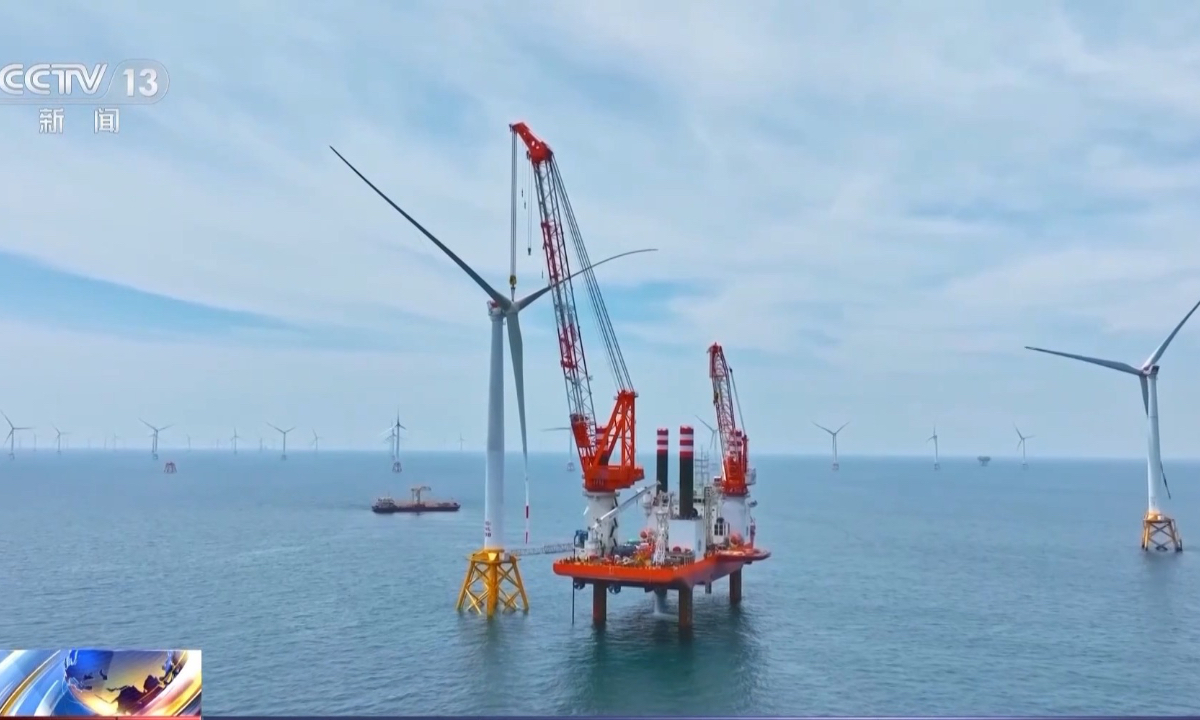
China's farthest offshore wind power project, the Three Gorges Jiangsu Dafeng Offshore Wind Power Project, achieves full-capacity generation and grid connection on December 15, 2025. Photo: Screenshot from China Media Group
China's cumulative installed capacity of wind and photovoltaic (PV) power has for the first time exceeded 1.8 billion kilowatts, according to the latest data released by the National Energy Administration (NEA), underscoring the rapid growth of the country's related green industries.
According to the NEA posted on its website on Thursday, as of the end of 2025, China's total installed power generation capacity reached 3.89 billion kilowatts, up 16.1 percent year-on-year. The cumulative installed capacity of wind and PV power has for the first time exceeded 1.8 billion kilowatts, reaching 1.84 billion kilowatts and accounting for 47.3 percent of the total.
In 2025, the cumulative installed capacity of wind and PV power surpassed that of thermal power for the first time in history, exceeding it by about 300 million kilowatts. Over the past four years, newly added wind and PV capacity has consecutively surpassed the thresholds of 100 million, 200 million, 300 million, and 400 million kilowatts, the People's Daily reported.
By advancing both centralized and distributed development, China is accelerating large-scale wind and PV power bases in desert, Gobi, and other arid regions, while promoting orderly offshore wind development, expanding urban and rural rooftop photovoltaics, and encouraging decentralized rural wind power, the report said.
As a result, China has built the world's largest and fastest-growing renewable energy system, with wind and PV capacity accounting for nearly half of the global total, the People's Daily report said.
The remarkable figures underscore the accelerated green and low-carbon transition in China's energy consumption structure, with renewable energy seeing leapfrog development and the share of non-fossil energy consumption continuously on the rise, Lin Boqiang, director of the China Center for Energy Economics Research at Xiamen University, told the Global Times on Thursday.
Lin said that the achievements lay a solid foundation for building the country into an energy powerhouse.
China will strive to reach peak carbon dioxide emissions before 2030 and carbon neutrality before 2060.
Against this backdrop, during the 15th Five-Year Plan period (2026-30), electricity demand is expected to continue growing at a relatively fast pace, while the structure of power supply will become more diversified. Compared with the 14th Five-Year Plan period (2021-25), the construction of a new-type power system will be more urgent and face greater challenges, the Xinhua News Agency reported.
For example, China's annual newly installed wind power capacity will be no less than 120 million kilowatts during the 15th Five-Year Plan period, including at least 15 million kilowatts of offshore wind power added each year. This will ensure that China's cumulative wind power installed capacity reaches 1.3 billion kilowatts by 2030, the Economic Information Daily reported.
"China's new energy development has made significant contributions to the world, providing a viable low-carbon solution," Lin said.
RELATED ARTICLES