Shantou’s experience in wind energy highlights opportunities in China’s green transition
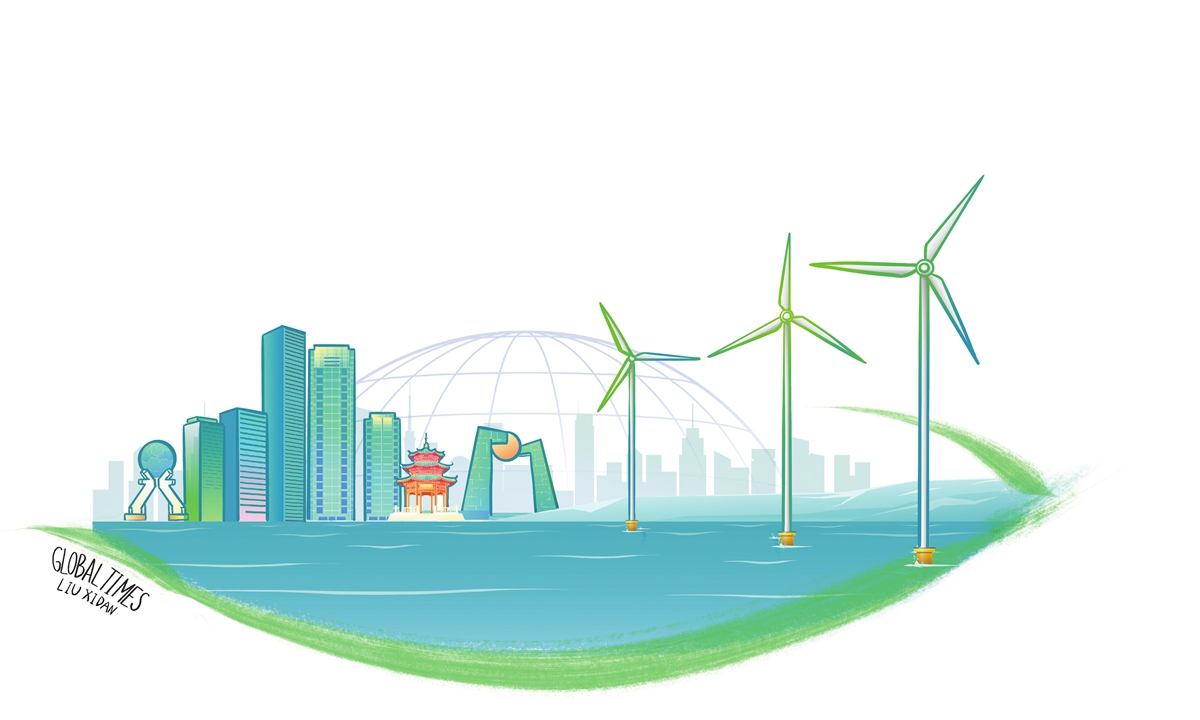
Illustration: Liu Xidan/GT
As World Wind Energy Conference 2025 is scheduled to convene on Wednesday in Shantou, a coastal city in South China's Guangdong Province, the event may offer a valuable vantage point for observing China's wind power industry at close range. Shantou provides a concrete example of how incremental advances in wind energy take shape on the ground, offering a clearer sense of the practical forces that guide the sector's development.Against the backdrop of a global push to address climate change and accelerate the transition to low-carbon energy, wind power, as an important component of the clean-energy mix, is entering a period of real opportunity.
The challenge, contrary to narratives in some Western media outlets of so-called overcapacity, lies in expanding these opportunities and translating current momentum into scalable, commercially viable growth. Shantou's experience offers a useful perspective on this issue, illustrating how wind energy development can generate meaningful spillover effects for local economies, support related industries, and reinforce broader regional activity.
A recent report from Shantou Fabu highlights efforts to integrate "computing power with green electricity," leveraging six international submarine cables and an estimated 60 gigawatts of offshore wind potential. The approach is pragmatic: energy-intensive data-processing centers require reliable, low-carbon power, and wind energy is among the few renewable sources capable of meeting that demand at scale. By linking renewable generation with digital infrastructure, Shantou demonstrates how wind power can support emerging industries while making efficient use of local energy resources.
Media reports suggest that Shantou has developed a large-scale, concentrated offshore-wind industrial cluster, providing a reliable source of green momentum for the region's ongoing energy transition. Wind power projects are progressing in an orderly manner, and local firms have delivered a range of technological advancements. Taken together, these developments demonstrate how coordinated industrial activity can strengthen both energy capacity and technological capability in a sustainable way.
The development of Shantou's wind energy sector has provided a constructive boost to the local economy, particularly supporting emerging industries that rely on stable power. Shantou's experience is by no means isolated. Across broader regions of China, the wind energy sector is expanding rapidly and contributing positively to economic development, illustrating how the growth of renewable energy can reinforce both industrial capacity and regional economic activity.
China's green and low-carbon transition continues to gain momentum. In the first half of this year, new wind and solar installations doubled year-on-year. As of the end of June, total installed wind power capacity nationwide had reached 573 million kilowatts, according to the People's Daily.
Some regions around the world possess abundant natural wind resources but lack sufficient local production capacity and technical expertise in wind power. The transition to clean energy can further stimulate local economies and support the development of emerging industries. Globally, there is no evidence of systemic overcapacity; instead, what is needed are cost-effective, technologically advanced, and reliable clean-energy solutions that enable local energy transitions while providing stable power to underpin economic growth.
It would be valuable to have more examples like Shantou, where renewable energy and emerging industries develop in tandem, offering tangible illustrations of how initiatives involving clean energy can support economic activity. The upcoming World Wind Energy Conference 2025 will provide international experts and industry professionals with an opportunity to observe these developments firsthand, gaining direct insight into the practical realities of China's clean-energy sector and helping to correct misconceptions sometimes conveyed in media narratives.
China's wind power industrial chain and manufacturers are advancing rapidly, opening new avenues for international collaboration across the sector. With low-cost, technologically advanced, and highly reliable green power solutions, China has become an important contributor to the global energy transition and the fight against climate change.
There are many examples of how China's wind industry is supporting green development around the world. For instance, the Xinhua News Agency recently reported that Vietnam's Binh Dai offshore wind project - China's first offshore wind power project abroad - has completed grid connection for its first three phases totaling 141 megawatts. The project is expected to reduce Vietnam's carbon dioxide emissions by 26,200 tons each year.
Renewable energy is not only a cost-effective way to address climate change but also a substantial economic opportunity. For economies with significant potential in renewable energy, cooperation with Chinese companies in the development of wind power not only supplies clean energy and cuts emissions, but also creates local jobs, improves technical capacity, and brings tangible benefits across the environment, energy, the economy, and people's livelihoods.
The author is a reporter with the Global Times. bizopinion@globaltimes.com.cn
RELATED ARTICLES