World’s first urban-use mW-class high-altitude wind turbine completes test flight
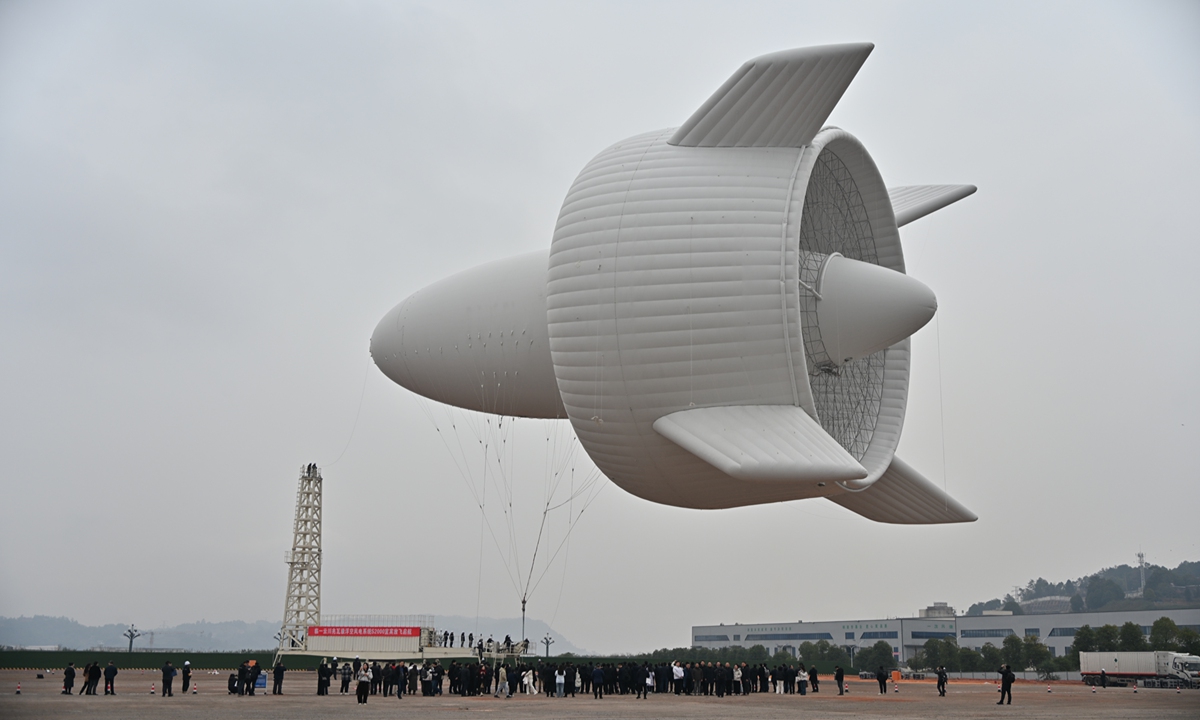
World's first megawatt-class urban-used high-altitude wind power system - the S2000 Stratosphere Airborne Wind Energy System (SAWES) - completes its test flight in Yibin, Southwest China's Sichuan Province, on January 5, 2026. Its hourly electricity output can fully charge approximately 30 electric vehicles from zero to full. Photo: Tao Mingyang/GT
The world's first megawatt-class high-altitude wind power system designed for urban deployment — the S2000 Stratosphere Airborne Wind Energy System (SAWES) — successfully completed a test flight in Yibin, Southwest China's Sichuan Province, on Monday. The achievement marks a key breakthrough as China's high-altitude wind energy technology advances from experimental validation toward engineering-scale application.
From an environmental perspective, SAWES offers clear advantages, including a simpler structure, lower land requirements, and reduced environmental impact compared with conventional wind farms, according to experts.
The S2000 SAWES is an integrated airborne wind energy system that incorporates an airship platform and wind turbines into a single unit, and the whole system is 60 meters long, 40 meters wide and 40 meters high.
After an ascent of approximately 30 minutes, the S2000 reached an altitude of 2,000 meters during the test flight and generated 385 kilowatt-hours of electricity. It also successfully completed grid-connected power generation, becoming the world's first high-altitude wind power device to be formally connected to the power grid.
Dun Tianrui, CEO and chief designer of the system's main developer, Beijing-based start-up Sawes Energy Technology, told the Global Times on the sidelines of the test flight that the S2000 model can be deployed at altitudes of up to 2,000 meters, with a single-unit power output of about 3 megawatts.
"At its current output level, one hour of operation can generate enough electricity to fully charge approximately 30 top-spec electric vehicles from zero to full," he said.
Compared with the S1500 model previously tested in Hami, Northwest China's Xinjiang Uygur Autonomous Region, from September 19 to 23, 2025, the S2000 features greater payload capacity and a fully upgraded weather-resistance design. These enhancements enable the system to operate not only in remote environments such as deserts and the Gobi, but also within urban settings, the company told the Global Times.
The entire S2000 SAWES can be transported in containers, and it takes only eight hours from site preparation in Yibin to full inflation, said Dun, noting that with local gas supply, the entire process can be reduced to four to five hours.
The system combines mature wind power technology with an airborne platform and is deployed at high altitudes, where stronger winds offer greater power generation potential, Wang Yanan, editor-in-chief of Aerospace Knowledge magazine, told the Global Times on Monday, adding that its airborne design allows flexible deployment and retrieval, making it especially suitable for sparsely populated areas where large-scale infrastructure is difficult to build.
According the National Energy Administration, as of the end of November 2025, China's total installed power generation capacity reached 3.79 billion kilowatts, up 17.1 percent year-on-year. Of this, installed wind power capacity reached 600 million kilowatts, up 22.4 percent year-on-year.
Wang noted that the key to SAWES' commercialization lies in whether the costs of manufacturing, deploying, retrieving, and transmitting electricity from the airborne system can be covered - or even exceeded - by the power it generates.
RELATED ARTICLES