AI plays growing role in college applications after gaokao, experts say it bridges information gaps but human judgment remains key
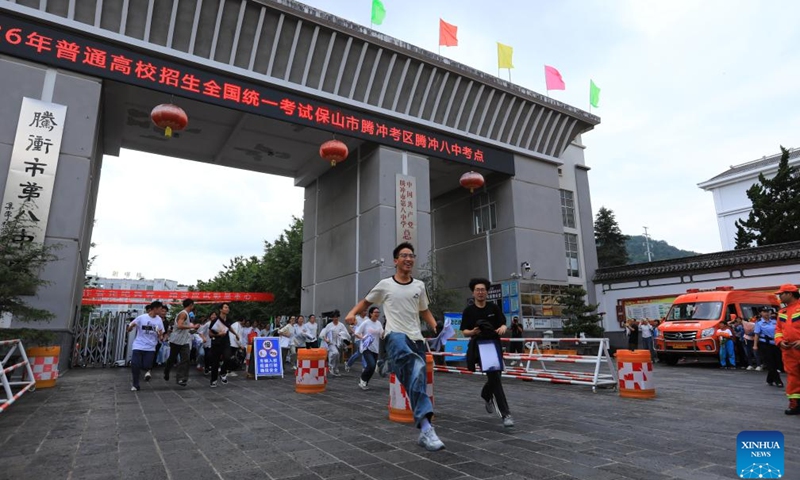
Students celebrate after the national college entrance exam in Tengchong, southwest China's Yunnan Province, June 9, 2026. China's national college entrance exam, also known as the gaokao, began on June 7 this year. The exam in some regions has ended on Tuesday. (Photo: Xinhua)
As China's university application season gets underway following the national college entrance exam, or gaokao, artificial intelligence (AI) has emerged as a new adviser for millions of students and parents, with many turning to AI tools for guidance on university and major choices. A Chinese expert said that AI can help narrow information gaps, but major life decisions still require careful human judgment.
According to data from iiMedia Research, the number of users of AI-powered college application tools in China is expected to exceed 92 million in 2026. About 78.4 percent of candidates have used AI to search for universities or generate application plans, while more than 60 percent of parents regard AI-generated recommendations as a key reference in the application process.
From the Ministry of Education's official AI mini-program to free services rolled out by leading internet companies, the threshold for using intelligent application tools continues to fall.
Around June 10, China's leading internet platforms moved quickly into the university application advisory market. Alibaba's Qwen launched what it described as the country's first full-cycle university application planning agent; Tencent Yuanbao, together with QQ Browser, rolled out Yuanbao Gaokao Tong; Baidu added a gaokao section to its Wenxin assistant; and ByteDance's Doubao opened its own university application planning service. All of the services are free to use.
On June 13, the Ministry of Education upgraded and relaunched its "Sunshine Gaokao" application information service system, offering a free, one-stop public service for students and parents based on large volumes of authoritative data on admissions, student records, employment and graduate tracking surveys.
The system integrates real historical admissions data from universities across China and provides application-filtering services for regular undergraduate and vocational college batches in 31 provincial-level regions. By entering information such as elective subjects and ranking, candidates can receive AI-generated application recommendations.
Wu Di, whose child took the 2026 gaokao, told the Global Times that she is open to use AI to search for information gathering because it is free, fast and helps her explore a wide range of information options.
"I find it quite useful, but I will still listen to different voices, including teachers, acquaintances working in the education sector and, most importantly, my child's own views," Wu said.
"Using AI to choose college majors does help students and their families bridge information gaps," Liu Dingding, a veteran internet observer told the Global Times. Although information is more accessible than ever, many families still struggle to understand university programs, admission policies and career prospects, he said.
"AI is transforming the process by rapidly analyzing vast amounts of data and generating personalized recommendations based on a student's academic performance, interests and target universities," Liu said.
But Zhang, an IT worker whose child is preparing for the gaokao, takes a different view. He told the Global Times on Sunday that he would not over-rely on AI when mapping out college application choices, citing worries over AI hallucinations and the information gaps that AI alone cannot fill.
"Filling out gaokao applications is too important to depend on AI. I would not dare to do that, because its accuracy still falls short of what you can get through research," Zhang said. "Unless a family knows almost nothing about universities or majors, and is unwilling to pay for professional consulting or does not trust such services, AI may only be useful for obtaining basic information and serving as a reference."
"In fact, experience shared by real users on platforms such as Xiaohongshu can sometimes be more accurate than AI-generated answers. AI is not reliable enough yet for such a major decision," he said. "For less critical tasks, such as planning a travel itinerary, AI is completely fine."
Liu said AI is not flawless and can sometimes produce errors or even fabricate majors or programs. "Given the long-term impact of college applications, many families remain cautious on AI," Liu said. "Some use it as an efficient support tool, while others still turn to consultants, teachers or trusted acquaintances."
As AI technology continues to advance, more Chinese people are adopting AI tools. By December 2025, China had 602 million generative AI users, up 141.7 percent from the end of 2024, official data showed. Data from OpenRouter, the world's largest AI model API aggregation platform, showed that global large model usage reached 46.7 trillion tokens in the week from June 15 to 21. China's large model usage reached 18.81 trillion tokens that week, ranking first globally for the eighth straight week.
In the long run, AI-assisted college application planning is an irreversible trend, Liu said. As AI models continue to evolve, they will provide high-quality guidance at little or no cost, further narrowing information gaps between families. Human consultants will continue to play a role, particularly in personalized and premium advisory services, but AI should always be viewed as an assistant rather than a decision-maker.
Liu emphasized that AI should support, rather than replace, human decision-making. "When it comes to major life decisions, the most important thing is still to follow your own judgment and aspirations," Liu said.
RELATED ARTICLES