Expanding durian imports from ASEAN backed up by China's 'soft infrastructure' system
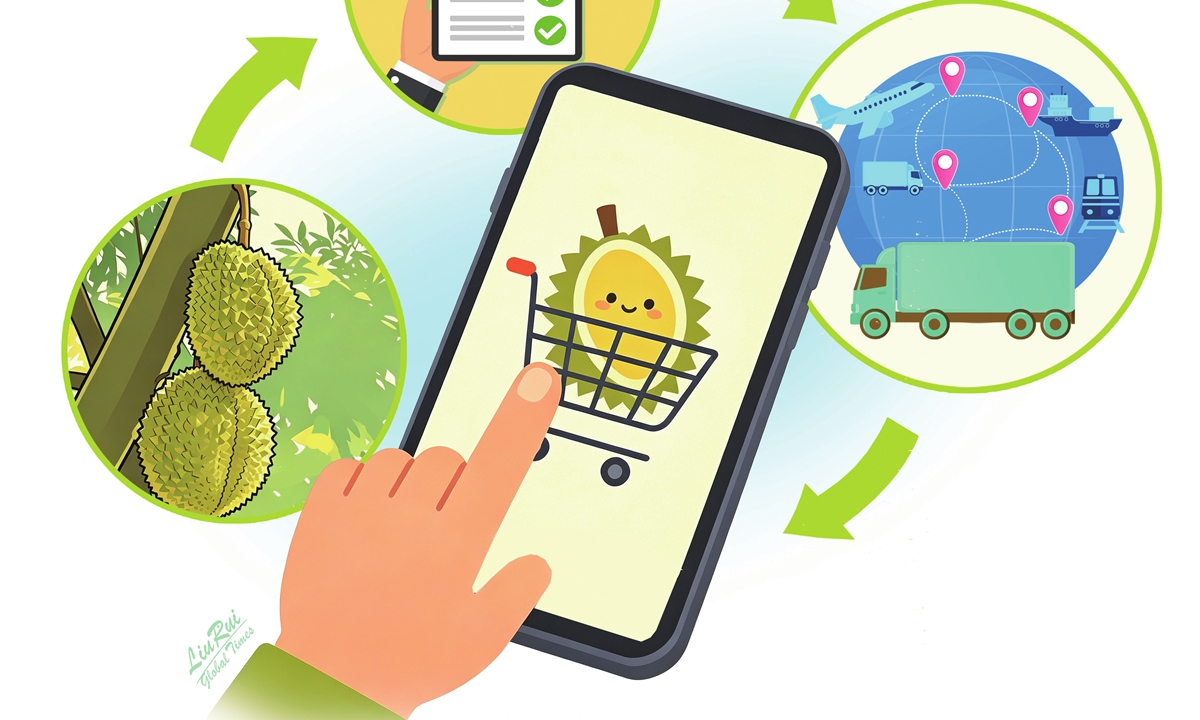
Illustration: Liu Rui/GT
Durian has become one of the favorite fruits among Chinese for many years. This summer, however, what determines whether durians from Southeast Asia can truly win the massive Chinese market is no longer only transportation efficiency. Increasingly, success depends on who can respond faster and more precisely to the evolving demand of vast Chinese consumers.In a sprawling fruit market in Zhengzhou, capital city of Central China's Henan Province, placing imported fresh durians in the shopping carts this summer is not driven solely by efficient cold-chain logistics and transportation networks there.
It is also backed up by an improving ecosystem of market services, including origin-based direct procurement, supply-demand matchmaking platform, express customs clearance, prompt financial service, as well as advanced information and technical support system, according to a report by people.com.cn over the weekend.
Together, these systems help form what can be described as a "soft infrastructure" that connects overseas suppliers more directly and efficiently with the Chinese market, providing an impeccable platform for the circulation of imported agricultural products.
This development points to a deeper structural shift. With the upgrading of consumption patterns and the continuous improvement of the supply chain, China is not only expanding its agricultural imports but also reshaping the global agricultural supply chain toward higher efficiency and higher value-added coordination.
A crucial driver accelerating this transformation is the ongoing upgrade in Chinese consumer demand. For instance, the New York Times reported in February that over the past year or so, many Chinese consumers have moved away from frozen durian shipments and increasingly prefer fresh fruit. This shift in preference has raised the bar for the supply chain players, requiring faster logistics, more precise coordination, and closer alignment between overseas suppliers and Chinese consumers.
A single durian from Southeast Asian travels thousands of kilometers before reaching Chinese consumers. But the journey is not merely physical. It is also embedded in a broader value chain composed of market information, procurement channels, and shifting consumer preferences.
Cold-storage facilities, cross-border transportation corridors, and large-scale distribution hubs form the "hard network" of agricultural trade circulation. In contrast, organized sourcing at origins, supply-demand matchmaking mechanisms, information-sharing platforms, and cross-border coordination services constitute the "soft network" that empowers global suppliers.
For instance, in South China's Guangxi Zhuang Autonomous Region, where fruit imports from ASEAN countries through the border ports have expanded significantly in recent years, and a series of institutional and service upgrades have been implemented at the ports. At several ports there, dedicated inspection laboratories have been set up for imported durians and other fruits. The inspection capacity for imported and exported fruit has reached 180 batches per day, 2.5 times the level before the system upgrade, according to a report by people.com.cn.
What increasingly determines whether imported fruit performs well in the Chinese market is the invisible layer of services: market coordination, information connectivity, and organizational capability. Emerging from China's vast consumer market, rapidly advancing trade digitalization, and high-level opening-up, these systems function as essential market infrastructure.
Supply-demand matchmaking events help bridge structural gaps between the buyers and the sellers. Origin-based direct procurement reduces intermediary layers. Real-time consumption data feeds back into production decisions at overseas farms, influencing planting cycles, varietal selection, and harvesting strategies. Together, these mechanisms form a service-driven circulation system rooted in China's large-scale consumer market, creating a distinctive form of "soft infrastructure" in agricultural trade.
As more Southeast Asian durians and tropical fruits enter everyday consumption in China, what is unfolding is not only an expansion in trade volume, but also an upgrade of the underlying circulation system. This shift offers a new model for global trade.
For Southeast Asian growers and a broader range of global agricultural suppliers, understanding and integrating into this service-based market system is becoming an important pathway to accessing the Chinese market.
The author is a reporter with the Global Times. bizopinion@globaltimes.com.cn
RELATED ARTICLES