China launches 'yisuan computing ark' full-stack platform to help solve software designing challenges

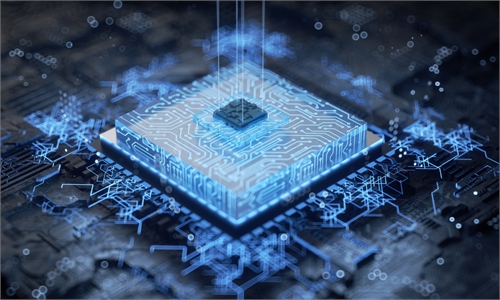
A concept photo of GPU and computing power Illustration: VCG
The "yisuan fangzhou," literally means "heterogeneous computing ark," a full-stack platform aiming to solve software ecosystem issues for domestic computing power, was officially released on Monday. The platform addresses key pain points in China's high-performance computing: difficulty in adapting software to domestic hardware, challenges in migrating code, and complicated operations for researchers, the developers said.
Industry experts said that the "heterogeneous computing ark" platform will fill a critical gap in China's domestic computing software ecosystem.
By automating code migration and optimizing performance in software engineering, it greatly reduces the cost and difficulty for research institutes and industrial enterprises to use domestic computing power. This will help build an independent, efficient, and user-friendly scientific computing ecosystem in China.
Developed by the Computer Network Information Center (CNIC) of the Chinese Academy of Sciences and partner institutions, the platform addresses long-standing pain points in China's high-performance computing sector: the difficulty of adapting existing software to domestic GPUs, the complexity of migrating code, and the cumbersome operations faced by researchers, according to a statement by CNIC.
"Although China has made rapid advances in developing its own high-performance computing hardware, such as domestic GPUs, the supporting software ecosystem still lags. Many scientific programs and industrial codes are hard to run efficiently on domestic systems, and complex operations slow down research and industrial applications, as well as the efficiency of research and development in science and engineering," the CNIC statement explained why the platform matters in the statement.
The new "heterogeneous computing ark" platform offers an all-in-one solution to help scientific software adapt, migrate, and run efficiently on domestic computing infrastructure, analysts said.
Wang Yanfang, a researcher at the CNIC, said in the statement that the team will continue to focus on AI for Science, domestic GPU adaptation, high-performance scientific computing software, and intelligent toolchains. "We plan to keep upgrading the platform to better serve pilot bases and various scientific and engineering applications."
At its core, the platform consists of three integrated layers. Analysts pointed out that in simple terms, the platform connects algorithms, cross-system compatibility, and full-chain applications, helping China move from leading in hardware to achieving mature software-hardware integration.
The bottom layer features the "nine derivatives hub" algorithm library, which includes 16 high-performance computing tools covering areas such as linear algebra, parallel computing, fluid simulation, biological computing, and deep learning. These tools are fully optimized for domestic computing architectures and can deliver more than ten times faster performance in key calculations.
The middle layer is powered by the self-developed "BoundX" large model, which can automatically convert code to work across varied computing environments. This significantly reduces the need for time-consuming manual rewriting and lowers the technical barrier for migrating existing software and research codes, said CNIC.
The top layer provides researchers with a simple, user-friendly one-stop operating environment by providing an intelligent agent "Agent-HiReFlow." It simplifies complex tasks such as simulation, modeling, and job scheduling. The intelligent agent uses multi-agent technology to automate processes, particularly in fluid simulation and other engineering applications.
Global Times
RELATED ARTICLES