VW shareholder urges China-model production in Germany as Chinese expert says tech can help but EU climate must improve
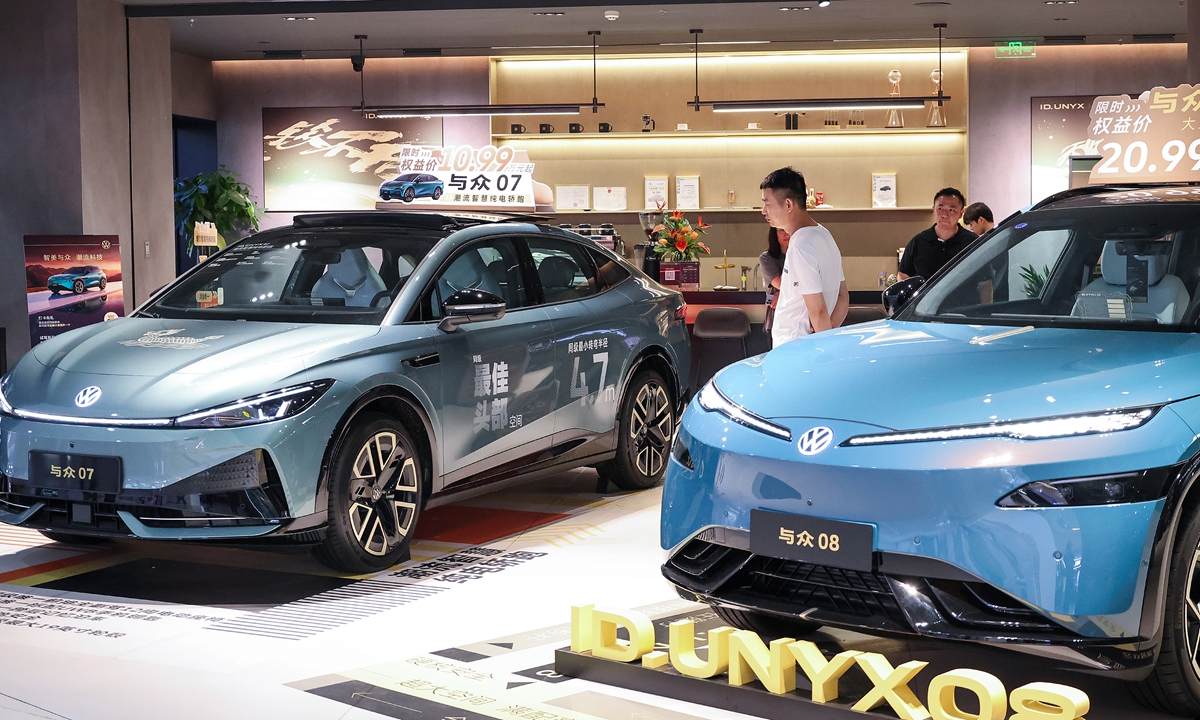
Visitors check out Volkswagen Anhui models during a new energy vehicle trade show in Shanghai on June 20, 2026. Photo: VCG
Volkswagen could secure jobs in Germany if it produces auto models there that it currently develops in China, said Olaf Lies, premier of the German state of Lower Saxony, where Volkswagen is headquartered, stressing that isolating oneself from technological developments originating in China will be "the wrong approach," German news agency DPA reported.
A Chinese expert said China's electric vehicle (EV) industry has strong competitiveness, and thus industrial chain integration between China and the EU in this regard will increase mutual complementarity; however, the EU should foster a sound investment and business environment for Chinese companies, as a series of protectionist measures from the EU deteriorate economic and trade relations with China, the expert said.
"If we produced vehicles here that we currently make in China, we could stabilize capacity utilization of our plants," Lies said in an interview with DPA. "This would also create the opportunity for new development and innovation at our locations. To me, it's about stabilizing employment and capacity utilization at our plants, instead of watching others build new plants outside of Germany," he said, following media reports claiming that the auto giant is considering shutting four German factories and cutting up to 100,000 jobs.
This reflects a reversal in industrial flows: Whereas in the past, Germany and Europe as a whole invested in and built factories in China, a new trend may be emerging in which Germany is attracting joint brands from China to manufacture in Germany, Jian Junbo, director of the Center for China-Europe Relations at Fudan University's Institute of International Studies, told the Global Times on Monday.
Given the global competitiveness of China's EV industry, investments by Chinese automakers are highly beneficial to Europe, for example, Chinese lithium-ion battery companies' investment in Europe provides critical support for European EV manufacturing, Jian said.
Volkswagen has been collaborating with Chinese partners for decades. Through partnerships with companies such as XPeng and SAIC, the group has been able to rapidly close the gap in development and boost its competitiveness, Lies said.
Lies also said that isolating Germany from technological developments originating in China will be the wrong approach. "Our goal must not be to wall off technological developments from one another," he said, according to DPA. The report said that as early as April, following a trip to China, Lies had advocated examining the possibility of manufacturing Chinese cars at German Volkswagen plants.
"China is and remains an indispensable partner for Lower Saxony, particularly in future technologies such as battery production, autonomous driving, and innovative mobility solutions. We saw this firsthand today in Shanghai. China is also one of the most important markets worldwide for Volkswagen. That is why it is important to maintain close cooperation," Lies posted on social media platform LinkedIn in April when visiting China.
Volkswagen didn't immediately reply when reached by the Global Times for comment on Lies' remarks.
Industry observers, however, said that deepening ties with Chinese partners has become a strategic imperative for the German automaker. Struggling in the EV market, Volkswagen has an urgent need to team up with China's new car-making forces to tap into China's tech advantages for new model development so as to maintain its international competitiveness, Zhang Xiang, secretary-general of the International Intelligent Vehicle Engineering Association, told the Global Times on Monday.
"Currently, some systems in EVs are shared with traditional fuel vehicles, particularly in body structures, doors, hoods and certain chassis components. However, core elements like the electric motor, battery, and electronic control systems are entirely new. This is precisely where German automakers need to collaborate with Chinese automakers - to leverage each other's strengths and offset weaknesses," Zhang said.
However, the feasibility of Volkswagen producing China car models in Germany remains to be seen, given higher costs and intense China-EU economic and trade relations, the expert said.
The EU's economic security agenda toward China has hardened noticeably in 2026, coming up with a series of protectionist instruments on trade and investment.
Chinese and EU teams have held intensive consultations this week, conducting discussions on China-EU economic and trade issues in preparations for the first meeting of the China-EU Trade and Investment Consultation mechanism, the Global Times learned from a source familiar with the matter, who warned that the EU's lack of sincerity is raising concerns that China-EU ties may drop to a freezing point.
"Europe should provide a sound investment and business environment for Chinese companies. Currently, there is considerable skepticism and concerns among Chinese firms regarding the European market, which poses a major challenge," Jian said, calling on the EU to properly manage its relations with China.
RELATED ARTICLES