Hunan Province requires fireworks producers to reward workers for reporting safety hazards after Liuyang blast killing 37
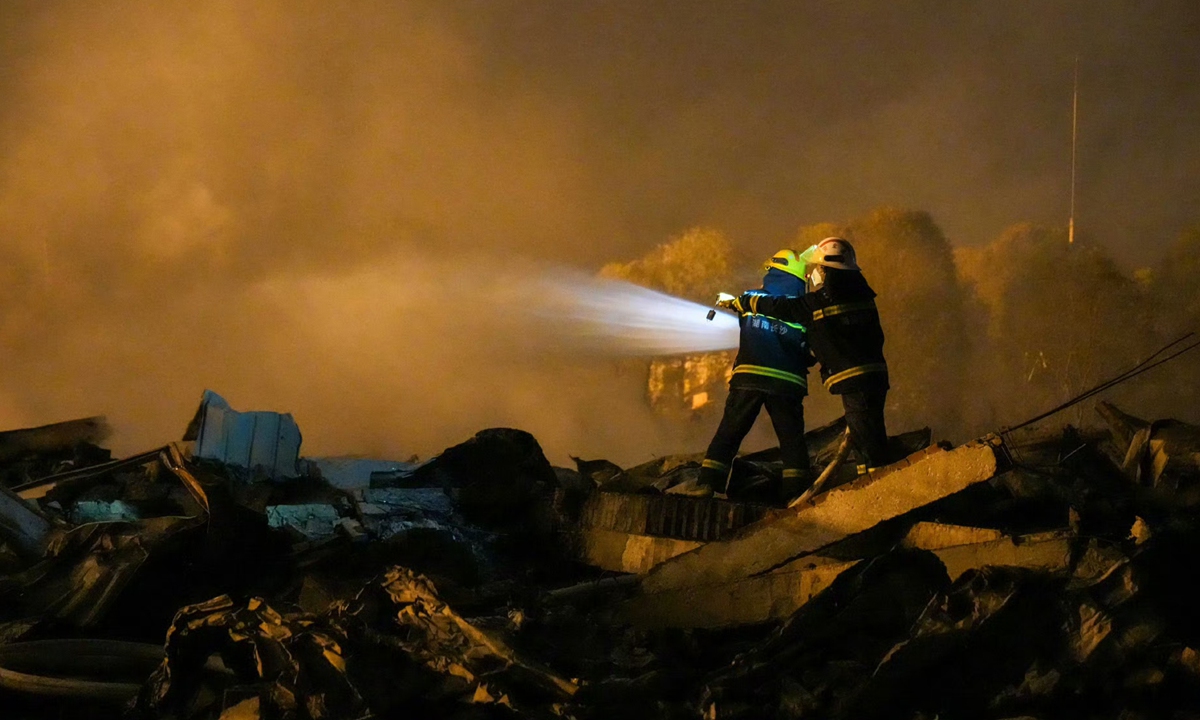
Rescue teams conduct operations at the accident site in Guandu twoship, Liuyang, Central China's Hunan Province on early morning on May 5, 2026. Photo: Sina Weibo account of Xinhua News Agency
Central China's Hunan Province has introduced a new regulation on firecracker production safety, requiring producers to set up internal reward systems for those who report hidden hazards, after a deadly explosion at a fireworks factory in Liuyang in May which exposed serious safety risks in the sector.
A set of provisions on the safety management of fireworks and firecracker production in Hunan was adopted on Monday at the 23rd session of the Standing Committee of the 14th Hunan Provincial People's Congress, which took effect the same day, according to an announcement seen on the website of the provincial legislature.
Under the new regulation, fireworks and firecracker producers must establish internal systems to reward workers for reporting hidden hazards. Labor-intensive enterprises are required to set aside safety reward funds equivalent to no less than 5 percent of their employees' total wages, while other enterprises must set aside funds of no less than 10 percent.
The funds will be used to reward employees who report hidden risks. Any remaining funds may be used for internal safety production performance rewards, according to the regulation.
The regulation notes that if an enterprise fails to promptly rectify hazards reported by employees, the employees may report the case to local governments at various levels and relevant departments.
For clues involving serious violations, the person whose report is verified will receive a reward of between 20,000 yuan ($2,760) and 50,000 yuan from emergency management authorities. Those who report unlicensed production, irregular operation, transportation or illegal storage of firecrackers may receive rewards of up to 300,000 yuan.
The regulation requires governments and relevant departments to keep informants' personal information confidential.
The regulation followed the May 4 explosion at a facility operated by Huasheng fireworks manufacturing and display company in Liuyang, a county-level city under Changsha, capital of Hunan Province. The explosion left 37 people dead.
After the accident, Hunan held a provincial work conference on production safety on May 5 and launched a province-wide campaign to rectify safety risks, according to Xinhua.
Beyond the internal reporting reward mechanism, the regulation also clarifies who bears responsibility for safety production. It states that the legal representative, actual controller or other main decision-makers of a firecracker producer, including ultimate beneficiaries and behind-the-scenes controllers, are the first persons responsible for safety production.
According to the new regulation, fireworks producers are required to carry out closed-loop management covering the purchase, warehousing, storage, use, consumption and verification of black powder, fuses, explosives and explosion-prone chemical raw materials. Enterprises must establish both electronic and paper ledgers and truthfully declare transportation permit quantities based on designed production capacity, production plans and real-time storage capacity.
The regulation also requires relevant enterprises build and use facial and vehicle recognition access systems, full-video surveillance, and emergency management risk monitoring and early warning systems.
It further targets major safety violations such as overcrowding in production or storage areas, excessive storage of explosive materials, production beyond approved categories or risk levels, and unauthorized changes to workshops or production processes that increase safety risks.
Global Times
RELATED ARTICLES