IN-DEPTH / IN-DEPTH
How the 'American story' was built and how it is losing its credibility
A narrative that no longer sells
Editor's Note:
"It's our 250th birthday, and no one seems to know what we're celebrating." In a recent article published by The Atlantic, Yoni Appelbaum, the magazine's deputy executive editor and a cultural historian, said bluntly that without a coherent national story, the US "will fail to be a coherent nation."
Some observers say the US' greatest crisis today is not economic weakness or military decline, but the fact that many people believe that the "American Dream" is no longer achievable. Once-powerful US soft power is now facing its most serious crisis of trust since the end of the Cold War.
In this story, we trace the long history of the US' repeated reconstruction of its national narrative, examine why the US national identity has become so deeply fractured, and explore whether this country can bridge its divides and tell its story anew.
'American story' falls silent
In The Atlantic article, Appelbaum mentioned a discussion he was invited to take part in, which took place in 2019. By then, the organizers had come to realize that US democracy was in steady decline and that the country needed a shared narrative. Yet they found themselves deeply divided over what that narrative should be. So they turned outward, inviting jurists, Ivy League professors, journalists, theologians and others in the hope of finding fresh ideas.
At the discussion, when the facilitator asked participants to list words or concepts that all Americans could endorse, an uncomfortable silence permeated the air. Appelbaum volunteered "patriotism." The word, he recalled, "had rolled a live grenade into the center of the room," with "voices and tempers rising." One woman said the word made her feel excluded. Another said it connoted violence and racism. Still another participant was offended that anyone could be offended by the word, Appelbaum recalled in the article.
"All of the people in the room had come here for the specific purpose of finding a common narrative," he wrote. "What hope did that project have if they could not even agree - each in their own way - on loving the country they were trying to save?"
This scene is a microcosm of the rupture in US cultural cohesion and narrative identity. The US has always been a vast and internally diverse country, yet it was once held together by a unifying national story: that providence had destined the continent to become a model of democratic governance.
Today, however, that myth no longer carries the same power of persuasion. In a poll released by the Pew Research Center in 2025, 62 percent of Americans said they were dissatisfied with the way democracy is working in the country. As partisan culture wars intensify, and as value divisions shaped by ideology, race, religion and other layers of identity deepen, the US is increasingly mired in a crisis of national identity.
Wang Hao, a professor at Fudan University's Center for American Studies, has been visiting the University of California San Diego since September 2024. He told the Global Times that anxiety is running high among the US people today, manifesting most visibly in political disillusionment and in a lack of confidence about future living costs, social mobility and public safety. The symbol of the "American Dream" is losing much of its real-world appeal, especially among young people, the middle and lower classes, and ethnic minorities, Wang said.
Wang believes the roots of the global decline in favorability toward the US lie in the widening gap between the "American story" and the country's domestic reality and external conduct. He explained that for years, the US portrayed itself as a nation defined by freedom, openness, abundant opportunity and institutional stability, and that narrative was closely tied to its economic prosperity, social mobility, technological innovation, world-class universities and global popular culture. But that picture has changed. Wealth inequality in the US has intensified, social mobility has fallen and political polarization has deepened. Issues such as contested elections, congressional deadlock, immigration clashes, identity-based conflict and gun violence have remained unresolved for a long time. What the outside world sees now is not only American power, but also the country's governance challenges.
Moreover, the "America First" approach has further weakened the image of the US as a provider of international public goods. Tariffs, sanctions, technology restrictions, pressure on allies and selective participation in international mechanisms have led more and more countries to question the reliability of the US' commitments, according to Wang.

A template for external storytelling
The US is arguably one of the most skilled storytelling nations in human history, and this narrative tradition has been continually forged, revised and remade over the course of two and a half centuries.
The birth of the US was more like the result of a contract: in the 1770s, 13 colonies, vastly different from one another and united mainly in rebellion against Britain, formed an alliance to confront a common external enemy. Their inhabitants lacked shared historical, religious or ethnic bonds. They did not even possess a distinct language, nor did they have a history long enough to turn the land beneath their feet into a mythic homeland.
What filled this void was a civic creed articulated in the Declaration of Independence - equality, liberty and self-government.
Yet the American story of "all men are created equal," established in the early years of the country, long obscured a structural contradiction. Before World War II, the US was, in essence, a country dominated by white Anglo-Saxon Protestants. The military, the diplomatic systems, and the highest political offices were all controlled by this group.
Cultural critic Joseph Epstein put it bluntly in his book Snobbery: "If one was Catholic, or surely Irish Catholic, or Jewish, forget about it; if one was black, don't even think about it." That was the true background of the US narrative in that era.
The turning point came after World War II, when the US emerged as the only major power whose industrial system remained largely intact. It soon launched an ambitious campaign of global narrative projection. This time, the tools of storytelling were no longer political declarations, but Coca-Cola, Hollywood and Rock & Roll.
Joseph Nye, the Harvard professor who coined the concept of "soft power," recalled in an interview last April that during the Vietnam War, many street protesters opposed the US government's war policy, yet they sang Martin Luther King's "We Shall Overcome," not the communist "Internationale." During the Iraq War, he added, even as mass protests broke out against George W. Bush's war, many people still wanted to come to Harvard or watch Hollywood movies.
CBS News once described the reach of American cultural influence in the decades after the war in similar terms. Generations in Asia, Africa, Europe and Latin America, it wrote, grew up under the influence of the US superpower. America permeated their lives "through comics and Coke, through Hollywood and Neil Armstrong," and later through the internet, the iPhone and Facebook.
Wang traced the evolution of America's national narrative over the past 250 years. In its founding years, the US told the story of a "republic of liberty," emphasizing a political culture that valued freedom, rights and self-government. In the 19th century, the narrative shifted toward that of a "frontier nation" and "Manifest Destiny," with westward expansion, frontier settlement, individual striving and territorial growth becoming key parts of the American national imagination. From the late 19th century to the early 20th century, as industrialization, urbanization, immigration and overseas expansion gathered pace, the US began telling the story of an "industrial power" and a "world power."
After World War II, the US cast itself as the leader of the "free world," integrating ideas such as democracy, market economy, human rights, open society and the "American dream" into the framework of international institutions. The Cold War gave Washington a clear external narrative template: the US represented the "free world," while the Soviet Union represented "totalitarianism." That contrast greatly strengthened the global appeal of America's story.
After the Cold War, the US advanced another narrative, that of the "sole superpower" and "a model of globalization." Liberal democracy, market economy, the internet revolution, financial openness and multiculturalism were packaged as the "standard path toward global modernization."
But after the 2008 financial crisis, and especially since 2016, America's national narrative has entered a stage of deep fracture. Liberal America emphasizes openness, diversity, inclusion and global leadership, while conservative populist America stresses borders, sovereignty, traditional values, anti-establishment politics and "America First." Today, the greatest dilemma facing the US is that it has become increasingly difficult for the country to use a single, unified, stable and optimistic story to persuade both its own society and the outside world, according to Wang.
A fractured anniversary
Appelbaum argued in the article that for a country built on an idea and held together by a shared understanding of history, the loss of a common story might well prove fatal. He also pointed to the marginalization of social studies in schools, the decline of college survey courses in American history and the striking fact that one of the signature spectacles of America's 250th anniversary is a UFC event on the White House South Lawn.
Judith Levine, an American liberal writer and journalist, criticized the anniversary celebrations in the Guardian. In her view, the White House-backed Freedom 250 is essentially a "commercial white Christian nationalist project," with a partner list packed with religious and conservative organizations. As the anniversary approaches, the White House website has highlighted a video series titled "The Story of America." The videos were produced by the conservative Hillsdale College and introduced by its president, Larry Arnn.
To Levine, this year's anniversary is not an objective or inclusive historical reflection.
In Wang's view, despite its many social contradictions, America's grassroots society, university system, civic organizations, public debate and innovation environment remain active. That social energy should not be underestimated. Yet it will be very difficult for the US to regain the global appeal it once enjoyed.
According to him, in the future, the US may try to tell its story in several ways. First, it may continue the old narrative of "leading the world through liberal democracy," but its credibility will depend on whether domestic governance problems can be repaired. Second, it may strengthen an "America First" national narrative, which has mobilizing power at home but relatively limited appeal abroad. Third, it may form a more restrained and pragmatic narrative, one that acknowledges America's own problems while relying on innovation, institutional repair and limited international cooperation to maintain influence.
The 250th anniversary of American independence is a highly symbolic moment. In the past, the US used commemorations of independence, military victory, institutional achievement and social progress to reinforce national identity. Today, however, the act of commemoration itself has become part of the country's political divide, Wang said.
"It's our 250th birthday, and no one seems to know what we're celebrating." In a recent article published by The Atlantic, Yoni Appelbaum, the magazine's deputy executive editor and a cultural historian, said bluntly that without a coherent national story, the US "will fail to be a coherent nation."
Some observers say the US' greatest crisis today is not economic weakness or military decline, but the fact that many people believe that the "American Dream" is no longer achievable. Once-powerful US soft power is now facing its most serious crisis of trust since the end of the Cold War.
In this story, we trace the long history of the US' repeated reconstruction of its national narrative, examine why the US national identity has become so deeply fractured, and explore whether this country can bridge its divides and tell its story anew.
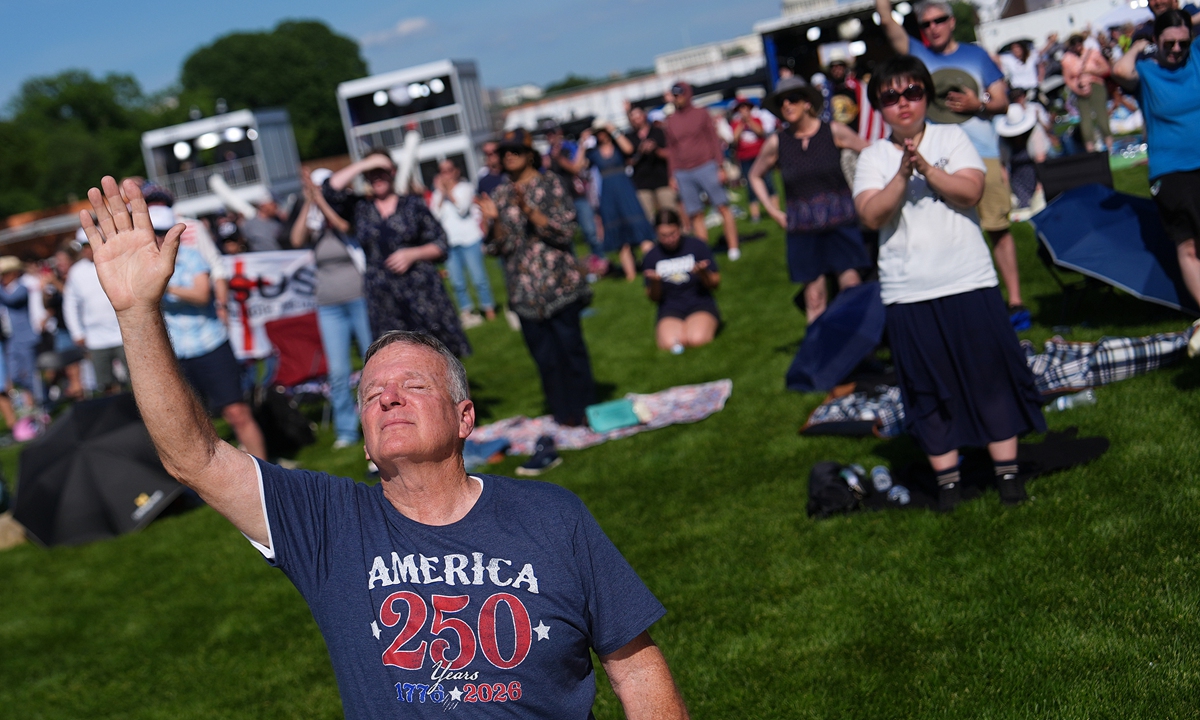
A man kneels in prayer during the Rededicate 250 gathering on the National Mall in Washington, DC, on May 17, 2026. Photo: VCG
'American story' falls silent
In The Atlantic article, Appelbaum mentioned a discussion he was invited to take part in, which took place in 2019. By then, the organizers had come to realize that US democracy was in steady decline and that the country needed a shared narrative. Yet they found themselves deeply divided over what that narrative should be. So they turned outward, inviting jurists, Ivy League professors, journalists, theologians and others in the hope of finding fresh ideas.
At the discussion, when the facilitator asked participants to list words or concepts that all Americans could endorse, an uncomfortable silence permeated the air. Appelbaum volunteered "patriotism." The word, he recalled, "had rolled a live grenade into the center of the room," with "voices and tempers rising." One woman said the word made her feel excluded. Another said it connoted violence and racism. Still another participant was offended that anyone could be offended by the word, Appelbaum recalled in the article.
"All of the people in the room had come here for the specific purpose of finding a common narrative," he wrote. "What hope did that project have if they could not even agree - each in their own way - on loving the country they were trying to save?"
This scene is a microcosm of the rupture in US cultural cohesion and narrative identity. The US has always been a vast and internally diverse country, yet it was once held together by a unifying national story: that providence had destined the continent to become a model of democratic governance.
Today, however, that myth no longer carries the same power of persuasion. In a poll released by the Pew Research Center in 2025, 62 percent of Americans said they were dissatisfied with the way democracy is working in the country. As partisan culture wars intensify, and as value divisions shaped by ideology, race, religion and other layers of identity deepen, the US is increasingly mired in a crisis of national identity.
Wang Hao, a professor at Fudan University's Center for American Studies, has been visiting the University of California San Diego since September 2024. He told the Global Times that anxiety is running high among the US people today, manifesting most visibly in political disillusionment and in a lack of confidence about future living costs, social mobility and public safety. The symbol of the "American Dream" is losing much of its real-world appeal, especially among young people, the middle and lower classes, and ethnic minorities, Wang said.
Wang believes the roots of the global decline in favorability toward the US lie in the widening gap between the "American story" and the country's domestic reality and external conduct. He explained that for years, the US portrayed itself as a nation defined by freedom, openness, abundant opportunity and institutional stability, and that narrative was closely tied to its economic prosperity, social mobility, technological innovation, world-class universities and global popular culture. But that picture has changed. Wealth inequality in the US has intensified, social mobility has fallen and political polarization has deepened. Issues such as contested elections, congressional deadlock, immigration clashes, identity-based conflict and gun violence have remained unresolved for a long time. What the outside world sees now is not only American power, but also the country's governance challenges.
Moreover, the "America First" approach has further weakened the image of the US as a provider of international public goods. Tariffs, sanctions, technology restrictions, pressure on allies and selective participation in international mechanisms have led more and more countries to question the reliability of the US' commitments, according to Wang.
A ferris wheel is seen at the Great American State Fair on the National Mall in Washington, DC, on June 27, 2026. Photo: VCG
A template for external storytelling
The US is arguably one of the most skilled storytelling nations in human history, and this narrative tradition has been continually forged, revised and remade over the course of two and a half centuries.
The birth of the US was more like the result of a contract: in the 1770s, 13 colonies, vastly different from one another and united mainly in rebellion against Britain, formed an alliance to confront a common external enemy. Their inhabitants lacked shared historical, religious or ethnic bonds. They did not even possess a distinct language, nor did they have a history long enough to turn the land beneath their feet into a mythic homeland.
What filled this void was a civic creed articulated in the Declaration of Independence - equality, liberty and self-government.
Yet the American story of "all men are created equal," established in the early years of the country, long obscured a structural contradiction. Before World War II, the US was, in essence, a country dominated by white Anglo-Saxon Protestants. The military, the diplomatic systems, and the highest political offices were all controlled by this group.
Cultural critic Joseph Epstein put it bluntly in his book Snobbery: "If one was Catholic, or surely Irish Catholic, or Jewish, forget about it; if one was black, don't even think about it." That was the true background of the US narrative in that era.
The turning point came after World War II, when the US emerged as the only major power whose industrial system remained largely intact. It soon launched an ambitious campaign of global narrative projection. This time, the tools of storytelling were no longer political declarations, but Coca-Cola, Hollywood and Rock & Roll.
Joseph Nye, the Harvard professor who coined the concept of "soft power," recalled in an interview last April that during the Vietnam War, many street protesters opposed the US government's war policy, yet they sang Martin Luther King's "We Shall Overcome," not the communist "Internationale." During the Iraq War, he added, even as mass protests broke out against George W. Bush's war, many people still wanted to come to Harvard or watch Hollywood movies.
CBS News once described the reach of American cultural influence in the decades after the war in similar terms. Generations in Asia, Africa, Europe and Latin America, it wrote, grew up under the influence of the US superpower. America permeated their lives "through comics and Coke, through Hollywood and Neil Armstrong," and later through the internet, the iPhone and Facebook.
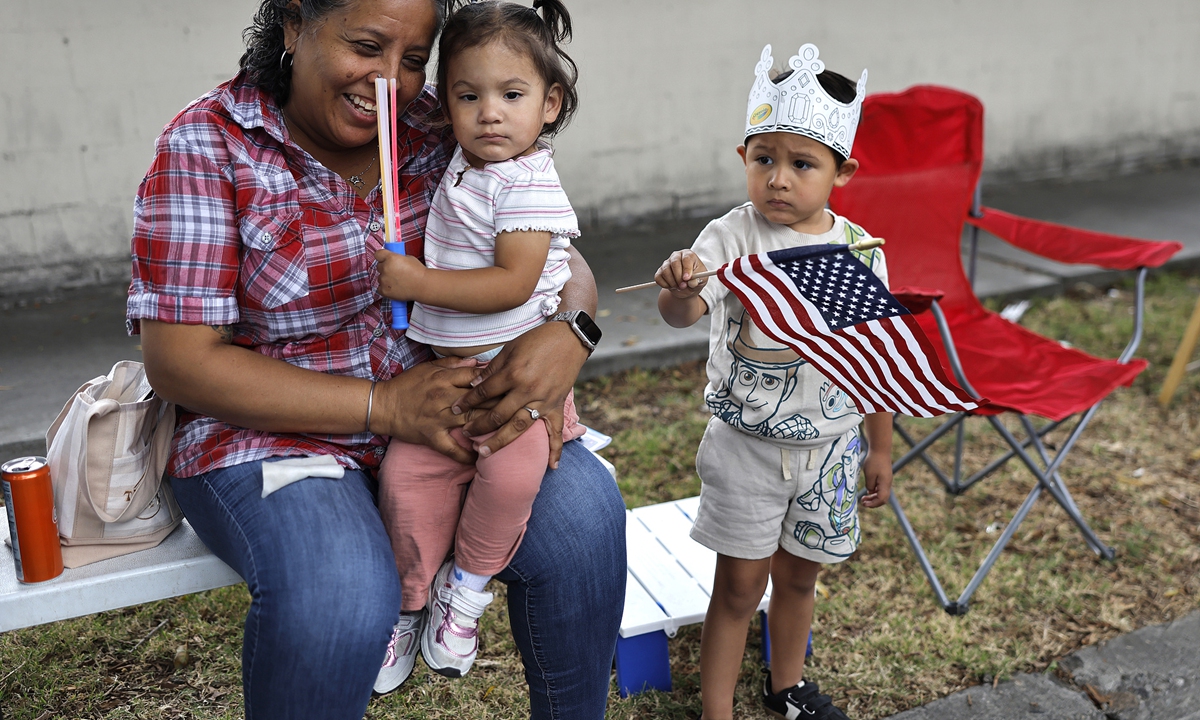
People celebrate during the El Sereno Independence Day Parade in Los Angeles, California, on June 27, 2026. Photo: VCG
Wang traced the evolution of America's national narrative over the past 250 years. In its founding years, the US told the story of a "republic of liberty," emphasizing a political culture that valued freedom, rights and self-government. In the 19th century, the narrative shifted toward that of a "frontier nation" and "Manifest Destiny," with westward expansion, frontier settlement, individual striving and territorial growth becoming key parts of the American national imagination. From the late 19th century to the early 20th century, as industrialization, urbanization, immigration and overseas expansion gathered pace, the US began telling the story of an "industrial power" and a "world power."
After World War II, the US cast itself as the leader of the "free world," integrating ideas such as democracy, market economy, human rights, open society and the "American dream" into the framework of international institutions. The Cold War gave Washington a clear external narrative template: the US represented the "free world," while the Soviet Union represented "totalitarianism." That contrast greatly strengthened the global appeal of America's story.
After the Cold War, the US advanced another narrative, that of the "sole superpower" and "a model of globalization." Liberal democracy, market economy, the internet revolution, financial openness and multiculturalism were packaged as the "standard path toward global modernization."
But after the 2008 financial crisis, and especially since 2016, America's national narrative has entered a stage of deep fracture. Liberal America emphasizes openness, diversity, inclusion and global leadership, while conservative populist America stresses borders, sovereignty, traditional values, anti-establishment politics and "America First." Today, the greatest dilemma facing the US is that it has become increasingly difficult for the country to use a single, unified, stable and optimistic story to persuade both its own society and the outside world, according to Wang.
A fractured anniversary
Appelbaum argued in the article that for a country built on an idea and held together by a shared understanding of history, the loss of a common story might well prove fatal. He also pointed to the marginalization of social studies in schools, the decline of college survey courses in American history and the striking fact that one of the signature spectacles of America's 250th anniversary is a UFC event on the White House South Lawn.
Judith Levine, an American liberal writer and journalist, criticized the anniversary celebrations in the Guardian. In her view, the White House-backed Freedom 250 is essentially a "commercial white Christian nationalist project," with a partner list packed with religious and conservative organizations. As the anniversary approaches, the White House website has highlighted a video series titled "The Story of America." The videos were produced by the conservative Hillsdale College and introduced by its president, Larry Arnn.
To Levine, this year's anniversary is not an objective or inclusive historical reflection.
In Wang's view, despite its many social contradictions, America's grassroots society, university system, civic organizations, public debate and innovation environment remain active. That social energy should not be underestimated. Yet it will be very difficult for the US to regain the global appeal it once enjoyed.
According to him, in the future, the US may try to tell its story in several ways. First, it may continue the old narrative of "leading the world through liberal democracy," but its credibility will depend on whether domestic governance problems can be repaired. Second, it may strengthen an "America First" national narrative, which has mobilizing power at home but relatively limited appeal abroad. Third, it may form a more restrained and pragmatic narrative, one that acknowledges America's own problems while relying on innovation, institutional repair and limited international cooperation to maintain influence.
The 250th anniversary of American independence is a highly symbolic moment. In the past, the US used commemorations of independence, military victory, institutional achievement and social progress to reinforce national identity. Today, however, the act of commemoration itself has become part of the country's political divide, Wang said.
RELATED ARTICLES