ARTS / CULTURE & LEISURE
Conservator blends ancient craft with modern illustration
Drawing life, restoring the past
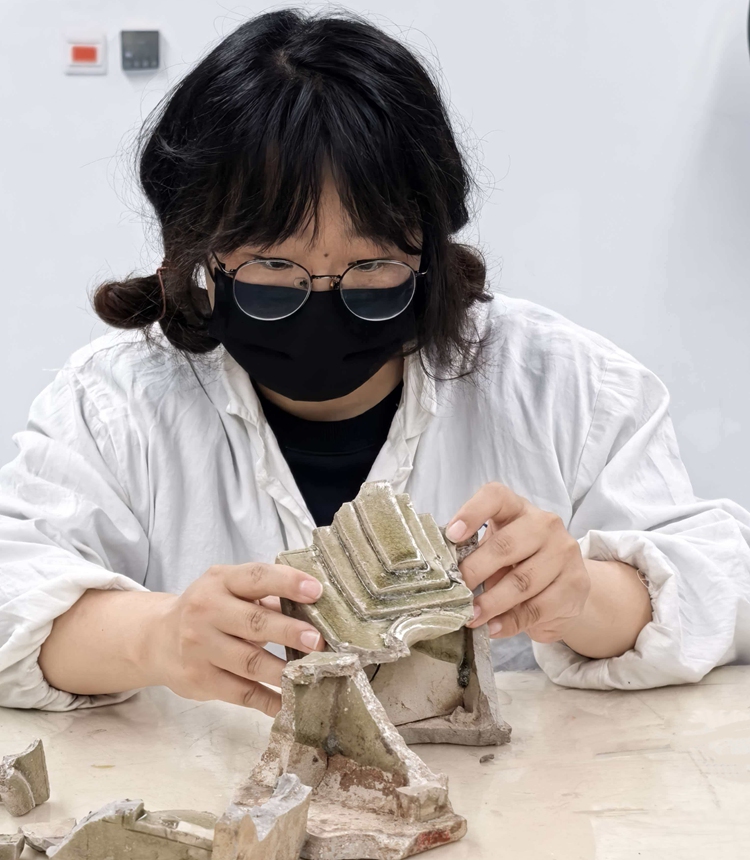
Conservator Cao Yuanyuan restores a ceramic artifact. Photo: Courtesy of Cao Yuanyuan
When visitors admire an ancient porcelain vessel at the Sichuan Museum in Chengdu, few realize how many months, or even years, of painstaking work may have gone into bringing it back to life.
For ceramic conservator Cao Yuanyuan, every repaired crack tells a story. Since joining the Sichuan Museum in 2013, Cao has spent more than a decade restoring cultural relics, repairing over 500 artifacts ranging from Han Dynasty (206BC-AD220) stone carvings to Song Dynasty (960-1279) celadon wares and national first-grade treasures.
Yet outside the conservation studio, she is also known on the internet for something completely different: Delicate watercolor illustrations of pandas and other animals that have earned her a loyal readership.
For Cao, however, these two worlds are inseparable. The skills and observation sensitivity developed through drawing are just as essential in conservation work, and both are, at their core, about preservation and care.
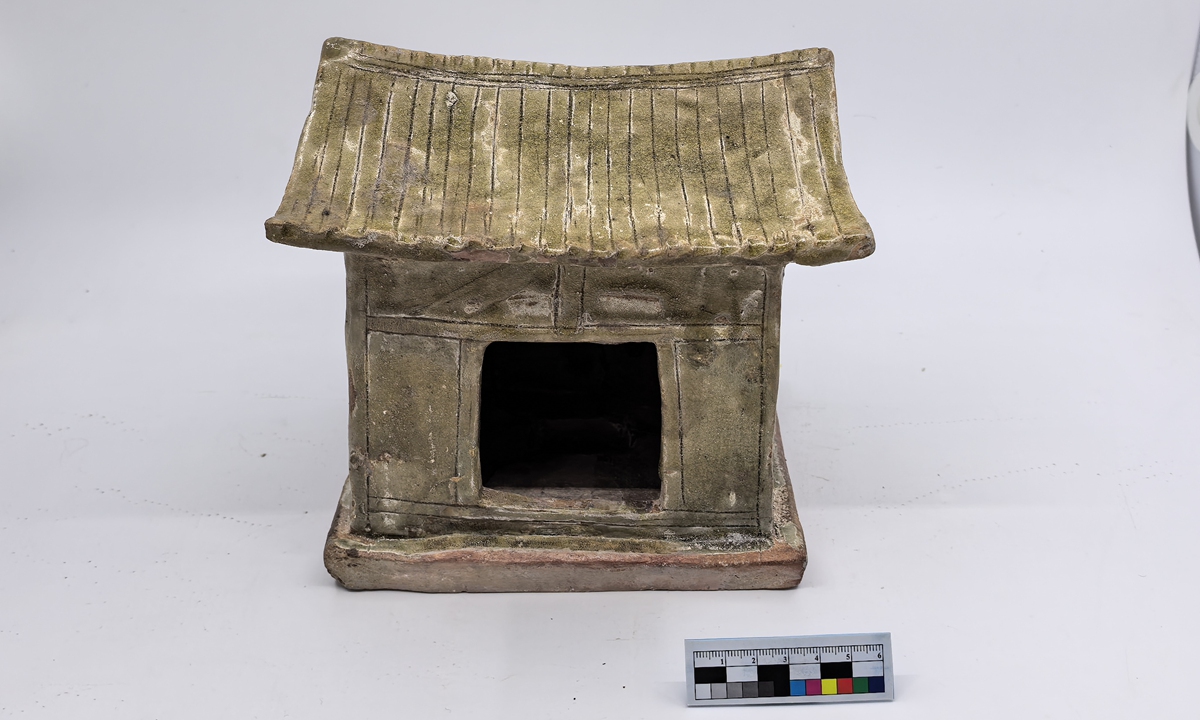
A ceramic artifact restored by Cao and her students Photo: Courtesy of Cao Yuanyuan
Giving history a second life
Cao's fascination with antiques began long before she entered a conservation lab. Her father enjoyed collecting antiques, and she grew up surrounded by old objects. That childhood exposure eventually led her to study ceramic conservation at a university in Shanghai.
The first ceramic she restored carried particular significance: a Qing Dynasty (1644-1911) blue-and-white vase decorated with pheasants and peonies, once part of her grandmother's dowry.
The restoration marked the end of her university years and also the beginning of becoming a professional conservator. After graduating from university, she joined the Sichuan Museum as an artifact conservator, restoring broken artifacts ranging from stone relics to ancient ceramics.
One of the most memorable projects of Cao's career was a Song Dynasty Longquan celadon five-tube vase.
When she first encountered it, the vessel was in devastating condition. One tube was completely missing. Another had broken into three separate pieces. The remaining tubes were also chipped. Layers of dirt covered the elegant green glaze, and previous restoration work had left behind aged adhesive that had yellowed over time. The work stretched over an entire year.
Before any repairs could begin, the vase underwent detailed examination and analysis. Cao then developed a conservation plan before carefully cleaning, reassembling, filling missing sections, sanding surfaces and finally applying color to integrate the restored areas.
The finished vase once again revealed the graceful beauty intended by its makers nearly a thousand years ago, preserving valuable information for researchers studying the Longquan kilns.
For Cao, the reward came not from finishing another assignment but from witnessing history re-emerge. "Even if we don't consider its historical or artistic value, the object itself is already perfect. To help restore it with my own hands was priceless," she told the Global Times.
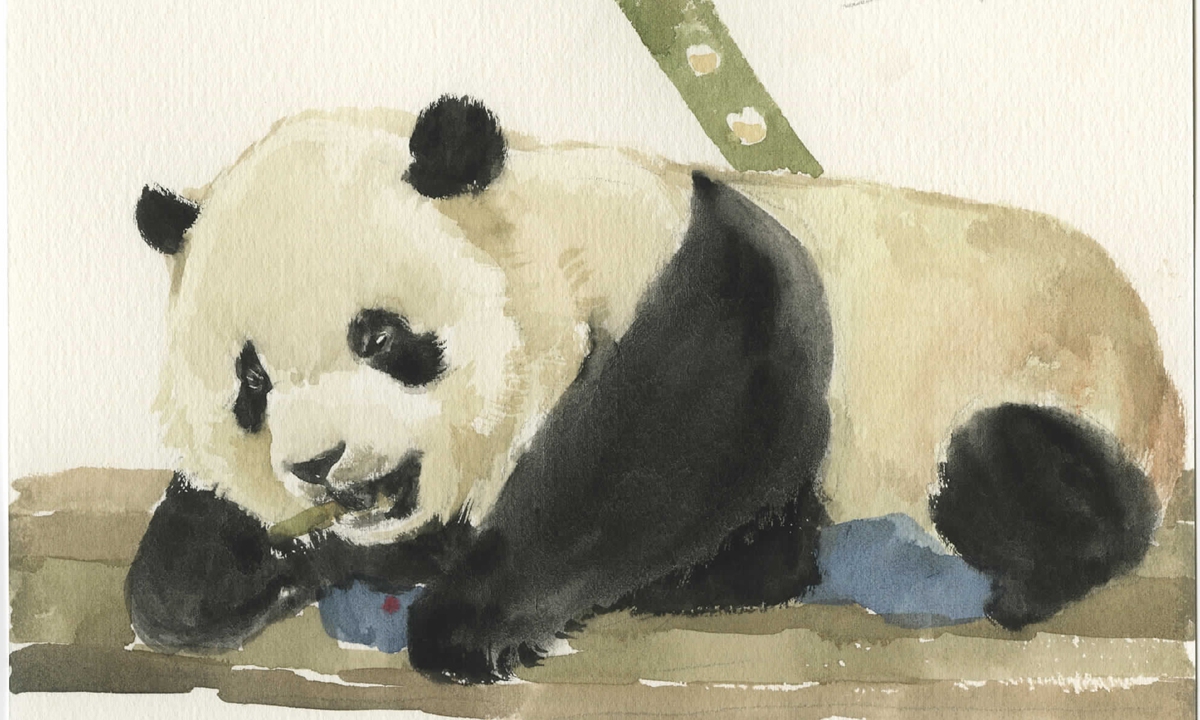
A painting of giant panda Pang Dahai by Cao Yuanyuan Photo: Courtesy of Cao Yuanyuan
Art of drawing
Since childhood, Cao has loved sketching animals. Chinchilla-inspired characters, koalas, foxes, and countless other creatures have filled her sketchbooks over the years, though pandas remain a recurring favorite.
For a long period, she drew one small animal every day, pairing each illustration with lighthearted captions before sharing them on social media. The project later became her first illustrated book, Draw One Little Animal Every Day, published in 2018.
This year, ahead of the ninth birthday of PandaHi, also known as Pang Dahai, a giant panda living in Beijing Zoo, on June 25, Cao released a new volume in her picture-book series: Hello! I'm Pang Dahai.
Painted in watercolor, the book follows the panda from the age of 3 to 4, introducing readers to its growth, habits, and behavior. Drawing, for her, is far more than a hobby. It subtly influences her conservation work.
"It gives you a much better feel for the work," she told the Global Times. "Your sense of color, your familiarity with pigments and materials, even the pressure of your hands, knowing when to apply a lighter touch and when a firmer one, all of that carries over into conservation."
Years of sketching animals have trained her to notice subtle textures, forms, and patterns that many people might overlook.
The connection extends to technical aspects of restoration. Familiarity with artistic materials helps when selecting conservation compounds, while years of drawing make it easier to analyze decorative motifs and reconstruct missing patterns on ceramics. She recalls restoring a fossilized fish skeleton that had broken cleanly in half. After filling in the missing sections, she needed to recreate every tiny detail by hand.
"When I look at it, I naturally think about how the fish scales should flow," she explained. "If there's a bone running through the middle, I have to recreate that sense of movement as well."
She now passes this approach on to her students.
When mentoring young conservators, Cao often asks them to pick up a pencil before they pick up a restoration tool. If they need to reconstruct an intricate pattern, she has them draw it on paper first. "Once you understand how the lines flow and how the design was originally constructed," she said. "It becomes much easier to restore it on the artifact."
Her creative work continues to expand. She is preparing a new illustrated book about stray cats, while also collaborating with the Chengdu Research Base of Giant Panda Breeding on a project to illustrate every giant panda living at the base.
In her view, creating illustrated books about animals is relatively simple. What matters more is the intention behind them: to help more people notice and care about animals and to bring greater visibility to lives that might otherwise go unseen.
RELATED ARTICLES