ARTS / CULTURE & LEISURE
Panda: Eco-protection icon, peace envoy
By Published: Nov 23, 2025 10:31 PM


Illustration: Chen Xia/Global Times
The Global Panda Partners Conference 2025 convened in Chengdu, Southwest China's Sichuan Province, on Friday, showcasing China's latest achievements in giant panda conservation and positioning the species as a symbol of both ecological progress and international cooperation.
With the inauguration of the Mianyang base of the China Conservation and Research Center for the Giant Panda, Sichuan Province has strengthened its integrated network of five major conservation bases.
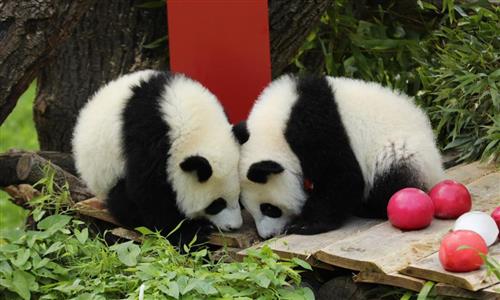
Against this backdrop, the recent departure of two giant pandas "Chenxing" and "Xiaoyue" for a 10-year cooperative research program in Malaysia further underscored China's ongoing commitment to global dialogue and partnership in wildlife protection.
Currently, pandas are not only residents of zoos, but have also become a vibrant part of global pop culture. At the conference's cultural market, one could find everything from traditional bamboo-woven panda figurines made by local artisans in the city's Shuangliu district to trendy designer items that blend the panda's image with motifs from museum artifacts.
This creative energy is being channeled on a global scale. The launch of the initiative for the panda partners digital creativity has brought together creators from over 20 countries.
Building upon the success of the first panda homeland cultural creativity contest, which received 13,854 submissions, the initiative is creating a platform for copyright trading and product development, with 8,417 works already registered.
Meanwhile, the newly formed international panda culture digital communication alliance - uniting media and social platforms from 30 countries - is building a multi-language content network expected to reach over 500 million people annually.
Even conservation has gone high-tech: The panda ecological big data platform now shares real-time monitoring data from 4,194 square kilometers of a core panda habitat with research institutions worldwide.
This kind of open collaboration is making a real difference. In Malaysia, for example, experts successfully developed heat-resistant bamboo and customized ventilation systems for local facilities with guidance from their Chinese counterparts, ensuring the pandas feel at home while sharing Chinese culture with local communities.
The director of the Zoo Berlin also highlighted its productive cooperation with Chinese research institutes, which has led to successful panda breeding programs, including the zoo's second pair of twins.
During the conference, he observed advanced conservation technologies, particularly the use of drones for non-intrusive wildlife monitoring in natural habitats. He emphasized how such innovations offer new possibilities for effectively observing and protecting these animals in the wild.
These concrete technological collaborations have enabled panda conservation to transcend geographical boundaries.
In fact, the panda's journey from "endangered" to "vulnerable" is no accident. It's the result of half a century of dedicated ecological stewardship.
According to the latest data from the National Forestry and Grassland Administration in 2025, the wild panda population has grown from around 1,100 in the 1980s to nearly 1,900 today, with captive pandas reaching 808.
Behind this achievement lies a vast conservation network. This includes 67 nature reserves, the 22,000-square-kilometer Giant Panda National Park, which integrates 73 protected areas, and the restoration of 331,400 mu (22,093 hectares) of habitat alongside seven vital ecological corridors.
In Sichuan Province's section of the national park, 1,227 wild pandas (accounting for 91.6 percent of the park's total animal population) now share their homes with red pandas, golden monkeys and other species.
In 2024, the number of annual wild panda sightings rose to 185, a visible sign of recovering biodiversity.
China's five panda conservation bases, each specializing in breeding, wild training, or international exchange, work in tandem to turn scientific plans into real results. These efforts are not just about saving one species, but have become a model of how systematic, long-term commitment can heal ecosystems.
Perhaps the most heartwarming role of the panda is that of a peace messenger. The national treasure's charm has transcended culture and politics, making the animal a natural bridge for global dialogue.
Before the 2nd Golden Panda Awards, a "postcards of love" campaign related to the giant pandas traveled through six countries, including the US, the UK, and Australia, collecting 187 heartfelt messages. One panda lover from San Francisco wrote, "Dear panda, you are not just China's treasure, you are the world's gentle miracle!"
This sentiment is echoed worldwide. Since the 1990s, China has cooperated with 26 institutions in 20 countries, resulting in the successful breeding of 71 panda cubs abroad. These collaborations have transformed panda conservation into a shared scientific and cultural endeavor.
As Erastus Mwencha, former deputy chairperson of the African Union Commission, noted at the conference, the giant panda's role has transitioned from a flagship species to a cooperative bridge. This momentum should be harnessed to strengthen joint research, youth exchanges, and broader collaboration in conservation and green development.
Pandas embody China's dedication to protecting nature, its creativity in sharing culture, and its willingness to build friendships. These fluffy ambassadors remind us that some bonds are universal.
The author is a reporter with the Global Times. life@globaltimes.com.cn
RELATED ARTICLES